 Outh
Outh10-Step Due Diligence List for Civil Claims
Use this due diligence list to assess a civil claim’s evidence, deadlines, witnesses, costs, legal risks, and collection prospects before pursuing it.
A compelling story isn't enough to justify investing in a civil claim. You may remember exactly what happened, yet lack an organized timeline, preserved messages, reliable witnesses, or a clear estimate of what could realistically be recovered. An approaching filing deadline can make that uncertainty more dangerous, because valuable evidence and legal rights can disappear while you're still deciding whether to act.
A practical due diligence list should move in order of decision impact. Preserve deadlines and proof first. Then test whether the facts satisfy a legal theory, whether the evidence supports each required element, what the claim may be worth, what representation will cost, whether the opposing party can pay, and how the matter compares with other demands on your resources.
Outh is a legal intelligence platform for U.S. matters. Its claim-element checklists, evidence tools, benchmarks, valuation models, attorney matching, and communication features can help you prepare for a focused conversation with counsel. They don't decide whether you have a claim, predict an outcome, or replace legal advice. Platform estimates are informational and not legal advice.
Table of Contents
- 1. Case Viability and Claim Elements Assessment
- 2. Factual Evidence Sufficiency and Documentation Audit
- 3. Witness Identification and Testimony Reliability Review
- 4. Statute of Limitations and Procedural Deadline Management
- 5. Jurisdiction and Applicable Law Alignment
- 6. Financial Valuation and Settlement Range Modeling
- 7. Opposing Party Solvency and Collection Feasibility Assessment
- 8. Attorney Fit and Specialization Alignment
- 9. Legal Cost and Fee Structure Transparency
- 10. Legal Communications Interpretation and Plain-Language Translation
- 11. Portfolio Prioritization and Resource Allocation Strategy
- 11-Point Due Diligence Comparison
- Turn the Review Into a Defensible Next Step
1. Case Viability and Claim Elements Assessment
Start with the legal theory, not the emotional force of the narrative. A viable claim generally requires proof of specific elements under applicable law. For an employment retaliation theory, that might include protected activity, an adverse employment action, and a causal connection. If one element is weak, the case may need targeted investigation before you spend heavily on discovery or representation.
Outh's Case Element Checklist supports this early mapping across 100+ claim categories, including employment, personal injury, civil rights, and education matters. The useful output isn't a reassuring score. It's a record showing which elements appear supported, which depend on assumptions, and which still need evidence.
Turn missing elements into decisions
For each element, record:
- Current proof: Identify the document, witness, or event supporting the element.
- Proof quality: Separate firsthand evidence from inference, hearsay, or an unverified account.
- Open gap: State exactly what's missing, such as a decision-maker's reason, a timeline connection, or medical causation evidence.
- Next action: Ask counsel whether the gap can be investigated lawfully and cost-effectively.
A whistleblower may have clear evidence of protected reporting and a later termination, but no document linking the two events. That doesn't prove the claim will fail. It does show where discovery, witness review, and attorney experience matter most.
Practical rule: A completed checklist is not a legal conclusion. It's a disciplined way to show counsel where the case is strong, where it's uncertain, and what would change the decision.
Revisit the element map when new records surface. Cross-reference missing elements with attorneys who regularly handle the specific claim type, rather than selecting counsel based only on a broad practice label.
2. Factual Evidence Sufficiency and Documentation Audit
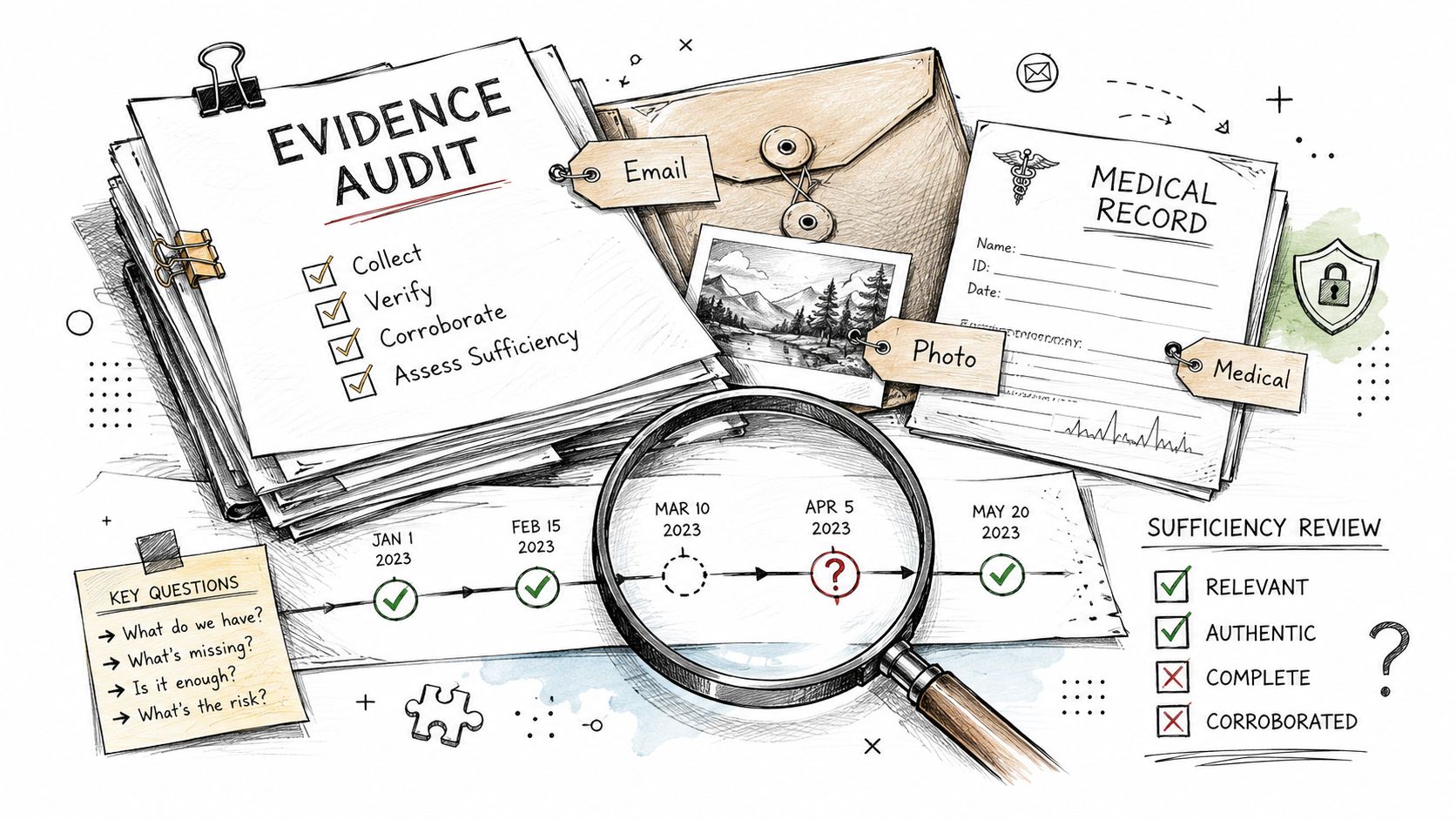
A legal narrative becomes useful only when the underlying record can support it. Gather emails, text messages, performance reviews, medical records, time sheets, photographs, contracts, insurance correspondence, and other materials that may prove conduct, causation, liability, or damages. Don't organize documents solely by date. Organize them around the elements they may establish.
Outh's Evidence Management system can connect with email and help surface relevant material for review. That can reduce the risk that a significant message remains buried in a personal inbox, but automated tagging still requires human verification. A document that contains a relevant phrase may not establish the full context, and an apparently neutral message may become important when placed beside earlier or later communications.
Audit provenance, not just presence
For every important item, note:
- Original source: Keep the original email, file, image, or record where possible.
- Timing: Preserve timestamps, formatting, attachments, and surrounding messages.
- Context: Record who created the item, who received it, and what event it relates to.
- Element connection: Link the evidence to a specific legal proposition.
- Conflict: Flag contradictions rather than choosing the version that supports your story.
An employment claimant might find repeated comments about being “not a cultural fit.” Those words may matter, but their significance depends on who said them, when they were made, how decisions followed, and whether comparable employees were treated differently. A wage claimant's time sheets may support unpaid work, yet payroll records and employer policies may complicate the calculation.
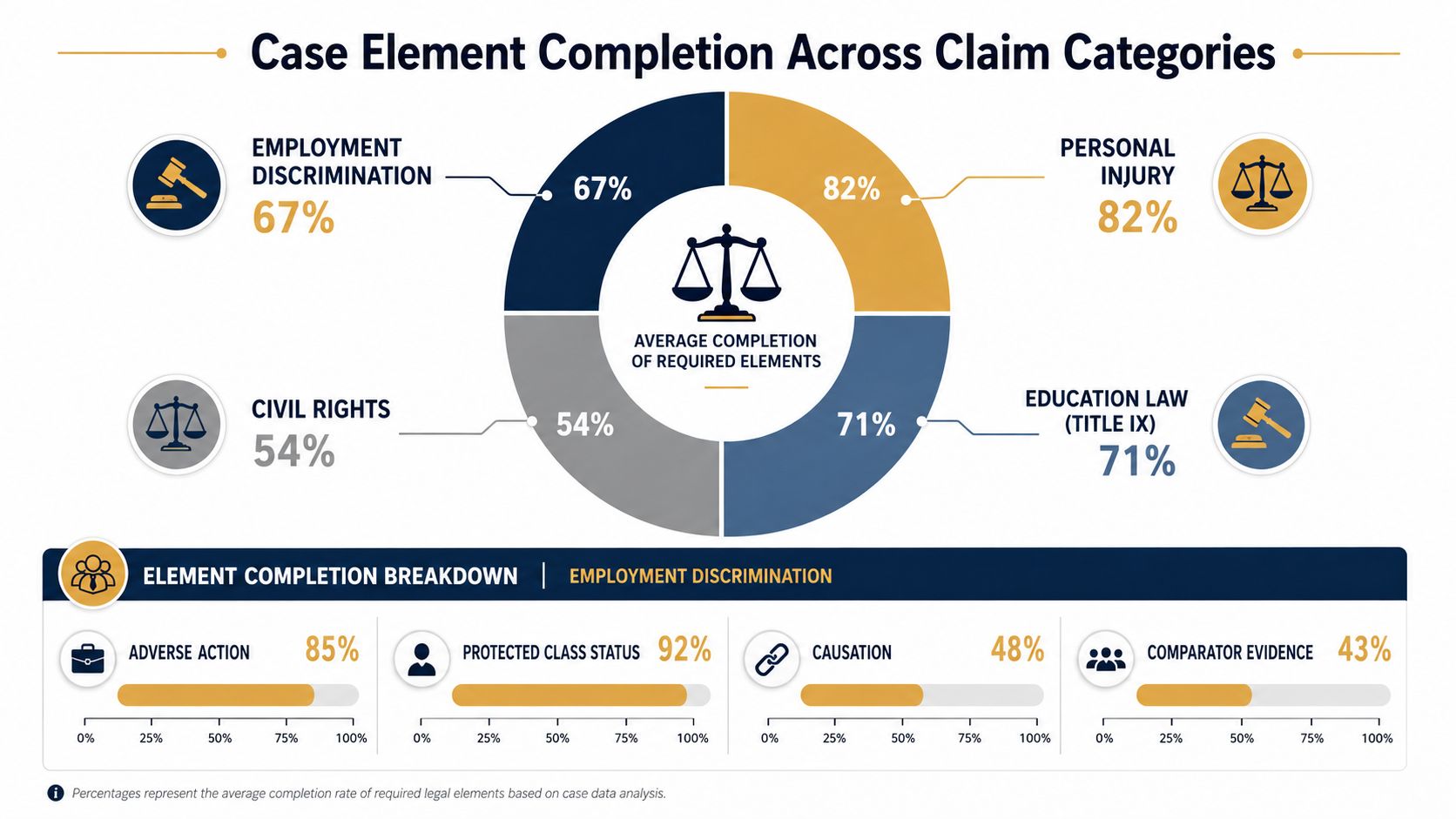
This chart can help visualize how element completion is being tracked, but it shouldn't be treated as a finding about the merits of any particular claim.
Email collection should happen early. Documents may be deleted, accounts may be deactivated, and memories may become less precise. Don't alter originals while creating working copies for attorney review.
A short demonstration of evidence organization can be useful before you decide how much material to import.
3. Witness Identification and Testimony Reliability Review
A long contact list isn't a witness strategy. The relevant question is what each person personally saw, heard, did, received, or can authenticate. A firsthand witness to a retaliatory schedule change generally serves a different function from a coworker who heard about it later. Both may matter, but they shouldn't carry the same evidentiary weight.
Build a witness matrix that connects each person to a specific claim element and document. Record the witness's relationship to the parties, likely availability, access to records, potential bias, memory concerns, and any risk of retaliation. Keep the description factual. “Dislikes my supervisor” is less useful than “worked on the same shift, received the schedule change directly, and left the employer afterward.”
Separate leads from usable testimony
For each witness, ask:
- What did the person directly observe?
- What document or event can the person authenticate?
- Which element does the account support or challenge?
- Could the person's account be contradicted by records?
- What practical concern could affect availability or credibility?
A wage claimant might link a coworker to particular time-sheet periods and note that the coworker still has access to scheduling records. That creates an investigative lead. It doesn't guarantee cooperation, admissibility, or favorable testimony.
Preserve nonprivileged contact information and write down your current recollection before contacting anyone. Don't pressure former colleagues, ask witnesses to coordinate stories, or send sensitive details through informal channels. Counsel should handle interviews, subpoenas, preservation demands, and communications that could affect the dispute.
4. Statute of Limitations and Procedural Deadline Management
A strong claim can be lost through delay. Civil matters may involve a statute of limitations, an administrative charge deadline, a contractual notice requirement, or an internal complaint procedure. These rules can differ by claim, defendant, location, and the event that starts the clock. Treat every date as provisional until qualified counsel confirms it.
Create a deadline record with the event date, possible triggering date, source of the date, required action, and consequences of missing it. Include tolling questions, discovery issues, notice dates, and administrative exhaustion requirements. Outh's deadline tools can help organize the baseline, but jurisdiction-specific rules require attorney review.
Protect the shortest runway
If several theories may apply, identify the one with the most urgent deadline first. An employment discrimination matter may require an administrative filing before litigation. A university complaint may involve an internal procedure with its own timing. A personal injury claim may turn on the date of injury, discovery, or a special defendant rule.
Set reminders well before the apparent cutoff. The point isn't to rely on a calendar alert as legal protection. It's to create enough time for counsel to investigate facts, determine the proper defendant, prepare a filing, and address uncertainty.
Missed deadlines can affect the claim before anyone evaluates whether the underlying conduct was wrongful.
Don't assume that sending a demand letter pauses a deadline. Don't assume an employer's internal investigation extends a statutory period. Write down every communication that could relate to notice or tolling, then ask counsel what legal effect, if any, it has.
5. Jurisdiction and Applicable Law Alignment
Location can affect the elements you must prove, available remedies, procedural prerequisites, and practical litigation conditions. The relevant jurisdiction may depend on where the conduct occurred, where you worked, where an injury happened, where a defendant is located, or where a contract assigns disputes. Those connections don't automatically establish the best forum.
Prepare a jurisdiction map with the parties' locations, relevant events, governing-contract language, administrative agencies, and potential venues. Then ask counsel to distinguish where a case can be filed from which law a court may apply. Those questions overlap, but they aren't identical.
Compare legal fit before comparing value
A claimant with employment connections across multiple states may have both state and federal theories. A personal injury claimant may face different rules concerning damages, fault, or procedural filing. A civil rights claimant may need to examine exhaustion, immunity, and the identity of the responsible institution.
Outh's state-specific benchmarks can support an initial comparison, but benchmark differences aren't proof that one forum will produce a particular result. A higher historical benchmark may reflect different case mixes, evidence quality, defendant profiles, or reporting practices. It can't resolve a conflict-of-law issue or tell you where counsel should file.
Use this checkpoint to reach a practical decision:
- Proceed: The forum and governing law appear legally available, subject to counsel's confirmation.
- Investigate: Several jurisdictions may apply, or a procedural prerequisite remains unclear.
- Reconsider: The preferred theory depends on a law that may not govern the facts.
Ask about venue, jurisdiction, exhaustion, forum-selection clauses, and any conflict-of-law problem before using valuation data to drive strategy.
6. Financial Valuation and Settlement Range Modeling
Value the claim in stages, because a headline number can hide weak proof, delay, fees, or collection limits. Start with documented economic losses, non-economic harm, statutory remedies, interest, fees, costs, liens, and likely deductions. Keep that fact-based estimate separate from external benchmarks drawn from historical outcomes.
Outh's valuation engine presents confidence intervals such as P10, P50, and P90, filtered by claim characteristics and state. A settlement value calculator can organize the questions behind a range, including whether the comparison matters are genuinely similar. These outputs remain estimates. They are not predictions, legal advice, or a substitute for counsel's review of the evidence and applicable law.
A useful worksheet should show both gross and net value:
- Proof strength: Identify each damage category that can be documented and tied to the defendant's conduct.
- Time and risk: Assess the likely duration, procedural uncertainty, and changes that could affect the claim before resolution.
- Fees and costs: Account for representation, experts, records, discovery, and possible appeals.
- Tax and liens: Check whether taxes, medical liens, benefit claims, or reimbursement obligations may reduce recovery.
- Negotiation posture: Determine whether an offer reflects a liability dispute, a damages dispute, or a perceived gap in proof.
Use the midpoint as a planning reference, not as an expected result. A high-end outcome can clarify potential upside, but it does not by itself justify rejecting a reasonable offer. Compare the offer with the evidence, projected costs, delay, personal burden, and collection prospects.
The decision checkpoint is simple: does the expected net value justify the matter's financial, personal, and procedural demands? Review that conclusion with counsel before making or rejecting a settlement demand.
7. Opposing Party Solvency and Collection Feasibility Assessment
A favorable judgment has limited value if the defendant cannot pay. Before committing substantial litigation resources, assess whether a judgment or settlement could be collected. The review should cover business status, apparent assets, insurance, ownership structure, bankruptcy indicators, and the party's ability to fund payment.
Begin with the legal claim, not the appearance of wealth. The relevant question is whether reachable assets or insurance may respond to that claim. A small business may have few operating assets but applicable coverage. An individual may earn substantial income while owning little collectible property. A corporation may reorganize, dissolve, or transfer operations. Each possibility can affect enforcement and requires counsel's investigation.
Tie the review to a go or no-go decision
Ask counsel which lawful methods can verify:
- Insurance coverage: Determine whether a policy may respond and whether disclosure can be requested.
- Entity status: Confirm the correct legal entity and whether it remains active.
- Asset evidence: Review public filings and other properly obtained information.
- Bankruptcy exposure: Identify warning signs without treating insolvency as proof of wrongdoing.
- Payment security: Consider installments, releases, guarantees, and enforcement terms in any settlement.
A wrongful termination claimant who finds limited employer assets but potentially relevant insurance may evaluate settlement differently from a claimant facing an uninsured individual with few collectible assets. The information changes payment strategy, not the underlying merits.
Collection evidence may be incomplete or legally sensitive. Avoid intrusive searches, improper contact with financial institutions, and online speculation presented as proof. Counsel can identify available discovery and enforcement tools, estimate their cost in practical terms, and decide whether further investigation justifies the resources required. Platform estimates can organize questions, but they are not legal advice and cannot establish solvency, coverage, or collectibility.
8. Attorney Fit and Specialization Alignment
Attorney selection should follow the claim's actual demands, not a résumé's length. A lawyer who handles general employment matters may still lack experience with retaliation, wage, whistleblower, Title IX, or disability claims. Check experience with the specific legal theory, jurisdiction, defendant type, procedural posture, and evidence problem involved.
Outh's Intelligent Attorney Matching can surface counsel by specialty alignment, success indicators, and proximity. Treat those results as a research tool, not a legal conclusion. Confirm profile details with the attorney, including whether comparable matters are current and whether the lawyer has capacity to take the case.
Use the first consultation to test fit
Ask focused questions:
- Subcategory fit: Has counsel handled this exact claim type?
- Jurisdiction: Is the attorney licensed and experienced where the matter belongs?
- Proof-gap experience: How would counsel investigate missing causation, damages, or credibility evidence?
- Capacity: Who will perform the work, communicate with you, and supervise the file?
- Strategy: What facts would support litigation, negotiation, further investigation, or no action?
A local lawyer may simplify meetings and provide jurisdictional familiarity. A remote specialist may bring deeper experience with a narrow claim. Co-counsel can combine those strengths, but may increase cost and blur responsibility. Establish who leads, who communicates, how fees are divided, and who makes settlement recommendations.
The review should end with a practical decision: retain counsel, seek another opinion, or pause while a defined proof gap is investigated. Do not treat a favorable profile metric as a case forecast. Results depend on facts, documentation, case selection, opposing counsel, and reporting definitions. Platform estimates can organize comparisons, but they are not legal advice and cannot replace an attorney's direct evaluation.
9. Legal Cost and Fee Structure Transparency
A fee proposal should be reviewed as an investment decision, not by its headline contingency percentage. Confirm who advances litigation costs, whether expenses are deducted before or after the fee calculation, what happens if there is no recovery, and which charges may arise for experts, records, discovery, depositions, motions, trial, or appeal.
Outh's Attorney Fee Transparency feature supports side-by-side review of contingency structures, retainers, estimated costs, and related terms. Its lawyer contingency fee guide can help you prepare questions, but the written engagement agreement controls. Ask counsel to explain each term before signing.
The practical comparison is the expected net recovery and the funding risk:
- Lower percentage, higher upfront burden: A reduced contingency fee may require a retainer or leave you responsible for more costs.
- Higher percentage, lower entry cost: A higher contingency may limit upfront expense while taking more of any recovery.
- Shared cost risk: Some agreements require repayment of advanced costs even when the case produces no recovery.
- Separate work phases: Pre-suit negotiation, litigation, appeal, and enforcement may carry different terms.
Request an itemized estimate by category. Clarify whether expert fees, filing fees, records, travel, technology, and deposition costs are included or billed separately. Ask what happens if counsel withdraws, you end the relationship, or the opposing party makes a fee-shifting offer. These answers identify the financial exposure before the representation begins.
A cheaper proposal may yield less after expenses. Paying more may make sense when counsel offers relevant specialization and a sound strategy, but that judgment depends on evidence, case value, collection prospects, and available funding. The go/no-go question is whether the expected net value justifies the cost and risk you can carry. Platform estimates can organize that comparison. They are not legal advice and cannot replace counsel's review of the agreement and case.
10. Legal Communications Interpretation and Plain-Language Translation
A settlement email can change the decision path without changing the dollar amount. If opposing counsel says they are “not inclined to continue settlement discussions absent significant movement,” treat that wording as a signal about negotiation posture, not as a formal counteroffer. An expiration date on an offer creates response pressure, but its legal effect depends on the document and applicable procedure.
Start with the source file, not a summary. For every email, offer, notice, and court document, record the requested action, responsible person, deadline, and consequence of inaction. Preserve the original message, attachments, metadata when available, and earlier related communications. A forwarded summary may omit language that affects interpretation.
Turn wording into a decision record
Outh's AI Email Decoder can help identify possible signals about settlement posture and timing. Its legal document translator may support comprehension, but it does not supply the full procedural context or legal advice. Treat any platform output as a working aid for questions to raise with counsel.
Before responding, have counsel classify the communication and set the response plan:
- Is it a rejection, counteroffer, inquiry, or negotiation tactic?
- Does the stated deadline carry legal effect, negotiating significance, or both?
- Does it preview discovery, expert challenges, or motion practice?
- Which response preserves flexibility without creating an unintended admission?
- Should it be logged alongside earlier settlement positions?
A request to depose medical providers may point to a causation dispute. It does not establish that the defense will succeed. It does identify a potential proof burden and added cost, which can affect whether further investment is justified. Do not answer substantive correspondence impulsively. Route the message to counsel when a deadline, admission, waiver, or settlement position may affect the claim.
11. Portfolio Prioritization and Resource Allocation Strategy
A claimant may face several employment events, injury theories, education complaints, or defendants. Money, attorney capacity, time, and emotional energy are limited, so each matter needs an ordered review. Treat the review as an investment decision, while remembering that a legal claim is not a financial asset and no outcome is guaranteed.
Start with preservation. Confirm deadlines, protect relevant records, and identify proof that could disappear. Then test legal fit and claim elements, followed by evidence quality, likely case value, representation requirements, collection prospects, and the resources each matter will consume. Each checkpoint should lead to a clear choice: pursue now, preserve and investigate, negotiate, refer for counsel review, or pause.
Sequence matters instead of dropping them
Priority can change when matters interact:
- Shared facts: One attorney may review overlapping evidence efficiently, but shared facts can also create privilege or strategy concerns.
- Different specialists: A complex civil rights matter may require different counsel from a straightforward wage claim. Coordination can add time and cost.
- Funding sequence: An earlier resolution may help finance a longer dispute, subject to counsel's advice. That possibility is not a forecast of recovery.
- Resource conflicts: Pursuing every matter at once may reduce preparation quality, delay communications, and weaken consistency.
Outh's multi-case dashboard can organize side-by-side comparisons and aggregate information across matters. Treat any platform estimate as a planning aid, not legal advice or a guaranteed recovery. A group of uncertain claims may involve duplicated costs, inconsistent positions, privilege concerns, or strategic conflicts.
Record the decision for each matter, the evidence supporting it, unresolved assumptions, the person responsible for the next action, and the date for review. Revisit the ranking when a deadline changes, new evidence appears, counsel evaluates the theory, or collection information changes the expected net value.
11-Point Due Diligence Comparison
| Assessment Item | Complexity 🔄 | Resources ⚡ | Expected Outcomes 📊⭐ | Ideal Use Cases 💡 | Key Advantages ⭐ | Main Limitations ⚠️ |
|---|---|---|---|---|---|---|
| Case Viability & Claim Elements Assessment | Moderate, rule-mapping + AI element ID 🔄 | Low–Moderate, user inputs + document upload ⚡ | Clear element checklist; go/no‑go signal; gap visualization 📊⭐ | Early screening; decide whether to pursue litigation 💡 | Prevents weak claims; focuses evidence collection ⭐ | Advisory only (not legal opinion); needs updates; input accuracy dependent |
| Factual Evidence Sufficiency & Documentation Audit | High, integrations + AI tagging 🔄 | Moderate–High, email import, document processing ⚡ | Evidence inventory, timeline reconstruction, completeness metrics 📊⭐ | Discovery prep; evidence‑heavy disputes 💡 | Automates import/tagging; reduces e‑discovery cost ⭐ | May miss context (sarcasm); privacy and non‑digital evidence gaps |
| Witness Identification & Testimony Reliability Review | Moderate, witness matrix & linkage 🔄 | Moderate, interviews, contact tracking ⚡ | Prioritized witness list with credibility flags; element links 📊⭐ | Cases relying on testimony or authentication of docs 💡 | Preserves witnesses; highlights testimony needs ⭐ | Witness availability/credibility uncertain; contact risks |
| Statute of Limitations & Procedural Deadline Management | Moderate, state rules + tolling logic 🔄 | Low–Moderate, calendar integration, rule updates ⚡ | Timely alerts; prevents dismissal; prioritizes urgent claims 📊⭐ | All claims with time limits (EEOC, state SOLs) 💡 | Prevents catastrophic deadline loss; portfolio prioritization ⭐ | Complex tolling rules; requires continuous updates and monitoring |
| Jurisdiction & Applicable Law Alignment | High, conflict‑of‑law + benchmark comparison 🔄 | Moderate, state data and analysis ⚡ | Forum suitability, damage caps, venue valuation impact 📊⭐ | Multi‑jurisdiction claims; forum selection analysis 💡 | State benchmarks inform forum choice and valuation ⭐ | Venue constraints; aggregate jury data may not predict specific outcomes |
| Financial Valuation & Settlement Range Modeling | High, statistical modeling + data feeds 🔄 | Moderate, benchmark datasets and refreshes ⚡ | P10/P50/P90 valuations; negotiation anchors; portfolio totals 📊⭐ | Settlement decisions; prioritization and negotiation planning 💡 | Data‑driven expectations; acknowledges uncertainty ⭐ | Historical data may not reflect unique facts; model lag |
| Opposing Party Solvency & Collection Feasibility Assessment | Moderate, asset search + insurance checks 🔄 | Moderate–High, financial research, reports ⚡ | Collection probability estimate; target strategy (insurer vs assets) 📊⭐ | Assessing collectibility before filing or settling 💡 | Avoids judgment‑proof targets; highlights insurance sources ⭐ | Asset info incomplete; solvency can change quickly |
| Attorney Fit & Specialization Alignment | Low–Moderate, matching + metrics aggregation 🔄 | Low–Moderate, profile data, availability checks ⚡ | Ranked attorney shortlist by niche fit and outcomes 📊⭐ | Selecting counsel by sub‑category and jurisdiction 💡 | Improves match quality; verified performance metrics ⭐ | Metrics retrospective; top specialists may be unavailable or costlier |
| Legal Cost & Fee Structure Transparency | Low, fee display & comparison tools 🔄 | Low, fee data collection, modeling ⚡ | Net‑to‑client estimates; side‑by‑side fee comparisons 📊⭐ | Financial planning; choosing fee arrangements 💡 | Prevents surprise costs; aids negotiation and selection ⭐ | Undisclosed/variable costs may persist; contingency ≠ quality |
| Legal Communications Interpretation & Plain‑Language Translation | Moderate, NLP + context flags 🔄 | Low, email/document text input ⚡ | Plain‑English translations; urgency/impact flags; negotiation signals 📊⭐ | Decoding offers, attorney emails, settlement deadlines 💡 | Reduces misinterpretation; flags deadlines and strategy cues ⭐ | May miss nuance or implied threats; can oversimplify legal distinctions |
| Portfolio Prioritization & Resource Allocation Strategy | High, multi‑claim modeling & tradeoffs 🔄 | Moderate, aggregates valuation, timelines, risks ⚡ | Ranked claims, allocation plan, sequencing roadmap 📊⭐ | Multiple concurrent claims with limited budget/attention 💡 | Maximizes portfolio recovery; sequences funding and effort ⭐ | May deprioritize meritorious low‑value claims; timelines probabilistic |
Turn the Review Into a Defensible Next Step
A completed due diligence list should end in a decision record, not a folder full of disconnected documents. Put the current position on one page. State the claims under consideration, the elements required for each claim, the evidence supporting those elements, the important witness leads, and every deadline that counsel must confirm.
Then add the unresolved issues. Label an assumption as an assumption. Label a missing record as missing. Label a disputed date as disputed. This discipline matters because a neat narrative can create false confidence when it hides contradictory documents, uncertain causation, unreliable recollections, or a defendant's inability to pay.
Your one-page record should include:
- Claim theories and elements: Identify what must be proven and which elements remain open.
- Evidence status: List preserved originals, missing records, contradictory materials, and provenance concerns.
- Witness leads: Distinguish firsthand knowledge from secondhand information and note availability concerns.
- Deadlines: Record filing, administrative, contractual, and internal dates for attorney confirmation.
- Jurisdiction questions: Identify possible forums, governing law, exhaustion requirements, and venue concerns.
- Value range: Separate documented damages from modeled estimates and explain the assumptions behind each.
- Representation costs: Record the proposed fee, cost treatment, retainer, and possible out-of-pocket expenses.
- Collection concerns: Note insurance, entity status, apparent assets, bankruptcy indicators, and enforcement questions.
- Next attorney conversation: Write the specific decisions you need counsel to address.
Use the record to ask better questions, not to direct counsel toward a predetermined answer. A lawyer may conclude that a claim is weaker than expected, that a different legal theory fits better, that more evidence is needed, or that early settlement is preferable to litigation. Those conclusions are part of due diligence, not failures of the process.
The sequence is straightforward. Preserve evidence and deadlines first. Validate legal theories with qualified counsel. Then use Outh's evidence, benchmark, communication, attorney-matching, and portfolio tools to organize the decisions around the facts. Outh is not a law firm, and its valuations, benchmarks, timelines, and other platform outputs are estimates, not legal advice or predictions of your result.
Outh can help you organize a civil claim through element checklists, evidence management, valuation ranges, attorney matching, fee comparisons, and plain-language communication tools. Visit Outh to prepare a more focused review before speaking with qualified counsel.