 Outh
OuthLawyer Contingency Fee Explained: Percentages, Costs
Understand how a lawyer contingency fee works, typical percentage ranges, hidden costs, and red flags to watch for before signing your agreement.
Most lawyer contingency fees are set at 33% to 40% of the recovery, with one-third remaining the long-standing market anchor across personal injury, employment, and civil rights cases. On a $300,000 recovery, a 33% fee means roughly $99,000 in attorney fees before expenses.
You've just received a $300,000 settlement offer. Your lawyer says the case is being handled on a contingency fee, so you won't pay hourly bills upfront. That sounds simple until you ask the question that matters most: How much will reach your bank account?
The answer depends on more than the headline percentage. You need to know whether the fee is calculated before or after expenses, whether the rate changes if the case proceeds to litigation, what happens if you replace your lawyer, and whether the agreement permits the firm to pass through costs at their actual value. A one-third fee can produce a very different net recovery depending on those terms.
Table of Contents
- What Happens After You Win Your Case
- How a Lawyer Contingency Fee Actually Works
- Typical Contingency Fee Percentages and Why They Stay Stable
- The Hidden Math of Expenses and Deductions
- Red Flags and Risks Most Guides Ignore
- State Differences and Ethical Boundaries
- How to Evaluate a Contingency Fee Agreement Before Signing
What Happens After You Win Your Case
The settlement offer looks clean on paper. The insurer proposes $300,000, and your attorney confirms that the offer is worth accepting. You may assume that the lawyer takes a percentage, the remaining balance comes to you, and the matter ends.
That assumption is incomplete.
Your lawyer's fee is only one deduction. The final distribution may also account for litigation expenses, medical liens, reimbursement claims, and other obligations described in your agreement. The settlement check is a gross recovery, not necessarily your take-home amount.
Start with the gross recovery
Suppose your agreement uses a 33% contingency fee. The attorney's fee would be approximately $99,000 on a $300,000 recovery, before expenses. If the agreement uses 40%, the fee would be $120,000, also before expenses. Those figures are mathematical illustrations based on the market percentages discussed in the Stanford Law School analysis of contingency-fee competition.
The important point is that the fee percentage doesn't tell you the net result by itself. You need the agreement's deduction rules and a written closing statement showing where every dollar went.
Practical rule: Never approve a settlement until you've seen a distribution estimate that separates the gross recovery, attorney fee, expenses, and your projected net amount.
Ask your lawyer to run the calculation using the actual offer. Don't settle for “you'll receive most of it” or a verbal estimate. Request the percentage that applies at the current stage, the expense balance, and the timing of each deduction.
The settlement stage matters
A case resolved before extensive litigation may use a different percentage from one that reaches trial or an appeal. Higher-complexity matters can carry a larger percentage because the lawyer is financing more work, costs, and default risk, as explained in ABA Formal Opinion 94-389.
Your decision should therefore focus on net recovery, not the attractive size of the settlement headline. The offer may be fair, but you won't know what you're receiving until the contract mechanics are visible.
How a Lawyer Contingency Fee Actually Works
A lawyer contingency fee makes payment dependent on a recovery. Instead of paying an hourly rate as the lawyer works, you agree in advance that the attorney will receive a percentage of money recovered through settlement, judgment, or another successful resolution.
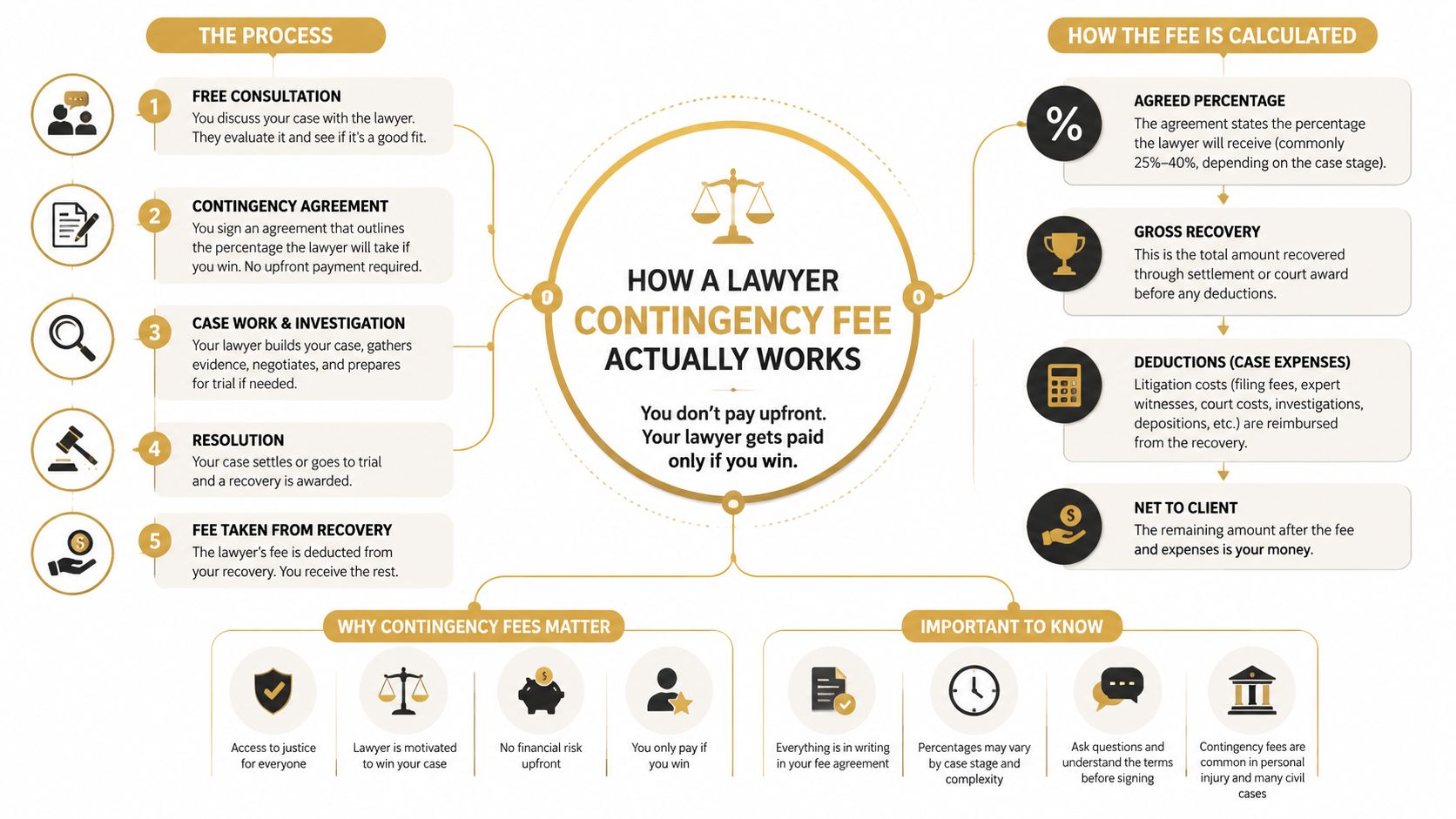
The arrangement typically works in four steps:
- You sign a written agreement. The contract states the fee percentage, how expenses are handled, and what happens at different case stages.
- The lawyer works without collecting the percentage upfront. The firm accepts the risk that the case may produce no recovery.
- A recovery is obtained. The percentage becomes payable under the agreement.
- The funds are distributed. The lawyer's fee and permitted expenses are deducted according to the contract, and you receive the remaining balance.
The basic calculation
Assume a $100,000 recovery and a 33% fee. The attorney's fee is approximately $33,000, leaving $67,000 before case expenses and other valid deductions. If the agreement instead applies the fee after certain expenses are removed, the attorney's percentage may be calculated on a smaller base.
That distinction belongs in the written agreement. The American Bar Association's Model Rule 1.5 requires contingent-fee arrangements to comply with applicable law, remain reasonable, and explain material terms. The agreement should also explain the percentage applicable to settlement, trial, or appeal and identify expenses deducted from the recovery.
Contingency arrangements are common in plaintiff-side matters where the client seeks a monetary recovery, including personal injury, employment disputes, civil rights claims, and some medical malpractice matters. They generally aren't the normal structure for criminal defense, family-law representation, or transactional work, where the lawyer's services aren't ordinarily tied to collecting a monetary recovery.
The bargain has a clear advantage: you don't need to fund hourly legal work as the case develops. The trade-off is equally clear: if the case produces a substantial recovery, the percentage can represent a significant fee, particularly when the lawyer also deducts expenses from your share.
Typical Contingency Fee Percentages and Why They Stay Stable
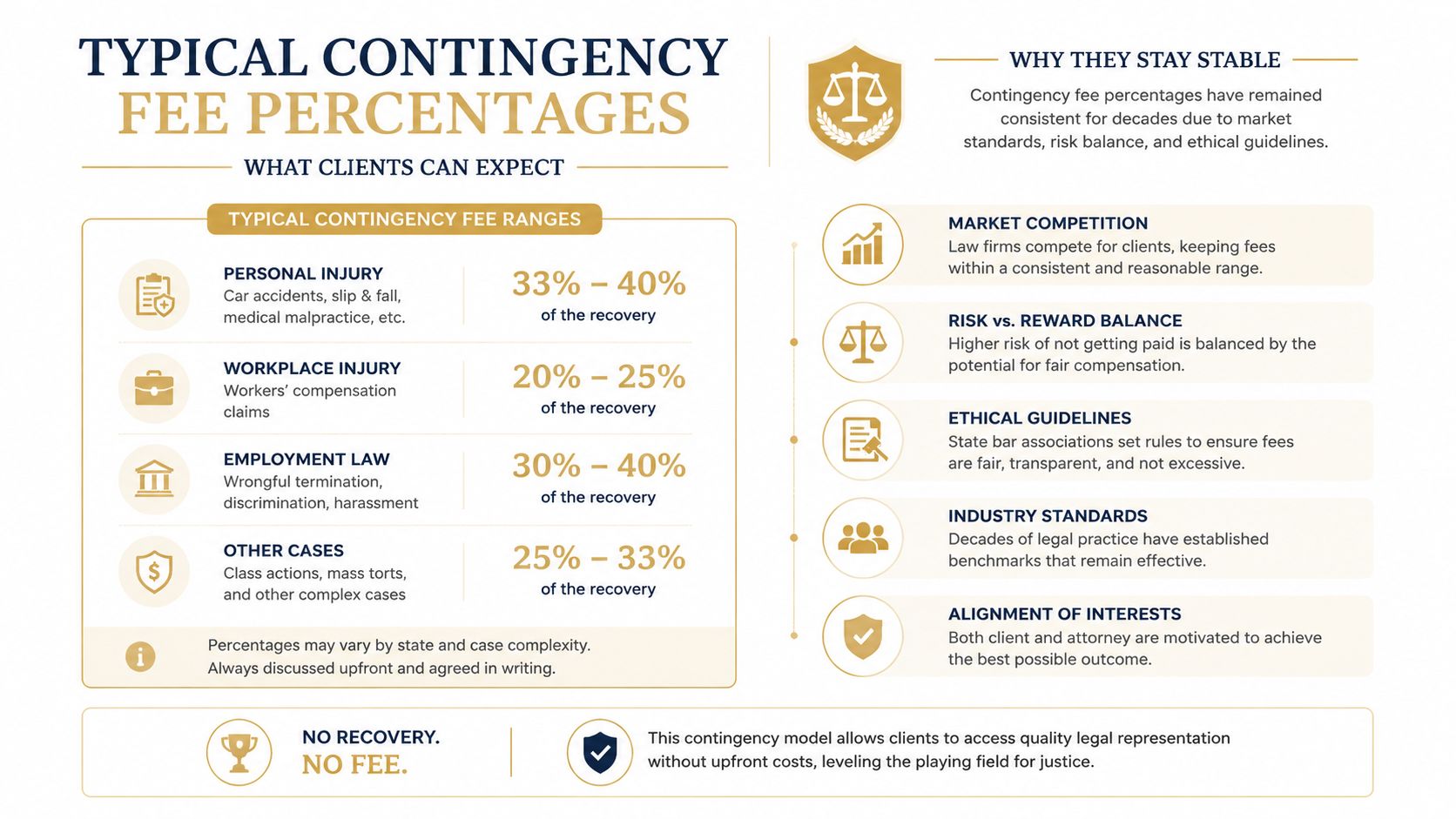
The market benchmark is straightforward. A separate legal analysis describes contingency fees as usually falling between 33% and 40%, while Stanford scholarship reports that the percentage has stayed around 33% across time, context, and case size. You can review that historical discussion in the Stanford Law paper on contingency-fee pricing.
That makes one-third the number to use when benchmarking a proposed agreement. It doesn't mean every lawyer must charge one-third, and it doesn't mean a 40% fee is automatically improper. It means you should demand a concrete explanation whenever the proposed rate sits outside the expected range or rises without a clearly stated trigger.
A durable pricing structure
Contingency fees have deep historical roots. The Supreme Court described their legality as “beyond legitimate controversy” in 1876, and historical scholarship identifies an even earlier decision recognizing a contingent fee arrangement, including a 5% fee on a claim against a foreign government in 1853. By 1964, one historical analysis placed the average contingency fee at roughly 33%, with that percentage remaining relatively stable across time, case type, and case size. Those facts are detailed in the historical Stanford Law analysis.
This history matters because the fee isn't merely a modern billing convenience. It became a durable financing structure for civil litigation, particularly for plaintiffs who couldn't afford hourly rates upfront. The attorney finances time and accepts the possibility of receiving nothing, while the client gains access to representation without paying the full cost as the case develops.
When a different percentage deserves scrutiny
A higher rate may reflect trial preparation, appellate exposure, difficult proof, or substantial litigation financing. But “the case is complicated” isn't enough by itself. Ask what work, risk, or stage change justifies the increase.
Use these questions to benchmark the proposal:
- What rate applies before suit? Identify the percentage if the matter resolves through negotiation.
- What rate applies after filing? Ask whether filing a complaint automatically increases the fee.
- What rate applies at trial or appeal? Make every escalation explicit.
- Is the percentage negotiable? A lawyer may decline to change it, but you should still ask.
- Is the fee based on gross or adjusted recovery? This affects the calculation base.
A personal injury claimant survey found that 87% of represented claimants had entered contingency-fee agreements, with a median fee of one-third, according to the Illinois Law Review analysis. That supports using one-third as a serious market reference point, not as an arbitrary target.
The Hidden Math of Expenses and Deductions
Clients often focus on the attorney percentage and overlook the separate bucket of case expenses. Those expenses can include filing fees, expert-witness charges, court-reporter costs, and medical-record charges. The agreement must tell you whether those amounts are deducted before the fee is calculated or after the fee is taken.
That timing changes the result.
Assume a $300,000 recovery, a 33% fee, and hypothetical expenses of $10,000. The figures below illustrate the difference between the two methods.
| Deduction Method | Fee Calculation | Attorney Fee | Expenses | Client Net Recovery |
|---|---|---|---|---|
| Expenses deducted before fee | 33% of $290,000 | $95,700 | $10,000 | $194,300 |
| Expenses deducted after fee | 33% of $300,000 | $99,000 | $10,000 | $191,000 |
The difference in this illustration is $3,300. The rate didn't change. The settlement didn't change. Only the order of deductions changed.
Ask what the agreement really says
The ABA's Model Rule 1.5 requires written disclosure of litigation and other expenses, including whether expenses are deducted before or after the fee. It also calls for a closing statement showing the remittance to the client.
Don't ask, “Are costs included?” That question is too vague. Ask:
Are expenses deducted before or after your percentage is calculated?
Then ask for the categories. A contract that says “all costs and expenses” without meaningful detail deserves a closer review. You should understand whether the firm advances those costs, whether you remain responsible if there is no recovery, and whether the contract imposes any spending limit.
For a second calculation of your potential take-home amount, you can use a settlement value calculator, but treat any estimate as a planning aid, not a substitute for the contract and final accounting.
Watch for markups
Expense reimbursement should reflect legitimate case spending, not an opportunity to add an undisclosed margin. Michigan ethics guidance states that contingency-case expenses must reasonably reflect actual costs and can't be marked up, as discussed in Michigan legal ethics guidance on contingency expenses.
Request invoices or an itemized ledger for material expenses. A court reporter's charge, expert invoice, or records fee should be identifiable. If your lawyer resists explaining a deduction, pause before authorizing distribution.
Red Flags and Risks Most Guides Ignore
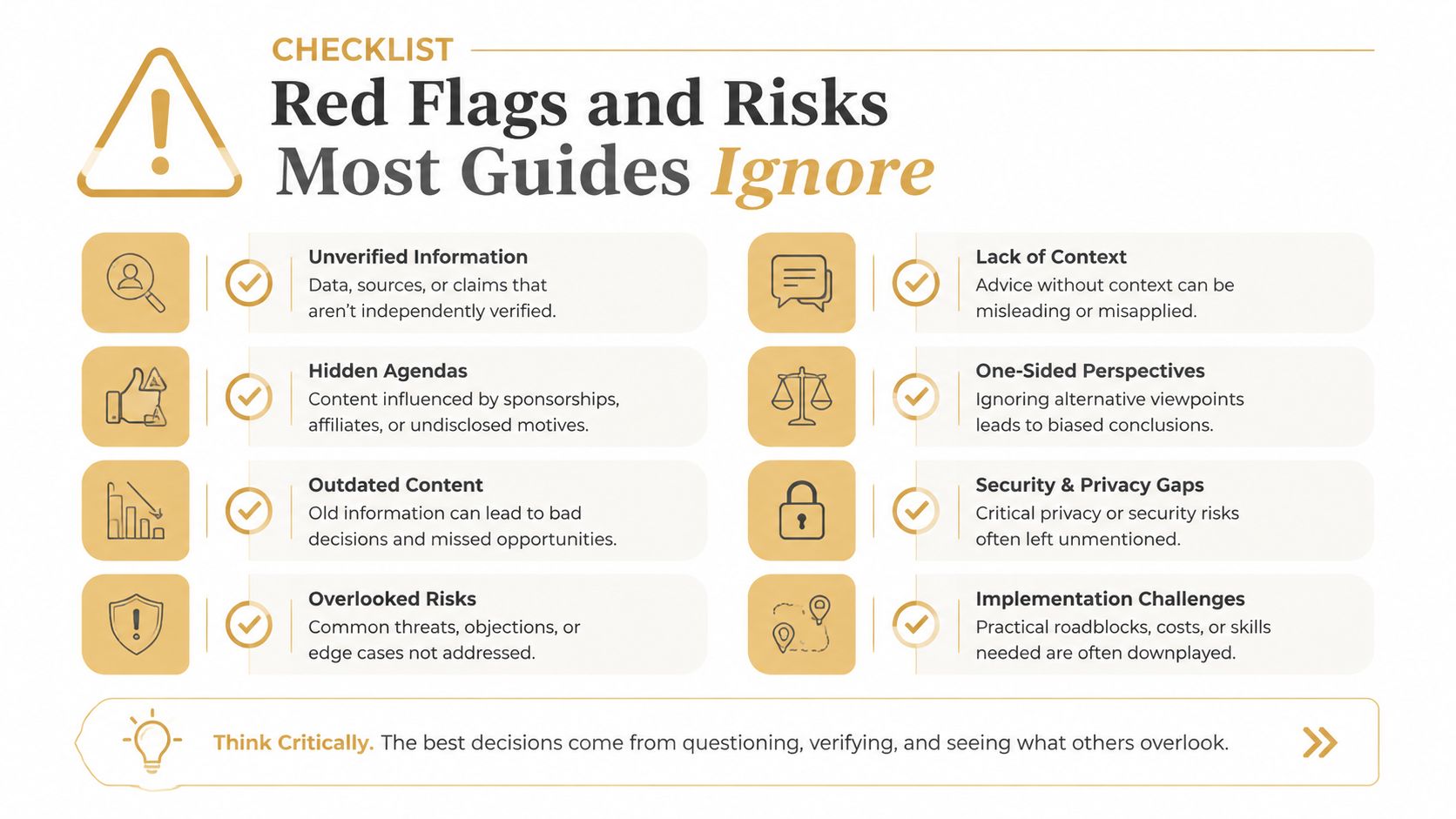
Most explanations stop at “no recovery, no attorney fee.” That slogan misses the disputes that arise after the case becomes valuable. The most serious problems usually involve lawyer changes, expense treatment, and vague escalation clauses.
Switching lawyers can create a second claim on the recovery
You can change lawyers, but that doesn't necessarily erase the first lawyer's financial interest. A predecessor may assert a fee lien or seek compensation for the value of services performed. California ethics guidance says a predecessor lawyer has a duty, on request, to account to the former client for the quantum meruit value of services tied to a fee lien. The guidance also doesn't decide whether a successor may require the client to pay both lawyers more than one contingent fee. Read the California ethics review's discussion of successor-lawyer fee issues before assuming a switch is financially neutral.
That unresolved practical issue creates double-fee risk. Before terminating counsel, ask both lawyers for a written allocation showing who claims what, whether the fees are shared between firms, and how your net recovery changes under each proposal.
Other warning signs
- Unclear stage increases: The agreement raises the fee after litigation begins but doesn't define when that stage starts.
- No expense timing: The contract says costs come from the recovery but doesn't say whether they come off before or after the fee.
- Unitemized charges: The firm provides a lump-sum expense deduction with no supporting ledger.
- Expense markups: The agreement permits charges that exceed actual case costs without a clear basis.
- No closing statement: The lawyer won't commit to a written accounting at resolution.
- Successor silence: The contract says nothing about withdrawal, discharge, liens, or fee allocation.
- Pressure to sign: The firm discourages you from taking the agreement away for review.
- No alternative discussion: The lawyer doesn't explain available billing arrangements where that discussion is relevant.
ABA ethics rules require a contingent fee to be permitted by law and reasonable in the circumstances. Formal Opinion 94-389 also emphasizes that clients must be informed about alternative billing arrangements and the fee's reasonableness. Use a lawyer-finding guide to prepare comparison questions, but make the final decision based on the written terms and the lawyer's answers.
The section's practical warning is simple. A low headline percentage can still produce a poor deal if expenses are marked up, deductions come off the wrong base, or a former lawyer later claims part of the recovery.
The following video provides another general explanation of contingency-fee mechanics. It shouldn't replace advice about your state's rules or your own contract.
State Differences and Ethical Boundaries
There isn't one nationwide contingency-fee contract. Your state's statutes, court rules, professional-conduct standards, and case-specific caps can control what the lawyer may charge and how the agreement must be written.
The ABA framework is a useful baseline, not a substitute for local law. Model Rule 1.5 permits contingent fees only where allowed by law and requires that the fee not be unreasonable. It also requires written disclosure of the fee method, the circumstances triggering payment, expense treatment, and the client's remittance.
Evaluate the fee through four local questions
First, check for caps. Some jurisdictions impose limits in particular categories, such as medical malpractice or specified civil matters. Don't assume a percentage commonly used in personal injury applies to every claim type.
Second, identify disclosure requirements. Your state may require specific language, signatures, delivery of a copy, or a closing accounting. Missing formalities can affect enforceability.
Third, examine reasonableness. The percentage isn't evaluated in isolation. The matter's complexity, risks, time, result, and stage can all matter under professional-conduct principles.
Fourth, ask about trial and appeal. A contract that changes percentages as the case advances must state those changes clearly. Higher-complexity matters can justify a larger fee because contingency arrangements bundle litigation financing and default risk into the lawyer's compensation, as described in ABA Formal Opinion 94-389.
Your state controls the boundaries. Treat a market benchmark as a comparison point, not proof that your lawyer's proposed fee complies with local rules.
A practical review should involve your state bar's published rules, the relevant statute, and a direct question to the attorney: “What rule authorizes this structure, and where does the agreement address it?” If the answer is evasive, get a second opinion before signing.
How to Evaluate a Contingency Fee Agreement Before Signing
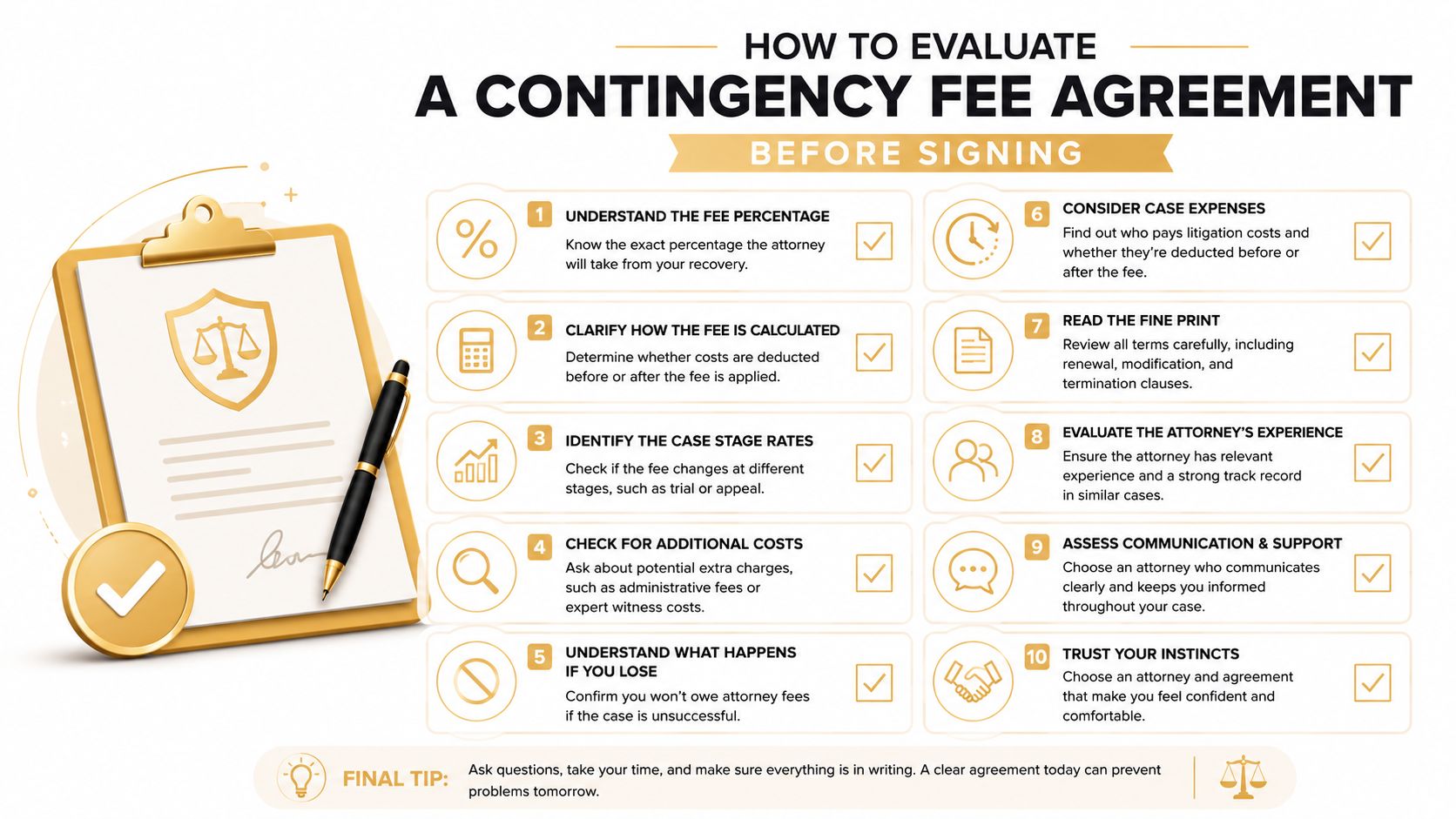
Read the agreement as a financial document, not just a legal form. Your objective is to calculate the amount you keep under realistic outcomes and case stages.
Use this signing checklist
- Write down every percentage. Record the rate for negotiation, filing, trial, and appeal. If the agreement uses one rate throughout, confirm that in writing.
- Identify the calculation base. Ask whether the percentage applies to the gross recovery or a defined amount after particular deductions.
- Locate expense timing. Find the exact clause stating whether expenses come off before or after the fee.
- List expense categories. Look for filing fees, records, experts, depositions, investigation, travel, and other charges. Ask whether the firm can mark up any item.
- Confirm loss responsibility. Determine whether you owe advanced expenses if the case produces no recovery.
- Demand a closing statement. The agreement should provide a final accounting that shows the recovery, deductions, and remittance.
- Address a lawyer change. Ask what happens if you discharge the lawyer, the lawyer withdraws, or another firm joins the matter.
- Run a net-recovery comparison. Compare the actual dollars you retain under each lawyer's proposed terms, not just the percentage.
For employment matters, fee structures can differ from personal injury arrangements, particularly where statutory fee-shifting may affect payment. Review employment attorney fees alongside the proposed agreement and ask whether any fee award from the opposing side changes your personal obligation.
Outh offers attorney-fee transparency tools that can display estimated contingency percentages, retainers, and a $0 retainer filter while you compare representation options. Use that information to create questions for consultations, then verify every term against the attorney's written contract and your jurisdiction's rules.
Bring the agreement home if possible. Mark every phrase involving “gross recovery,” “expenses,” “lien,” “quantum meruit,” “appeal,” and “termination.” If the lawyer won't explain a clause in plain English, don't sign until another qualified attorney reviews it.
Visit Outh to organize your claim information, compare attorney fee structures, and prepare a net-recovery calculation before your next consultation. Use the platform's fee transparency and attorney-matching tools to turn a confusing percentage into a clearer, documented decision.