 Outh
OuthHow to Find an Employment Lawyer That Fits Your Case
Learn how to find an employment lawyer who matches your claim, budget, and location. Practical steps, red flags, and fee tips for 2026.

You're staring at a termination letter at 11 p.m., scrolling through Slack messages and trying to decide whether your manager's comment was merely offensive or legally significant. A severance agreement sits beside your laptop, your deadline is unclear, and every search result seems to recommend a different “employment lawyer.”
The right search isn't about finding the attorney with the highest rating. It's about finding counsel who handles your specific claim in the forum that will control it, whether that's the EEOC, a state agency, or state or federal court. The wrong generalist can miss an administrative step, misunderstand the evidence, or spend valuable time learning the rules of your case.
Table of Contents
- When You Need an Employment Lawyer and Why the Search Feels Different
- Where to Start Looking for the Right Attorney
- How Employment Lawyers Charge and What to Expect
- Matching the Lawyer to Your Specific Claim Type
- Questions to Ask and Red Flags to Watch For
- Building Your Case Before You Reach Out
- Your Next Steps From Research to Representation
When You Need an Employment Lawyer and Why the Search Feels Different
Employment disputes become serious when your job, income, professional reputation, or legal deadline is at risk. Discrimination, harassment, retaliation, unpaid wages, worker misclassification, severance disputes, and non-compete enforcement all justify at least an initial legal evaluation, particularly when your employer has already involved human resources or outside counsel.
The urgency comes from procedure. Employment claims often begin with an administrative charge, an agency investigation, or a formal response to an employer document before a lawsuit ever reaches court. The California courts' employment dispute guidance directs workers toward labor-and-employment directories, lawyer referral services, and relevant agencies when administrative resolution may come before litigation. That sequence can affect what evidence matters, which deadline applies, and where the claim belongs.
Start with the claim, not the job title
A worker fired soon after requesting a disability accommodation needs a different first review from someone whose employer withheld overtime or labeled them an independent contractor. A person facing a severance agreement may need fast contract analysis, while someone reporting harassment may need counsel who understands agency filing strategy and retaliation evidence.
Don't search for “the best employment lawyer” as if employment law were one subject. Search for:
- The alleged conduct: discrimination, harassment, retaliation, wage violations, classification, contract enforcement, or another specific issue.
- The likely forum: the EEOC, a state civil rights or labor agency, arbitration, mediation, or court.
- Your position in the dispute: employee, former employee, contractor, executive, or employer.
- The immediate decision: preserve evidence, respond to a separation agreement, file a charge, negotiate, or litigate.
The legal profession is large but specialized. The United States had 1,322,649 active lawyers as of January 1, 2024, and the number had risen 3.2% from 2014, according to lawyer-market data summarized by Rev. That scale makes broad online searches noisy. It also explains why a lawyer who occasionally handles employment matters isn't automatically a strong fit for your dispute.
Practical rule: If an attorney can't quickly explain which claim and forum they're evaluating, keep searching.
Where to Start Looking for the Right Attorney
Use several sources, but don't treat them as equal proof. A directory helps you build names. It doesn't establish that a lawyer has handled your type of case successfully or that the lawyer will personally manage your matter.
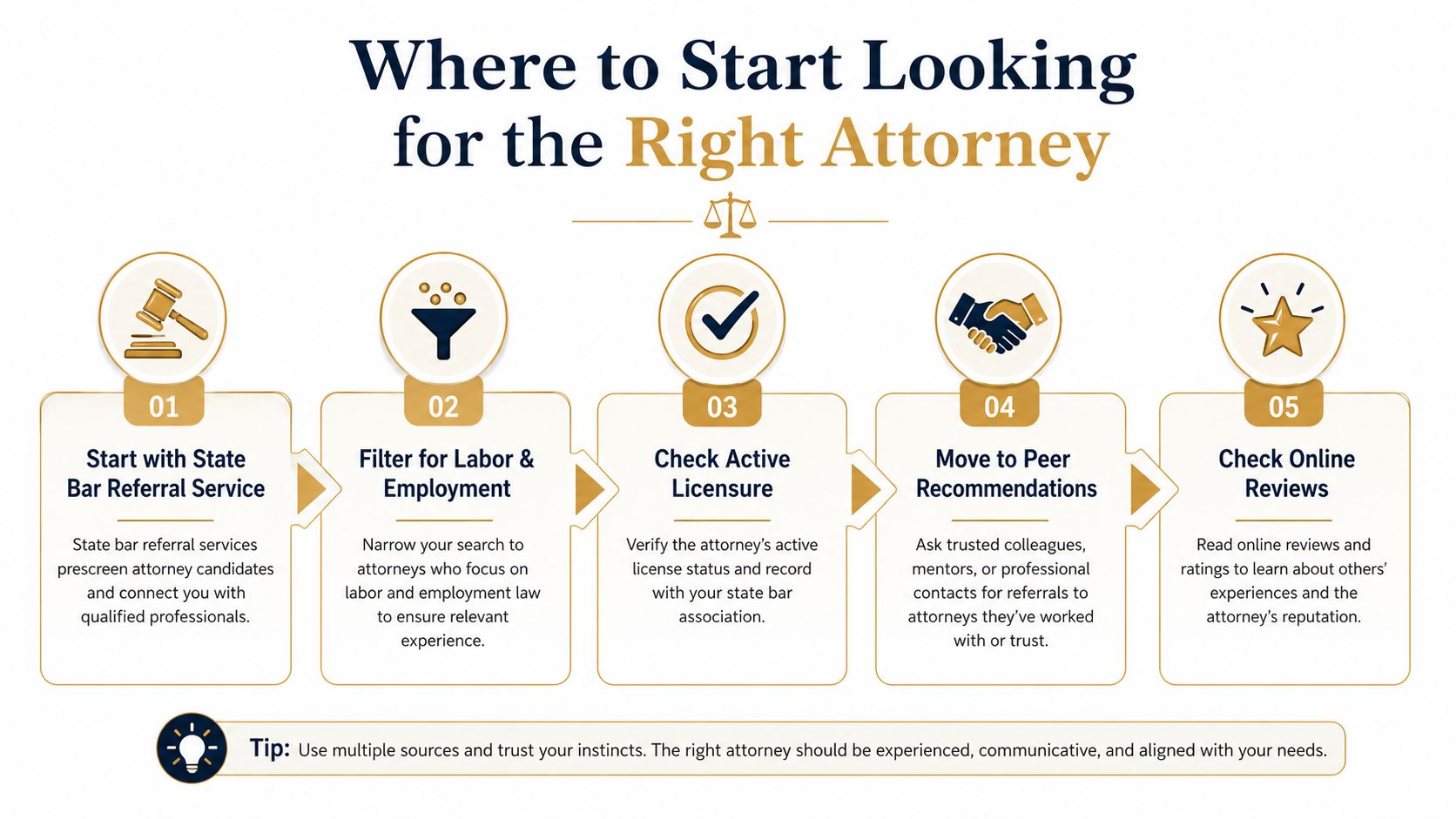
Start with your state bar's referral service or attorney lookup. Filter for labor and employment, then confirm the lawyer's active status and disciplinary information through the bar's own system. This is the basic verification step, not the final recommendation. A polished profile elsewhere can't substitute for checking whether the person is authorized to practice in the jurisdiction relevant to your dispute.
Next, use specialty directories and professional networks to expand the shortlist. Plaintiff-side workers may look for organizations such as the National Employment Lawyers Association, while employer-side searches may involve labor and employment sections of bar associations. Martindale-Hubbell and similar services can help identify attorneys by practice area, but ratings should remain secondary to comparable matter experience.
Build a shortlist before you make calls
Aim for two or three plausible candidates, not a dozen intake forms. For each name, record the practice focus, location, likely forum, consultation terms, and whether the lawyer represents employees, employers, or both. Ask trusted former colleagues, union representatives, and attorneys in unrelated fields for referrals. Lawyers often know who handles a niche matter, who has a conflict, and who has capacity.
Legal aid organizations and law school clinics may offer lower-cost help for people who meet eligibility requirements. They can be especially useful for document review, agency navigation, or understanding whether a matter needs private counsel immediately.
For a more general search framework, see Outh's guide to finding a lawyer, then independently verify every candidate through the applicable state bar. Don't hire based on a directory badge, an impressive website, or generic reviews. Those features can support a search, but they don't answer the question that matters: Has this lawyer handled a dispute like mine in the forum where mine will proceed?
How Employment Lawyers Charge and What to Expect
Fee discussions should happen before you share your entire history or sign anything. Employment lawyers commonly use contingency fees, hourly billing, flat fees, or retainers, and the right model depends on the claim, expected work, likely recovery, and whether you need advice or full representation.
A contingency arrangement means the lawyer receives an agreed share of a recovery rather than billing every hour in the ordinary way. This structure is common in plaintiff-side discrimination and wage matters, but it may not make financial sense for a small claim or a matter involving only contract advice. Hourly billing is common for defense work, discrete consultations, negotiations, and litigation where recovery isn't the payment source.
A flat fee works best when the task has a defined boundary, such as reviewing a severance agreement or preparing a limited response. A retainer usually functions as an advance against hourly work. The lawyer bills time against it, and the agreement explains when you must replenish the account.
Compare the agreement, not just the quote
| Fee Model | Typical Range | Best For | Watch For |
|---|---|---|---|
| Contingency | A negotiated share of recovery | Plaintiff-side discrimination or wage matters | Whether costs are deducted before or after the fee |
| Hourly | The lawyer's stated hourly rate | Defense, advice, negotiation, and litigation | Billing increments, staffing, and budget control |
| Flat fee | A fixed amount for a defined task | Severance review or limited-scope work | What happens when the project expands |
| Retainer | An advance applied to hourly work | Ongoing advice or representation | Replenishment rules and unused-balance treatment |
Market context can help you understand why lawyers emphasize specialization. IBISWorld's employment-law-firm overview describes a mature, competitive provider segment, so firms use different pricing and positioning strategies. That doesn't tell you whether a quote is fair, but it does mean you should compare scope and experience rather than choosing the lowest initial figure.
Read the agreement for scope of work, costs versus fees, expert or filing expenses, arbitration provisions, communication expectations, conflicts, termination rights, and settlement authority. Ask who pays costs if you lose, whether the lawyer can withdraw, and whether another firm or attorney may receive part of the fee. For a plain-English discussion of pricing questions, review this guide to employment attorney fees.
Matching the Lawyer to Your Specific Claim Type
The phrase “employment lawyer” hides important differences. A lawyer who spends most of the week defending wage audits may not be the best person to handle an EEOC discrimination charge. A litigator who excels at trial may not be the right first call for a severance agreement you need reviewed quickly.
Use the claim and forum as your filter
| Claim Type | Best-Fit Attorney Profile | Typical Forum |
|---|---|---|
| Discrimination or harassment | Attorney experienced with EEOC charges, state civil rights agencies, and discrimination litigation | EEOC, state agency, state or federal court |
| Wage and hour | Lawyer familiar with payroll records, collective or group claims, and wage statutes | State labor agency, federal or state court |
| Retaliation | Litigator who handles mixed discrimination, whistleblower, or protected-activity fact patterns | Agency, arbitration, or court |
| Misclassification or contract disputes | Employment or commercial litigator comfortable with classification rules and contract remedies | Agency, arbitration, mediation, or court |
For discrimination and harassment, prioritize an EEOC-track attorney. The EEOC opened its first field office in Dallas in January 1966 and added offices in Austin, Atlanta, Chicago, and Cleveland by the end of that year. Congress passed the Age Discrimination in Employment Act in 1967, protecting workers ages 40 to 65 at that time, as described in Clio's historical lawyer overview. The point for your search isn't history for its own sake. It's that agency procedures and federal discrimination statutes remain central to many employment claims.
A wage-and-hour matter calls for someone who can examine time records, pay stubs, deductions, job duties, and employer-wide practices. A lawyer may be a strong fit if they regularly evaluate group patterns rather than only advising employers on individual payroll questions.
Retaliation often overlaps with discrimination, whistleblowing, leave, and wage disputes. Choose counsel who has litigated cases where the employer offers a legitimate reason for discipline and the employee must connect the action to protected conduct. A policy adviser who rarely litigates may not provide the leverage you need.
Misclassification and severance disputes can require contract interpretation alongside employment analysis. Ask whether the lawyer handles arbitration clauses, fee-shifting provisions, restrictive covenants, and executive agreements. A generalist may be fine for a straightforward document review. A niche specialist matters when the agreement affects claims, forum selection, or your ability to work elsewhere.
Questions to Ask and Red Flags to Watch For
Use the consultation to test the lawyer's fit, not to persuade the lawyer that you deserve representation. Bring a concise chronology and ask the same core questions of every candidate so you can compare answers instead of comparing personalities.
Ask:
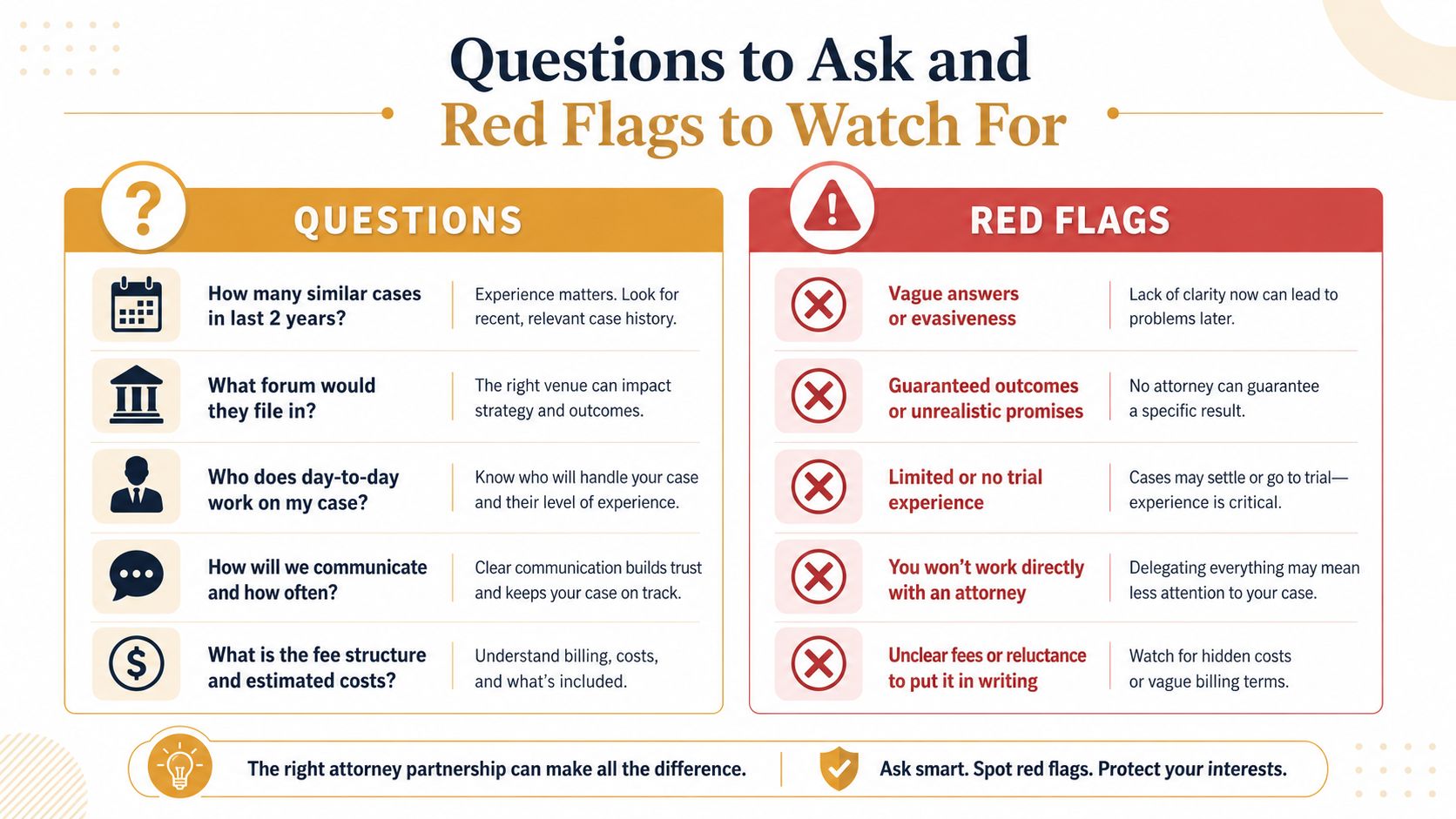
- Recent comparable matters: How many cases like yours have you handled recently, and what stage did each reach?
- Forum strategy: Would you begin with the EEOC, a state agency, arbitration, mediation, or court, and why?
- Actual staffing: Who will handle day-to-day communications, document review, discovery, and hearings?
- Case direction: What facts help your position, and what facts create problems?
- Costs: What fee model applies, what expenses are separate, and when might the budget change?
- Negotiation method: Who communicates with the employer, and how will you approve settlement decisions?
A strong lawyer won't promise an outcome. They'll identify missing facts, explain procedural choices, and tell you what they need to verify. A refusal to provide a written fee agreement, pressure to sign before reviewing key documents, or vague answers about the lawyer who will do the work should stop the process.
Watch the firm's behavior during intake
Slow communication before engagement is useful information. You don't need instant replies, but you do need a clear process for returning calls, uploading documents, and receiving deadline instructions. Also ask who attends depositions and hearings. A paralegal can handle important administrative work, but the engagement should identify the attorney responsible for legal judgment and advocacy.
After each call, score candidates on specialty fit, forum experience, clarity, responsiveness, fee transparency, and personal confidence. Write down one concern for each candidate. The best choice is usually the lawyer who gives you a realistic plan and a clear next action, not the one who sounds most certain.
Building Your Case Before You Reach Out
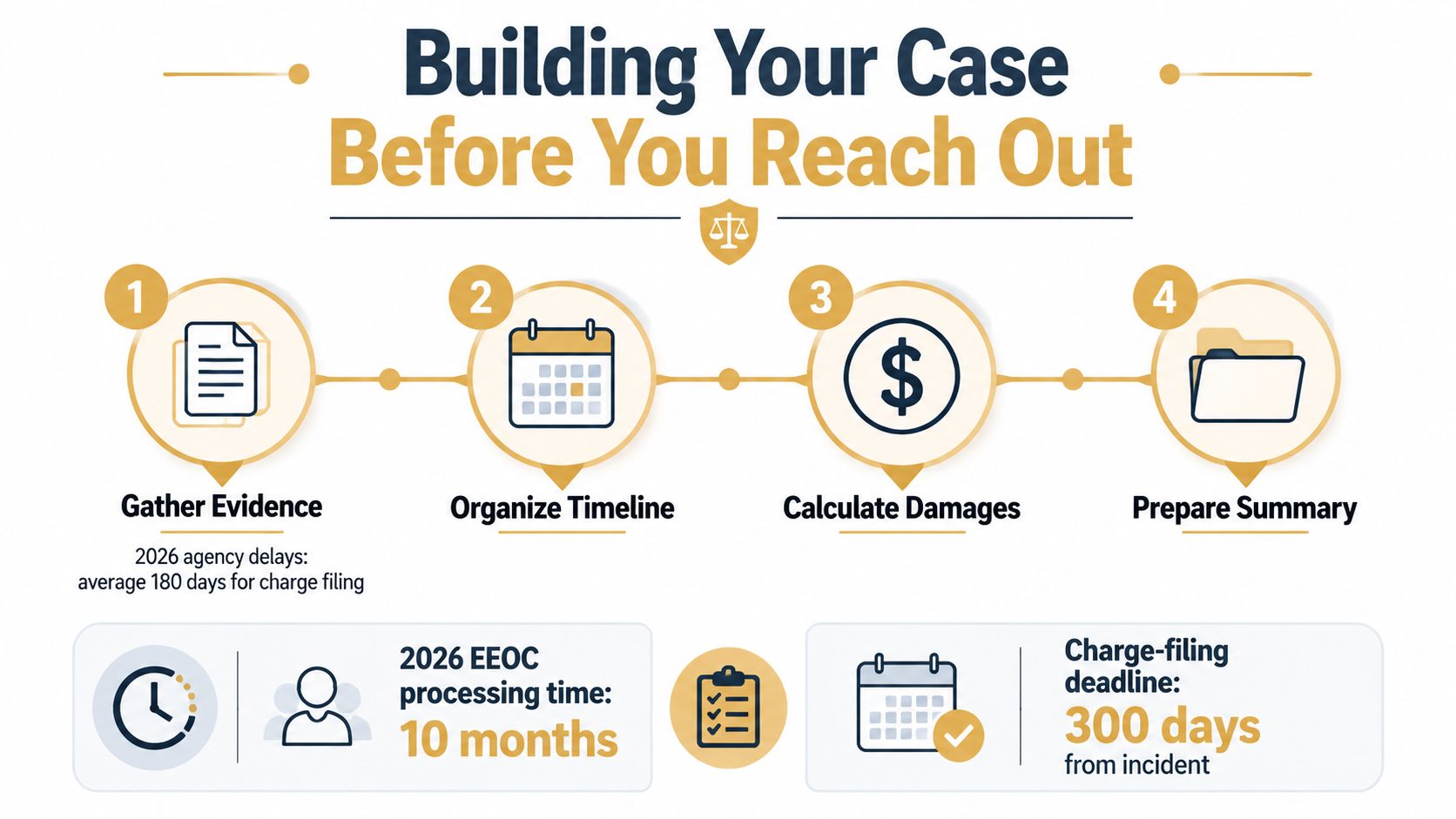
Your first call will go better if you arrive with organized facts instead of a folder of screenshots and a story that changes as you remember details. The EEOC received 269,755 inquiries in FY2025, up 8.7%, ended that year with 49,807 pending charges, and began FY2026 with 1,809 employees, down from 2,170 the prior year, according to the EEOC's FY2027 performance plan and FY2025 report. Those figures make early triage and clean evidence especially important.
Start with the documents that establish the employment relationship and the disputed event:
- Employment records: Offer letter, employment agreement, handbook, compensation plan, and relevant policies.
- Performance material: Reviews, warnings, improvement plans, promotion records, and commendations.
- Pay evidence: Pay stubs, time records, commission statements, expense records, and benefits communications.
- Communications: Emails, Slack or Teams messages, text messages, voicemails, calendar invitations, and HR complaints.
- People and events: Witness names, decision-makers, meeting participants, and dates of important conversations.
Make the chronology easy to test
Create a clean timeline with the date, event, participants, supporting document, and why the event matters. Don't edit messages to make them look better. Preserve the original context, export files where possible, and avoid forwarding confidential company material to people who don't need it.
Write a one-page summary answering five questions: What happened? Who took the action? What protected activity or protected characteristic is involved? What changed afterward? What result do you want? If state law allows personnel-file access, ask counsel or a qualified legal-aid provider how to request the file without creating a new problem.
Don't secretly record conversations or delete anything because it seems embarrassing. Recording rules vary by jurisdiction, and evidence destruction can damage a claim. Use this due diligence list as an organizing aid, then ask the lawyer what needs immediate preservation.
Good preparation can shorten intake and reduce the time a lawyer spends reconstructing basic facts. It also lets you discuss whether a limited review, flat-fee project, contingency arrangement, hourly engagement, or hybrid structure fits the work required.
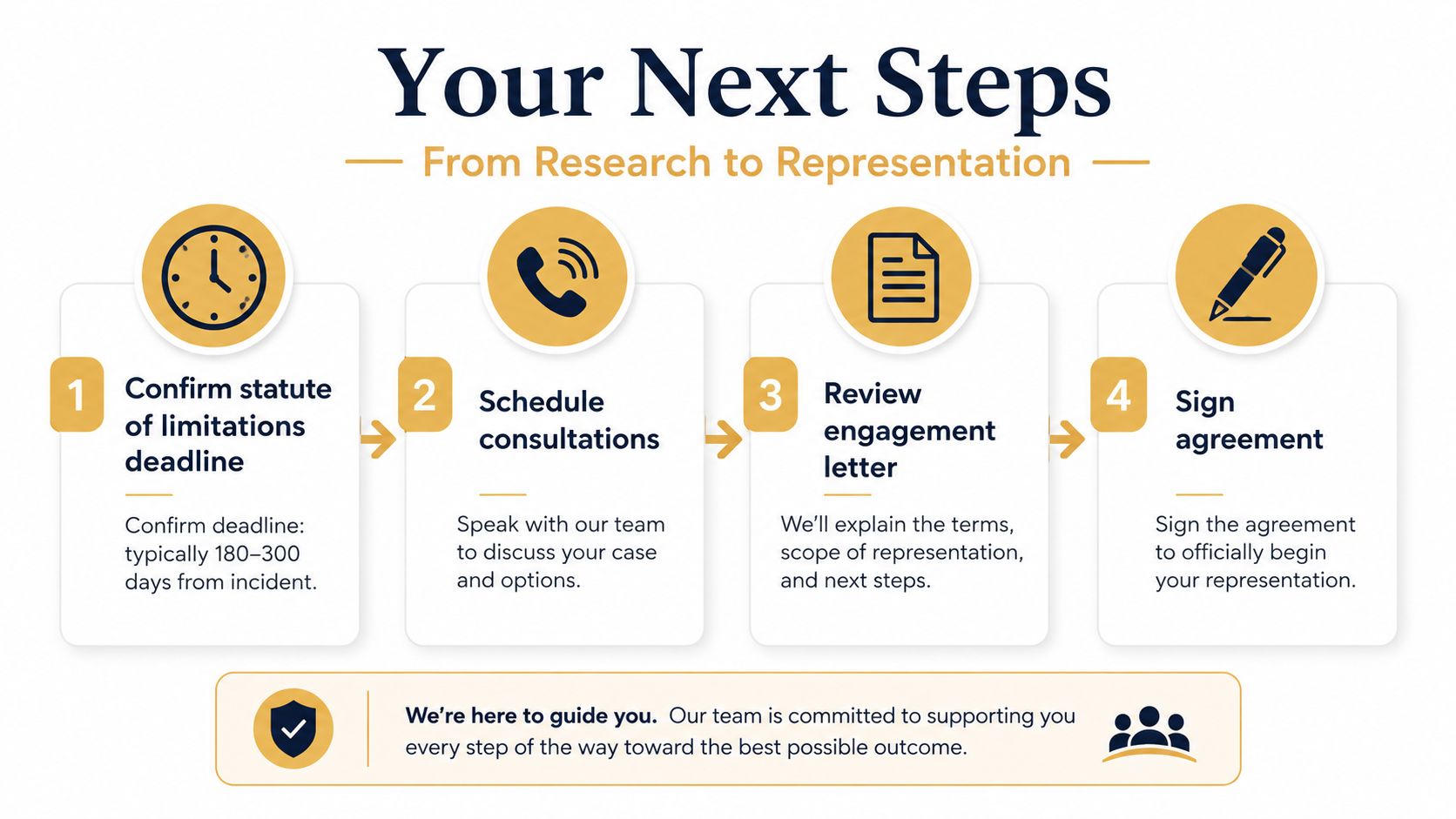
Your Next Steps From Research to Representation
You don't need an endless search. You need a controlled process that protects deadlines while giving you enough comparison to avoid the first available lawyer.
Follow the sequence
- Confirm the deadline. Check the applicable jurisdiction and filing rule, then ask an attorney or agency to verify it. Don't calculate solely from a general internet article.
- Prepare the one-page summary. Attach the most important documents, not every file you own.
- Request two or three consultations. Tell each office the claim type, location, immediate deadline, and whether you have signed anything.
- Compare the calls within one day. Rate responsiveness, forum knowledge, specialty fit, fee clarity, and who will handle the matter.
- Request written scope. Before signing, confirm the tasks covered, excluded work, costs, communication expectations, and termination terms.
- Sign only after review. Keep the executed agreement and every document you provided.
An imminent agency deadline overrides a leisurely comparison. So does a severance offer with a response window, a scheduled deposition, an active internal investigation, or a demand from the employer. In those situations, contact several lawyers immediately and tell each office the exact timing. You can still evaluate fit, but you shouldn't delay advice just to collect more online ratings.
Agency workload is another reason to favor lawyers who understand charge preparation and administrative follow-through. The EEOC's inquiry, pending-charge, and staffing figures cited above show why a lawyer's ability to organize a charge, preserve proof, and communicate promptly may matter more than a firm's star average.
The lawyer you hire should return calls within a reasonable, clearly explained window, answer fee questions without making you chase them, and tell you what happens next. Early responsiveness isn't proof of a favorable result, but it's direct evidence of how the firm communicates when your case needs attention.
If you're still sorting out whether your workplace facts support a claim, Outh can help you organize evidence, identify claim elements, estimate potential case value, and compare attorneys by specialty and fee structure. Visit Outh before your consultations so you can approach the right employment lawyer with a clearer record and better questions.