 Outh
OuthWrongful Termination Settlement Amounts: A Practical Guide
Learn what wrongful termination settlement amounts typically look like, what drives the range, and how to benchmark your case
Wrongful termination settlements typically cluster between $5,000 and $80,000 out of court, with an EEOC-derived average near $40,000, while a small share of cases exceeds $1 million. The spread is wide because settlement value depends less on the label “wrongful termination” than on lost income, proof quality, claim type, jurisdiction, and the employer's exposure.
That opening range is more useful than a headline verdict, but it still isn't a valuation. A claimant with limited wage loss and disputed evidence may face a low offer, while a worker with documented retaliation, extended unemployment, substantial benefits, and multiple legal theories may have materially greater negotiating power. The EEOC-based settlement analysis also describes a historical pattern in which roughly 90% to 95% of cases settle before trial, so the practical question usually isn't “What could a jury award?” It's “What amount makes sense given the proof, risk, delay, and cost of continuing?”
Table of Contents
- What a Wrongful Termination Settlement Includes
- The Three Buckets That Make Up a Settlement Amount
- Why Settlement Amounts Follow a Skewed Distribution
- Reading P10, P50, and P90 Ranges in Practice
- State and Claim-Type Benchmarks That Move the Number
- Evidence That Pushes a Case Into a Higher Range
- Typical Timelines From Intake to Resolution
- Evaluating Your Case and Choosing the Right Next Step
What a Wrongful Termination Settlement Includes
A settlement reflects negotiated risk, not the maximum damages a claimant might theoretically recover. The parties may reach it through direct attorney negotiation, mediation, a pre-suit demand, a resolution after an administrative charge, or discussions prompted by discovery and trial risk.
The pathway affects the information available to each side. Early negotiations may emphasize speed and privacy. A later agreement can incorporate employer documents, witness testimony, motion rulings, and a more developed damages estimate. The employment settlement data and analysis provides background on how these resolutions are evaluated, while an individual case still turns on its evidence and governing law.
What the payment is designed to resolve
A settlement may address several forms of harm:
- Lost wages and benefits: Pay the employee would have earned after termination, including qualifying benefits and, in some cases, bonuses.
- Future economic loss: Income that may remain unavailable if comparable employment is difficult to secure.
- Emotional distress: Harm connected to the termination, where applicable law permits recovery and supporting evidence exists.
- Statutory or other remedies: Some claims allow penalties, attorney-fee recovery, liquidated damages, or punitive components.
The agreement can impose obligations beyond the cash payment. Common terms include confidentiality, non-disparagement, cooperation with reference requests, resignation language, and a release of claims. Payment may come as a lump sum or scheduled installments. The document may also assign portions to wages, damages, fees, or other categories for tax and reporting purposes.
A larger gross offer may provide less practical value if taxes, fees, delayed installments, or restrictive terms reduce what the claimant keeps or can do afterward. The employment lawsuit settlement guide offers a framework for reviewing those tradeoffs, but it does not replace analysis of state law, the termination record, and proof of causation.
Practical rule: Compare the net payment with the obligations you accept, not only the gross number printed in the offer.
The Three Buckets That Make Up a Settlement Amount
Settlement dollars usually come from three analytical buckets. Separating them helps prevent a common mistake, treating the entire demand as if it were one undifferentiated injury.
Economic damages
Economic loss is the most concrete starting point. It can include back pay, front pay, lost bonuses, forfeited equity, retirement contributions, and the value of benefits that ended with employment. The calculation generally starts with what the employee would have earned, then considers replacement income and the likelihood of future recovery.
A worker who loses employment for a short period may have modest wage loss even if the termination was clearly unlawful. A higher-paid employee who remains unemployed or accepts substantially lower-paid work can present a larger economic model. Salary level, employment duration, bonus structure, and benefits documentation therefore matter directly.
Non-economic damages
Non-economic damages address harm that doesn't appear on a pay stub. Emotional distress, reputational injury, humiliation, anxiety, and loss of professional standing may support this part of a claim where the relevant law allows it. Medical records, contemporaneous messages, therapy documentation, and testimony can make the harm more concrete.
This bucket is negotiated alongside liability risk. Strong proof of discriminatory or retaliatory motive can increase the employer's concern about emotional-distress exposure, while weak causation evidence can suppress the amount even when the employee experienced genuine hardship.
Statutory and punitive components
Some claims create additional exposure through statutory penalties, liquidated damages, fee-shifting provisions, or punitive damages. These remedies depend on the statute, the claim elements, the employer's conduct, and the forum. They aren't automatic additions to every wrongful termination settlement.
| Settlement Bucket | What It Covers | How It Is Calculated | Typical Share |
|---|---|---|---|
| Economic | Back pay, front pay, benefits, bonuses, equity | Documented wage and benefit loss, adjusted for mitigation | Often the clearest baseline |
| Non-economic | Emotional distress, reputation, professional harm | Evidence of impact and liability strength | Varies substantially by proof and law |
| Statutory or punitive | Penalties, multipliers, fees, punitive remedies | Governing statute and conduct at issue | May materially increase leverage |
The right approach is to build each bucket separately, then discount the combined figure for disputed facts, litigation expense, delay, and collection risk. That produces a more defensible estimate than choosing a round number first.
Why Settlement Amounts Follow a Skewed Distribution
Settlement outcomes are not evenly distributed. Across EEOC-announced monetary resolutions from 1990 through 2026, the median announced employment-discrimination settlement was $110,000, while the mean exceeded $817,000 (EEOC data and statistics). A small group of very large matters therefore raises the average far above the outcome facing a typical individual claimant.
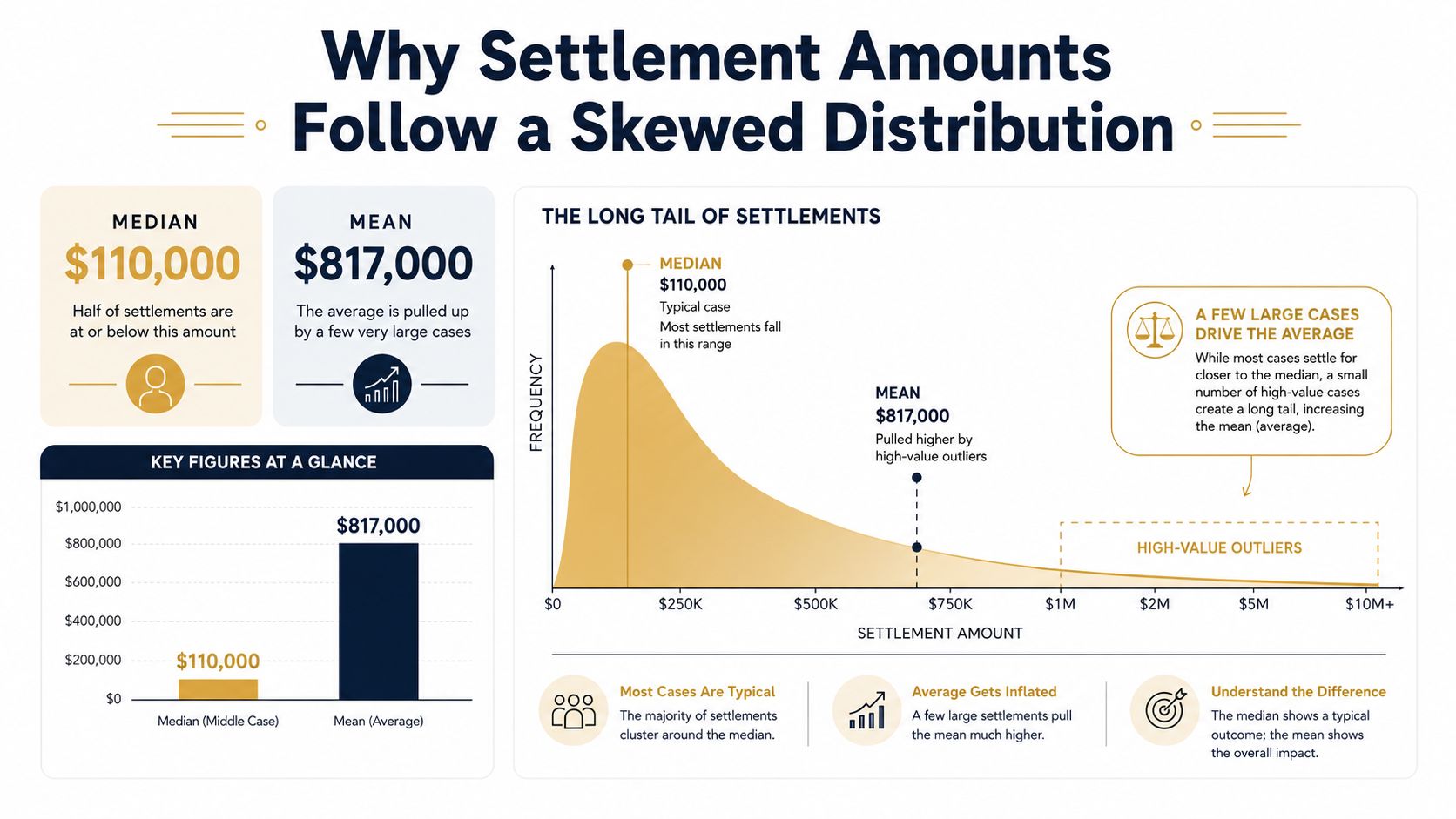
The dataset also shows a concentrated upper tail: the largest 30 resolutions above $10 million accounted for 45% of total dollars. Those matters may involve systemic conduct, many affected workers, executive compensation, or overlapping legal theories. They are poor comparators for an individual termination involving ordinary wage loss.
What creates the right tail
Higher outcomes can result from class or collective exposure, executive equity disputes, whistleblower protections, fraud or defamation allegations, or conduct supporting enhanced remedies. A single employee's claim may also become more valuable when evidence suggests a pattern affecting multiple workers. That development raises both potential recovery and factual complexity.
Most claimants remain in the distribution's dense middle or lower range. Their cases are generally negotiated around documented wage loss, emotional distress, attorney involvement, and the probability of proving liability. The mean describes total dollars divided by matters. The median identifies the midpoint, but neither figure predicts an individual result without case-specific adjustments.
A sound valuation uses scenarios rather than one headline number. The low case accounts for proof, mitigation, and causation risk. The central case reflects the most supportable result on the available evidence. The high case requires strong liability, meaningful damages, and aggravating facts. This right-skewed model provides the basis for P10, P50, and P90 analysis.
Reading P10, P50, and P90 Ranges in Practice
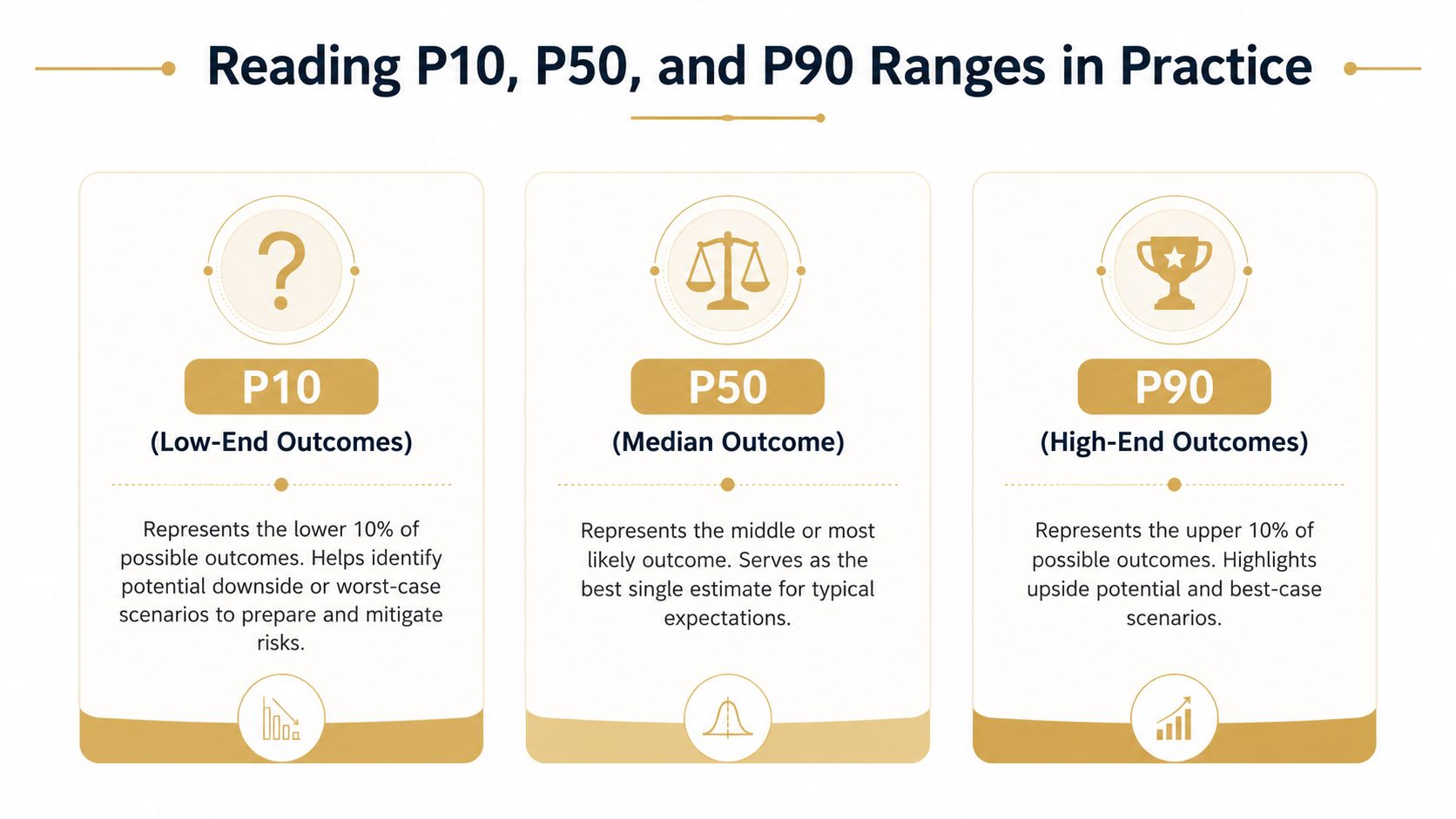
Percentiles are planning anchors, not promises. P10 represents a lower-end outcome, P50 represents the central estimate, and P90 represents a favorable outcome supported by unusually strong facts. They force the evaluator to state assumptions instead of presenting one unsupported settlement amount.
The supplied case framework suggests low-end outcomes may fall around $3,000 to $10,000, central outcomes around $35,000 to $50,000, and stronger cases around $150,000 to $500,000. Those planning bands aren't universal market statistics. They should be treated as scenario ranges that must be tested against the broader historical benchmarks, especially because datasets may include different claim types and procedural stages.
Three scenarios
- P10, low-end resolution: An at-will termination has no clear protected activity, no admission, and limited wage loss. The employer disputes both motive and damages, so a modest payment may buy closure without recognizing substantial liability.
- P50, central outcome: A discrimination or retaliation claim has credible documentation, but the employer offers a plausible alternative explanation. Back pay is measurable, emotional harm is supported to some degree, and both sides face litigation risk.
- P90, favorable outcome: The file includes clear retaliatory timing, contradictory performance records, corroborating witnesses, substantial unemployment, or multiple viable legal theories. The employer faces greater exposure and a stronger reason to pay for certainty.
The settlement value calculator can be useful for organizing assumptions, but a percentile estimate should always identify the claim type, venue, wage history, mitigation facts, proof gaps, and expected legal costs. A P90 number without a documented reason is an aspiration, not an analysis.
State and Claim-Type Benchmarks That Move the Number
State comparisons are often repeated as if they were interchangeable. They aren't. Settlement datasets may differ by claim mix, court, employer size, remedy rules, and whether the reported figure reflects an administrative resolution, private agreement, or public enforcement matter.
The supplied research suggests California matters may run above a national midpoint, New York matters can be more sensitive to retaliation theories, and Texas and Florida may produce lower expectations in some at-will employment disputes. However, the verified data doesn't establish reliable state-specific medians or the proposed claim-type averages. Those figures shouldn't be presented as facts.
A safer comparison framework
| State | Retaliation | Discrimination | Contract |
|---|---|---|---|
| California | Evaluate protected activity, timing, and available remedies | Analyze protected-status proof and FEHA-related exposure | Focus on contract language and promised compensation |
| New York | Examine whistleblower and retaliation protections | Test comparator and motive evidence | Review written terms and implied obligations |
| Texas | Scrutinize the legal exception to at-will employment | Identify the applicable federal or state protection | Quantify contractual promises and separation terms |
| Florida | Confirm the protected right and causal connection | Separate statutory discrimination claims from ordinary termination | Analyze enforceable compensation and notice provisions |
Claim labels also change the valuation model. Retaliation often turns on chronology and employer knowledge. Discrimination cases may depend on comparator evidence, decision-maker statements, and shifting explanations. Contract claims focus more heavily on the language of the agreement and the damages it permits.
The practical conclusion is narrower than “California pays more” or “retaliation is worth a certain amount.” A claimant should ask which law controls, what damages that law permits, whether the forum has meaningful caps or fee-shifting, and whether the available evidence proves each element. Without those answers, a state benchmark can create false precision.
Evidence That Pushes a Case Into a Higher Range
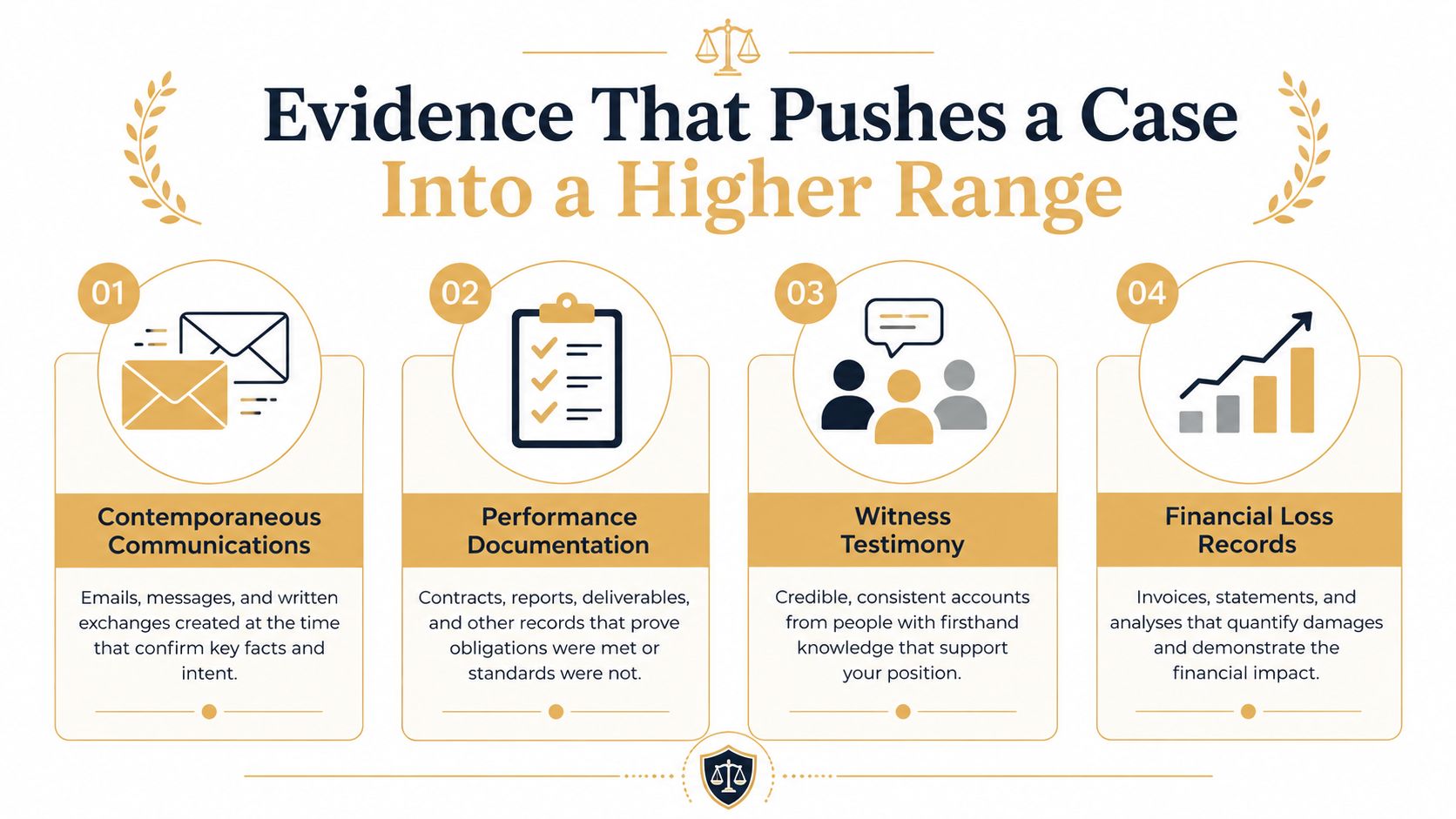
Documentation is the strongest practical lever because it connects the termination decision to an unlawful motive and turns claimed losses into verifiable damages. A persuasive file doesn't merely show that the employee was fired. It shows what happened before the decision, who knew about protected conduct, what reason the employer gave, and how that reason changed or conflicts with the record.
Build the evidence file
- Contemporaneous communications: Preserve emails, messages, HR complaints, and calendar records showing timing, motive, notice, or retaliation.
- Performance documentation: Compare reviews, goals, disciplinary records, and termination explanations. A sudden negative rationale after a strong record can create a credibility issue.
- Comparator evidence: Identify similarly situated employees who engaged in comparable conduct but received different treatment.
- Witness accounts: Record names and what each person personally saw or heard. Direct admissions and consistent testimony carry more weight than generalized workplace impressions.
- Financial loss records: Gather pay statements, benefit summaries, bonus plans, equity documents, job-search records, and new-income information.
- Health records: Where emotional distress is claimed, relevant treatment records can help show severity, duration, and causation.
The most useful documents are often created before anyone anticipates litigation. Don't alter originals, access materials you're not authorized to view, or remove confidential company data improperly. Preserve personal records lawfully and let counsel decide what belongs in a demand, charge, or complaint.
An evidence-first review also exposes weaknesses early. If the employer has consistent performance warnings, the claimant found comparable work quickly, or no witness can support the alleged motive, the high-end scenario may not be defensible even when the termination felt unfair.
Typical Timelines From Intake to Resolution
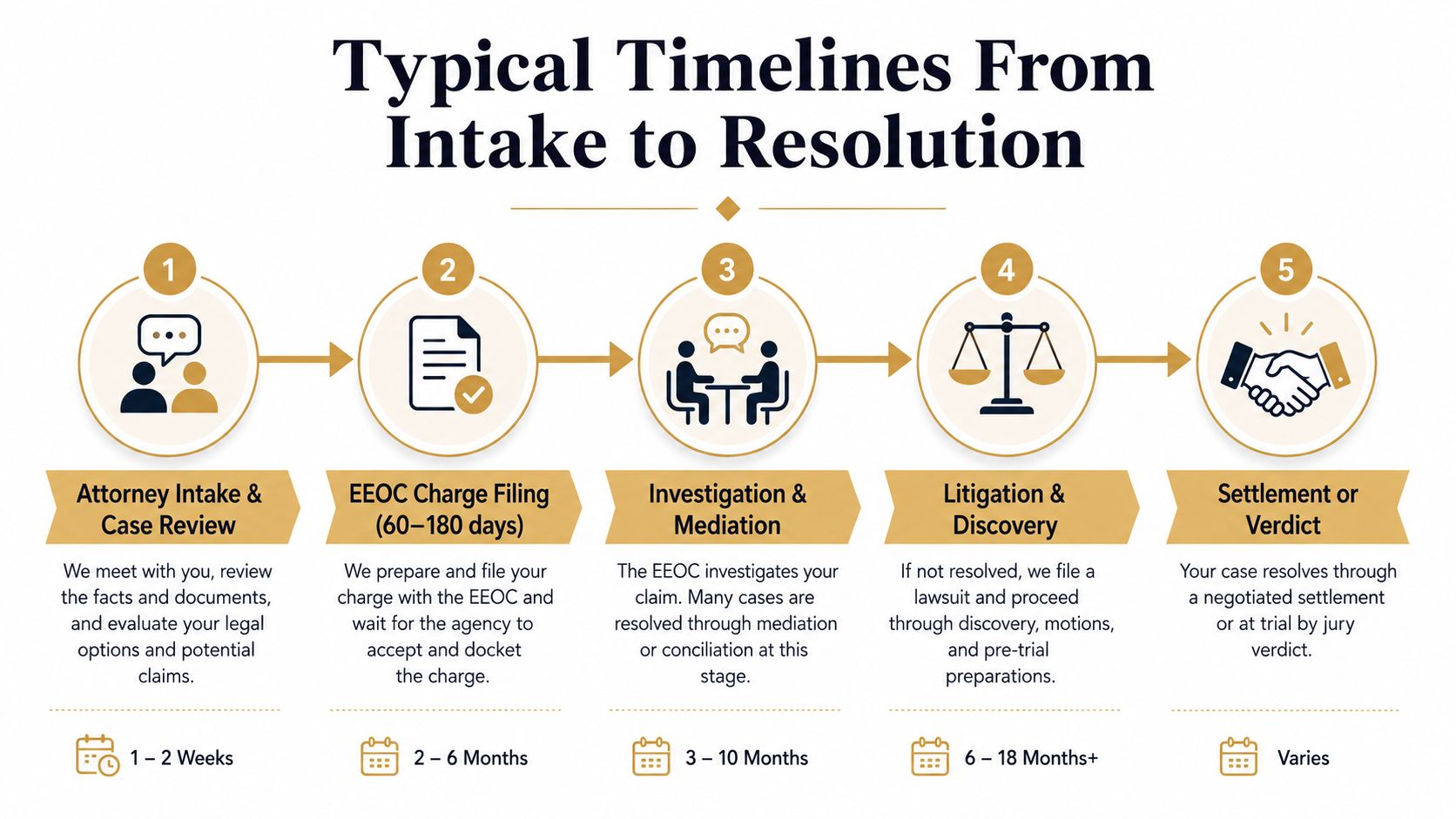
Timing changes negotiating power because each stage adds information, expense, and uncertainty for both sides. The planning framework identifies an EEOC charge window of 60 to 180 days, possible pre-litigation negotiation lasting 6 to 18 months, and litigation lasting 12 to 36 months if a lawsuit proceeds. These are planning ranges, not promises. The actual deadline depends on the claim and jurisdiction.
Where Negotiating Power Shifts
At intake, the employee often has the clearest memory of events, while the employer controls many relevant records. A charge or demand forces both sides to test the legal theory, available damages, and likely defenses. Mediation may support an early compromise when certainty is worth more than continued dispute.
Discovery can change the valuation again. Depositions, internal communications, comparator records, and performance files may strengthen or weaken the claim. Summary judgment briefing can show whether the case is likely to reach a jury. A scheduled trial also raises expected cost and reputational exposure, which may make a reasonable settlement more attractive.
Early resolution usually trades some potential upside for speed, certainty, and lower litigation burden.
The previously cited 60% to 90% mediation-resolution timeframe is not supported by the verified data and should not guide a case forecast. Verified EEOC enforcement figures show that administrative resolution remains significant. In fiscal year 2025, the agency secured $660 million for 17,680 workers, including $528 million through pre-litigation mediation, conciliation, and settlement (EEOC FY2025 recovery reporting).
The settlement payment process guide explains what follows after the parties reach an agreement. A lower-percentile case may resolve before filing, while a stronger claim may gain negotiating power during discovery. Neither route is automatically better. The practical choice turns on proof, urgency, cash needs, risk tolerance, and filing deadlines.
Evaluating Your Case and Choosing the Right Next Step
A credible valuation begins with evidence, not a demand number. Before negotiating, assemble the termination letter, performance reviews, compensation records, relevant communications, HR complaints, witness names, job-search history, and any agreement that governs employment or severance.
Then classify the claim. Is the theory discrimination, retaliation, breach of contract, wage-related retaliation, violation of public policy, or another protected-rights violation? Next, identify the controlling state, administrative agency, court, filing deadline, available remedies, and likely defenses. The same facts can produce different outcomes under different laws.
Create a three-case model
Write down assumptions for each scenario:
- Low case: What happens if the employer's stated reason is accepted and damages remain limited?
- Central case: What facts are most likely to survive negotiation and discovery?
- High case: What additional evidence or aggravating conduct would support enhanced remedies?
Include gross damages, likely mitigation, attorney fees, litigation expenses, tax treatment, delay, and the personal cost of continued proceedings. A settlement offer should be compared with the risk-adjusted value of continuing, not with the largest verdict found online.
Select the path that fits the evidence
An EEOC-focused route may suit a lower-complexity claim where administrative review is the practical first step. Negotiation may fit a mid-range dispute when both sides want privacy and closure. Litigation becomes more rational when the evidence is strong and the case includes willful conduct, substantial wage loss, multiple legal theories, or broader employer exposure.
Outh is one legal intelligence option that models claims with P10, P50, and P90 confidence intervals, organizes evidence, and uses settlement and public-data benchmarks to help users pressure-test a demand before choosing a strategy. It isn't a law firm, and its statistical estimates don't replace legal advice or a jurisdiction-specific case assessment.
The most defensible wrongful termination settlement amount is therefore a range with reasons behind it. Document the assumptions, challenge the weak points, and update the estimate as new records or testimony change the probability of proving liability.
Use Outh to organize your employment claim, compare evidence-supported settlement scenarios, and review the assumptions behind a potential demand. Visit the platform before sending a demand letter or accepting an offer, then take the resulting questions and documents to a qualified employment attorney.