 Outh
OuthSettlement Payment Process: A Complete Step-by-Step Guide
Learn how the settlement payment process works from agreement to disbursement. Stepwise guide covering escrow, liens, taxes, and payout timing.
Maria signed her personal injury settlement agreement and expected the hardest part to be over. Eleven weeks later, there's still no deposit in her account. She's wondering whether the money has been lost, delayed, or held by someone else.
That uncertainty is common because a settlement agreement and a settlement payment are separate events. Approval, appeals, lien resolution, tax review, claim validation, and payment processing can all stand between a signed document and cleared funds. Understanding each gate helps you identify delays early, answer administrator requests promptly, and ask your attorney specific questions instead of relying on a vague promise that payment is “in process.”
Table of Contents
- Why Understanding the Settlement Payment Process Matters
- What the Settlement Payment Process Actually Is
- How Agreement Terms Shape the Settlement Payment Process
- Escrow, Liens, and Taxes Before Funds Move
- Why Approved Settlements Still Take Months to Pay Out
- Comparing Disbursement Methods and Their Real Timing
- Documentation and Verification That Speed Up Your Payout
- Putting the Full Settlement Payment Process Together
Why Understanding the Settlement Payment Process Matters
A signed agreement proves that the parties have accepted legal terms. It doesn't necessarily mean the payer has released money, the court has approved the arrangement, or the administrator knows exactly where to send the claimant's net share.
In a class action, for example, the usual sequence includes preliminary approval, notice, claims submission, final approval, the appeal window, claims validation, payment calculation, and distribution. Neutral industry guidance places claims processing and validation at roughly 1 to 6 months, while payment calculation and distribution preparation can take roughly 1 to 3 months. These stages are summarized in guidance on the settlement distribution process.
The difference between legal completion and payment completion
Think of the settlement as a series of locked gates. The agreement opens one gate, but later gates may remain closed until:
- Court approval is final: The judge has approved the settlement and any appeal period has ended.
- Liens are resolved: Healthcare providers, insurers, government programs, employers, or other parties have confirmed what they're owed.
- The claim is validated: The administrator has verified eligibility, identity, contact information, and payment instructions.
- Taxes are handled: The distribution is classified and reported under the applicable rules.
- The payment is released: A bank transfer, wire, virtual card, or paper check moves through the chosen payment rail.
This explains why approval can be followed by additional months of administrative work. A review of the Kilmore East and Kinglake bushfire settlement noted that distribution took a further 29 months after settlement, demonstrating that approval isn't the same as completed payment. That post-approval problem is discussed in the review of settlement distribution delays.
Practical rule: Ask which gate is currently open, which gate is still closed, who controls it, and what document would move the process forward.
Knowing the stages also helps with personal budgeting. If you understand that funds may be held while liens are negotiated or bank details are verified, you can avoid treating the gross settlement amount as immediately available cash. You'll also be better prepared to respond when an administrator requests a tax form, identity document, updated address, or proof of authority.
What the Settlement Payment Process Actually Is
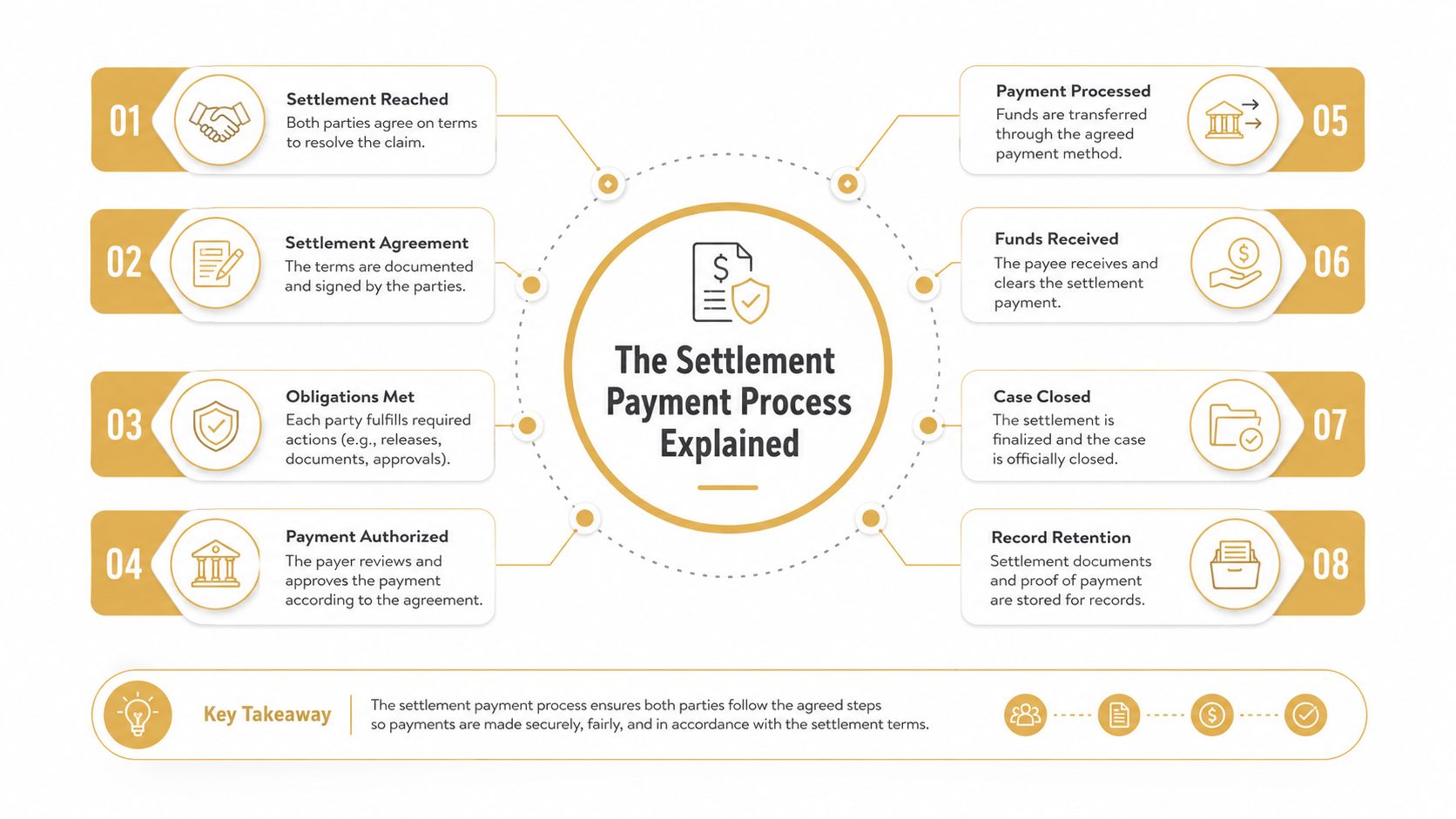
The settlement payment process is the operational chain that converts a legal promise into money received by the correct person. A useful analogy is a package moving through a sorting facility. The settlement agreement is the shipping label, the legal and financial checks inspect the contents, and the payment rail routes the cleared funds to the claimant's address.
The legal agreement determines what the payer owes. The payment workflow determines whether the money has been deposited, held in escrow, divided among recipients, or returned for correction.
The four main participants
The claimant is the recipient. The claimant may receive the full amount, or a net amount after attorney fees, expenses, liens, taxes, and other authorized deductions.
The defendant or insurer is usually the payer. It may send funds to an attorney trust account, a settlement administrator, an escrow agent, or a qualified settlement fund rather than directly to every claimant.
The settlement administrator coordinates eligibility, notices, claim review, address updates, payment calculations, and distribution. In a class action, the administrator may manage thousands of individual records under a court-approved plan.
The escrow agent or qualified settlement fund custodian holds and tracks settlement money before distribution. A paying agent may then issue checks, initiate electronic transfers, or provide another approved payment method.
Why the money may not come directly from the defendant
A defendant can fund the settlement while another entity handles the claimant-level work. That separation protects the accuracy of the distribution ledger and lets one administrator apply the same rules to every approved claim.
For a personal injury matter, the attorney may receive settlement funds into a trust account, resolve liens and case expenses, and send the remaining balance to the client. For a class action, the administrator may calculate each claimant's share and issue payments from a fund created for the settlement.
The lawsuit settlement process guide can help readers understand how attorney trust accounts, liens, fees, and expenses fit into this broader chain. The key point is simple: legal agreement, fund custody, claim validation, and final disbursement are connected but distinct workflows.
How Agreement Terms Shape the Settlement Payment Process
The same gross settlement figure can produce very different payment experiences depending on the agreement's wording. A personal injury settlement may state one total amount, but that figure can be divided among attorney fees, reimbursable expenses, medical liens, tax-sensitive categories, and the claimant's final share.
Start with the gross settlement amount. This is the amount the payer agrees to provide before authorized deductions. The claimant's net amount is calculated later. If the agreement provides a contingency fee, the attorney's percentage may be deducted first, followed by case costs such as filing fees, expert expenses, medical-record charges, or other approved disbursements.
Clauses that determine the net amount
Lien language is especially important. A settlement may reserve funds for Medicare, Medicaid, a hospital, a health insurer, an employer's subrogation claim, or another reimbursement demand. Until the responsible parties confirm the amounts, the administrator or attorney may hold the disputed portion instead of distributing the entire balance.
The payment schedule matters too. A lump-sum payment generally creates one principal distribution after the required conditions are satisfied. A structured settlement uses an annuity or scheduled payments, so the claimant won't receive the entire value at once. A hybrid arrangement may provide an initial payment followed by scheduled installments.
Release language can also control funding. If the defendant's obligation begins only after a signed release is received, a missing signature or incorrect execution can delay the transfer into escrow. Payee language affects the final step. A payment payable to the claimant alone may be eligible for direct deposit, while a payment requiring attorney, guardian, trustee, or representative involvement may require additional authority documents or a physical check.
| Settlement Clause Type | Example Language | Impact on Payment |
|---|---|---|
| Gross amount | “Defendant shall fund the settlement amount” | Establishes the amount entering escrow before deductions |
| Attorney fees | “Counsel may receive the agreed contingency fee” | Determines the fee deduction and payment priority |
| Case costs | “Approved litigation expenses shall be reimbursed” | Reduces the amount available for the claimant |
| Lien reserve | “Funds may be withheld for valid liens” | Can delay part or all of the net distribution |
| Structured payments | “Payments shall be made according to the schedule” | Prevents a single lump-sum transfer |
| Qualified settlement fund | “Funds shall be deposited into a qualified settlement fund” | Separates payer funding from claimant disbursement |
| Payee designation | “Payment shall be issued to the named payee” | Controls whether electronic payment or additional authority is required |
A qualified settlement fund can make the workflow more orderly, but it may add an administrative stage. Expenses, taxes, records, and approved distributions must be tracked before the custodian can release each payment. Read the payment provisions as operational instructions, not just legal boilerplate.
Escrow, Liens, and Taxes Before Funds Move
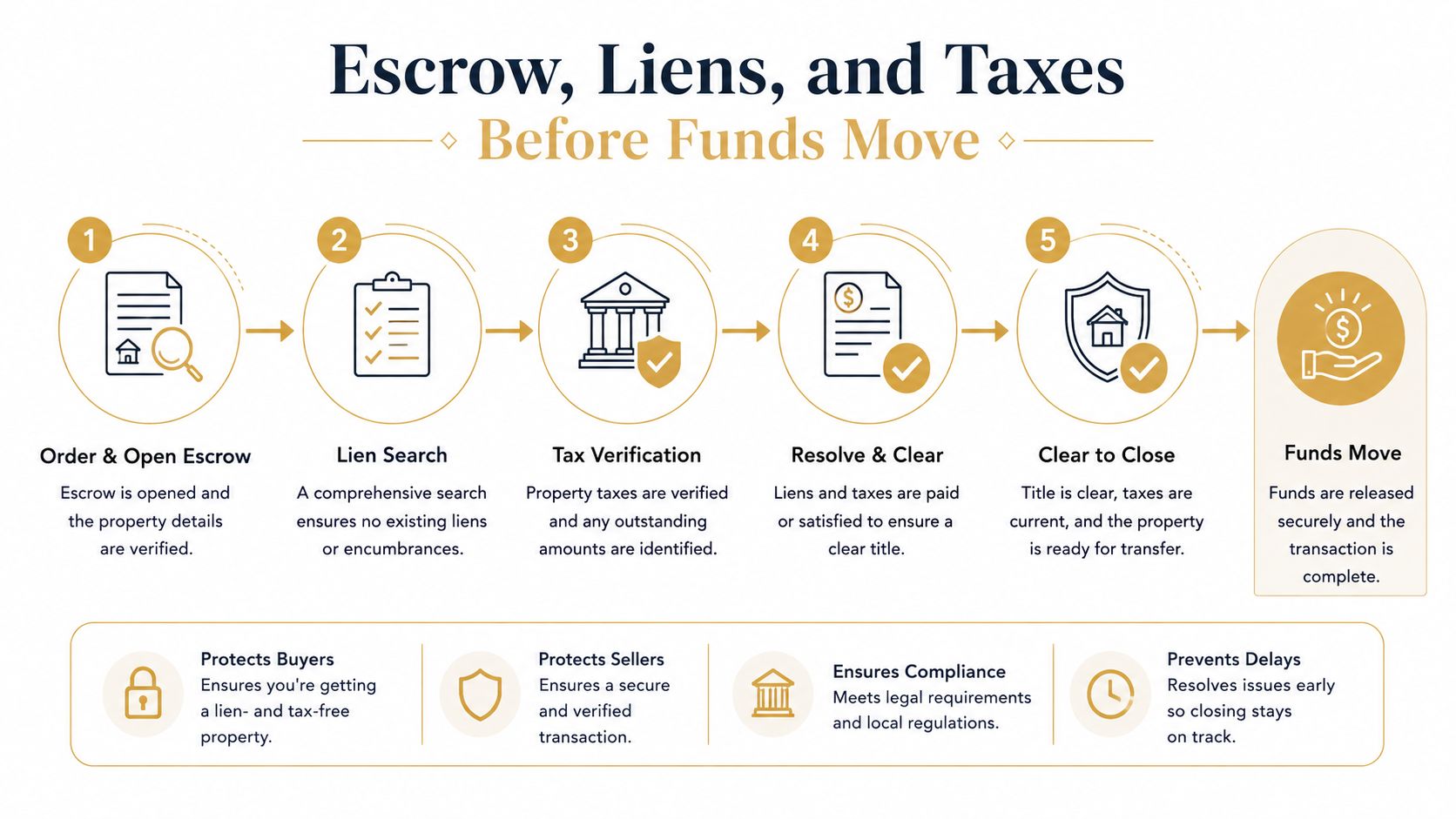
A signed settlement doesn't automatically create cleared money. Three practical controls usually sit between approval and disbursement: escrow custody, lien resolution, and tax handling.
First, the defendant or insurer funds the agreed gross amount into an account controlled by the administrator, attorney, escrow agent, or qualified settlement fund. The custodian records the deposit against a settlement ledger. This step confirms that the money is available, but it doesn't determine how much each claimant will receive.
Escrow protects the distribution process
Escrow separates the payer's obligation from the claimant-level calculations. The administrator can verify the settlement fund, track expenses, reserve amounts for unresolved claims, and authorize payments according to the agreement and court order.
For a claimant, the useful question isn't only “Has the defendant paid?” Ask whether the funds have been received into the account, whether they're being held in a qualified settlement fund or attorney trust account, and whether any portion is reserved for unresolved obligations.
Liens can hold up the net payment
A lien or reimbursement claim asserts that another party may be entitled to part of the recovery. Common examples include:
- Healthcare claims: A provider or insurer seeks repayment for treatment connected to the injury.
- Government recovery claims: Medicare or another public program requests reimbursement for conditional payments.
- Attorney liens: Prior counsel asserts a right to fees or expenses.
- Support obligations: Child support arrears may affect the amount released.
- ERISA claims: An employer-sponsored plan may seek reimbursement under its plan terms.
The responsible professionals typically identify the claim, verify its legal basis, request a final amount, negotiate where appropriate, and pay the accepted amount from escrow. A dispute can delay only a reserved portion, or it can delay the entire distribution if the administrator can't safely determine the claimant's net entitlement.
Tax classification affects reporting
Tax treatment depends on the nature of the payment and the facts of the claim. Physical-injury damages and emotional-distress amounts may be treated differently under IRC §104(a)(2), while other components can have different reporting consequences. Administrators may issue information returns for taxable portions, and a claimant should ask a qualified tax professional how the settlement applies to their circumstances.
The employment lawsuit settlement guide provides additional context for understanding how fees, deductions, and settlement administration can interact. Don't assume that the amount shown in the agreement is the amount you can spend, or that the administrator's tax form resolves every personal tax question.
Why Approved Settlements Still Take Months to Pay Out
You receive notice that the court approved your settlement, yet the money does not appear in your account. That timing is not necessarily a contradiction. Legal finality doesn't equal payout finality. Approval resolves the agreement's legal status, while administrators may still validate claims, confirm addresses, resolve liens, calculate individual shares, and prepare payment files.
Claims processing and validation may take 1 to 6 months, followed by roughly 1 to 3 months for payment calculations and distribution preparation. The personal injury settlement timeline guide helps place those stages in context. The transfer itself may be quick once the file is cleared, but several earlier steps must finish first.
The delay usually comes from a chain of dependencies
An appeal window can hold up distribution after a judge enters an approval order. The administrator may need to wait until the settlement is final, or obtain permission to distribute while a remaining issue is pending. Approval is therefore a milestone, not always the release instruction.
Lien resolution creates another review path. The claimant's attorney or administrator may request records from healthcare providers, insurers, government programs, or benefit plans. If a claimed amount does not match the available records, the parties may need clarification before the administrator can calculate the claimant's net payment.
Validation issues are more routine, yet they can stop a payment file. A name may differ from the bank account, an address may be outdated, a tax form may be missing, or a routing number may be incorrect. The administrator then pauses the payment, requests a correction, and runs the file again.
Ask for the exact pending item, not a general status update. “What document, approval, or third-party response is currently preventing release?” usually produces a more useful answer than “When will I be paid?”
The final delay can come from the payment operation itself. Once legal and administrative checks are complete, electronic rails may move cleared funds promptly. A paper payment still requires printing, mailing, receipt, deposit, and bank processing. A returned check or outdated address starts another research and reissue cycle.
Track each milestone separately: the approval date, appeal status, lien status, validation status, selected payment method, and expected release date. That record helps distinguish a legal hold from a missing document or a payment file that has not yet been released.
Comparing Disbursement Methods and Their Real Timing
The payment rail matters after the administrator has cleared the claim. Electronic payment portals can reduce distribution from weeks or months to 24 to 48 hours for some payouts, while traditional checks remain exposed to printing, mailing, reissue, and banking-hold delays, as described in this comparison of mailed checks and electronic payment portals.
That doesn't mean every electronic payment arrives immediately. The account must be verified, the payment file must be approved, and the receiving bank must accept the transaction. Still, the method you choose can affect the final part of the wait.
| Method | Typical Timing | Cost | Best For |
|---|---|---|---|
| ACH transfer | Often faster than mailed checks once verified | Often no claimant fee | Claimants with a verified domestic bank account |
| Virtual card | Can arrive quickly through a digital portal | Terms vary by issuer | Small or urgent payments where card use is practical |
| Wire transfer | Usually arranged directly with the administrator or bank | May involve a fee | Large or cross-border payments requiring direct bank settlement |
| Paper check | Slower because it must be printed, mailed, deposited, and cleared | Usually low administrative cost, but delay risk is higher | Claimants unable to use electronic methods |
Choose based on risk, not speed alone
ACH is usually the practical choice when the claimant has a stable bank account and can verify every digit. A virtual card may be convenient, but the claimant should review expiration, activation, spending, and transfer terms before selecting it.
A wire can be appropriate for a large or international payment, but the claimant should confirm the receiving bank's requirements and any charges before authorizing the transfer. Paper checks may be necessary for accessibility or administrative reasons, yet they carry the greatest exposure to an outdated address, lost mail, reissue work, and deposit holds.
Before choosing a method, ask three questions: When does the administrator consider the payment sent, what happens if the payment is rejected, and who pays any fee?
Never email bank details in response to an unverified message. Use the administrator's secure portal or a confirmed telephone number, and check that the payee name matches the account holder.
Documentation and Verification That Speed Up Your Payout
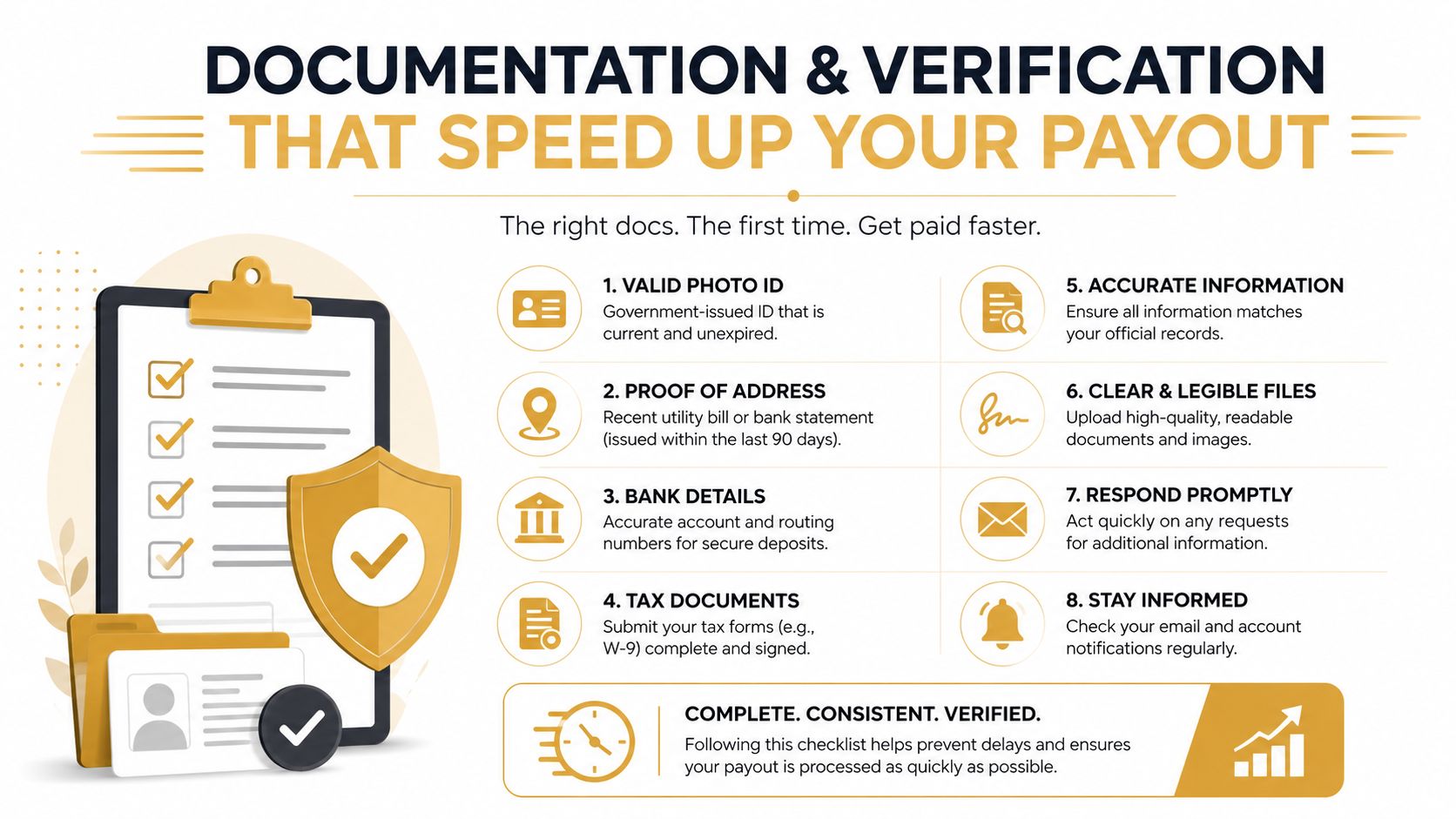
Administrators can't release money confidently when the identity, tax record, or payment destination is incomplete. The most effective preparation is to assemble the documents before approval, then update them if anything changes.
Common requests include:
- Tax form: A W-9 for a U.S. person, or a W-8BEN when applicable to a non-U.S. individual.
- Identity proof: A government-issued photo ID that matches the claimant's legal name.
- Settlement documents: The signed agreement, release, and any required acknowledgment.
- Bank verification: A voided check or bank letter showing the account holder, account number, and routing number.
- Representative authority: Power of attorney, guardianship, trustee, or estate documents when someone else receives or manages the funds.
- Contact details: A current mailing address, telephone number, and secure email address.
Use a pre-submission check
Small mismatches create avoidable review cycles. Compare the legal name on the settlement record with the name at the bank. Check the tax identification number carefully, confirm the routing and account numbers from a trusted bank document, and make sure the administrator has your current address.
Respond promptly when the administrator requests clarification. A fast response won't eliminate court, lien, or fund-level delays, but it can prevent your claim from sitting in a correction queue.
Protect sensitive information
Use only the administrator's verified portal for tax forms and banking details. Confirm the sender before opening attachments, and don't send a Social Security number or account information to an address copied from an unexpected message.
Keep a record of every submission. Save the date, document name, confirmation number, and the person or portal that received it. If a payment is delayed, that record lets you show that validation materials were complete and ask whether the delay is now with the court, a lienholder, the fund custodian, or the payment rail.
Putting the Full Settlement Payment Process Together
The journey starts with eligibility or claim review, then moves through agreement signing, release execution, payer funding, escrow custody, court finality, lien and tax review, claimant validation, payment calculation, and disbursement. Not every matter uses identical steps, but the underlying logic is consistent: the money moves only after the legal right, amount, recipient, and payment destination are sufficiently clear.
Use this practical tracking sequence:
- Agreement: Confirm the settlement terms, deductions, release, and payment schedule.
- Funding: Verify whether the payer has deposited the gross amount.
- Approval: Check whether final approval and any appeal period are complete.
- Liens: Ask whether healthcare, government, benefit-plan, or other claims remain open.
- Tax review: Confirm which forms or classifications the administrator requires.
- Validation: Submit identity, tax, authority, and bank documents.
- Calculation: Request confirmation that the net distribution has been approved.
- Disbursement: Confirm the selected method, release date, and reissue procedure.
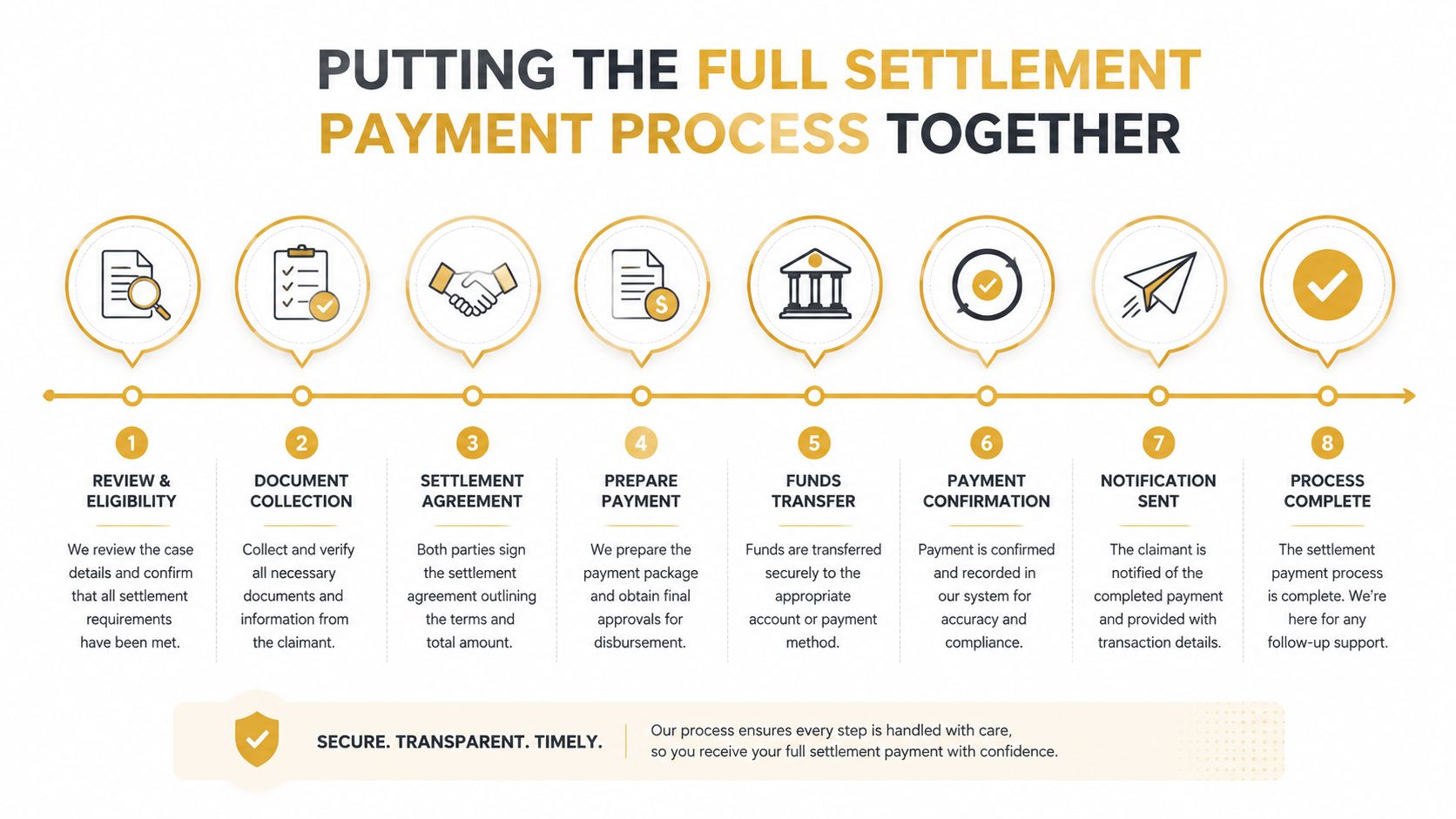
The most common preventable problems are incomplete paperwork, unresolved liens, unclear tax documents, stale contact details, and an unsuitable payment method. Match each problem to one action: submit a complete packet, request a lien status, ask what tax form applies, update your records, and choose a verified electronic rail when available.
A milestone dashboard can turn an opaque wait into a measurable process. Record the expected date for each gate, compare it with the actual status, and escalate the specific overdue item rather than asking only for a general update. Outh offers tools for legal-claim discovery, evidence organization, plain-language email interpretation, valuation estimates, and timeline benchmarking, which can help claimants organize the information surrounding a potential or active civil claim.
If you're waiting on a settlement, visit Outh to organize claim evidence, understand legal communications, and track the factors that can affect value and timing. Use the platform to turn scattered updates into a clearer record for conversations with your attorney or settlement administrator.