 Outh
OuthAssociate Attorney vs Attorney: Roles, Pay, and When to Hire
Associate attorney vs attorney explained clearly. Compare roles, billing, experience, and outcomes so you know exactly who to hire and what to expect.

You're comparing two lawyers, and the firm keeps using the word “attorney” as though it answers the question. It doesn't. You need to know who will draft the documents, who will make the strategic decisions, who will appear in court, and who will take responsibility if the matter turns difficult.
The associate attorney vs attorney distinction is less about legal authority than about career stage, supervision, cost, and accountability. An associate is a licensed lawyer working inside a firm without an ownership interest. “Attorney” is the broader professional title, covering associates, partners, counsel, and solo practitioners. That difference should shape how you hire, not merely how you read a law firm biography.
Table of Contents
- Why the Associate Attorney vs Attorney Question Actually Matters for Clients
- What Each Term Actually Means in U.S. Law Firms
- Side-by-Side Comparison of Roles and Responsibilities
- Experience Levels and the Associate Seniority Gradient
- When to Hire an Associate Attorney Versus a Senior Attorney
- Billing, Fees, and Cost Transparency for Each Role
- How to Decide Which Attorney You Actually Need
- Questions to Ask Before You Sign the Engagement Letter
Why the Associate Attorney vs Attorney Question Actually Matters for Clients
Clients don't hire a title. They hire work product, judgment, responsiveness, and someone accountable for the result. If you focus only on whether a lawyer is called an associate or an attorney, you can miss the more important question: which lawyer will handle the part of the matter that creates risk?
A junior associate may perform the research, prepare the first draft, organize discovery, and assemble the factual record. A partner may review the work, set the litigation strategy, negotiate with opposing counsel, and decide whether the case should settle or proceed. A senior associate may occupy the middle ground, handling substantial responsibility while still operating within a partner-led structure.
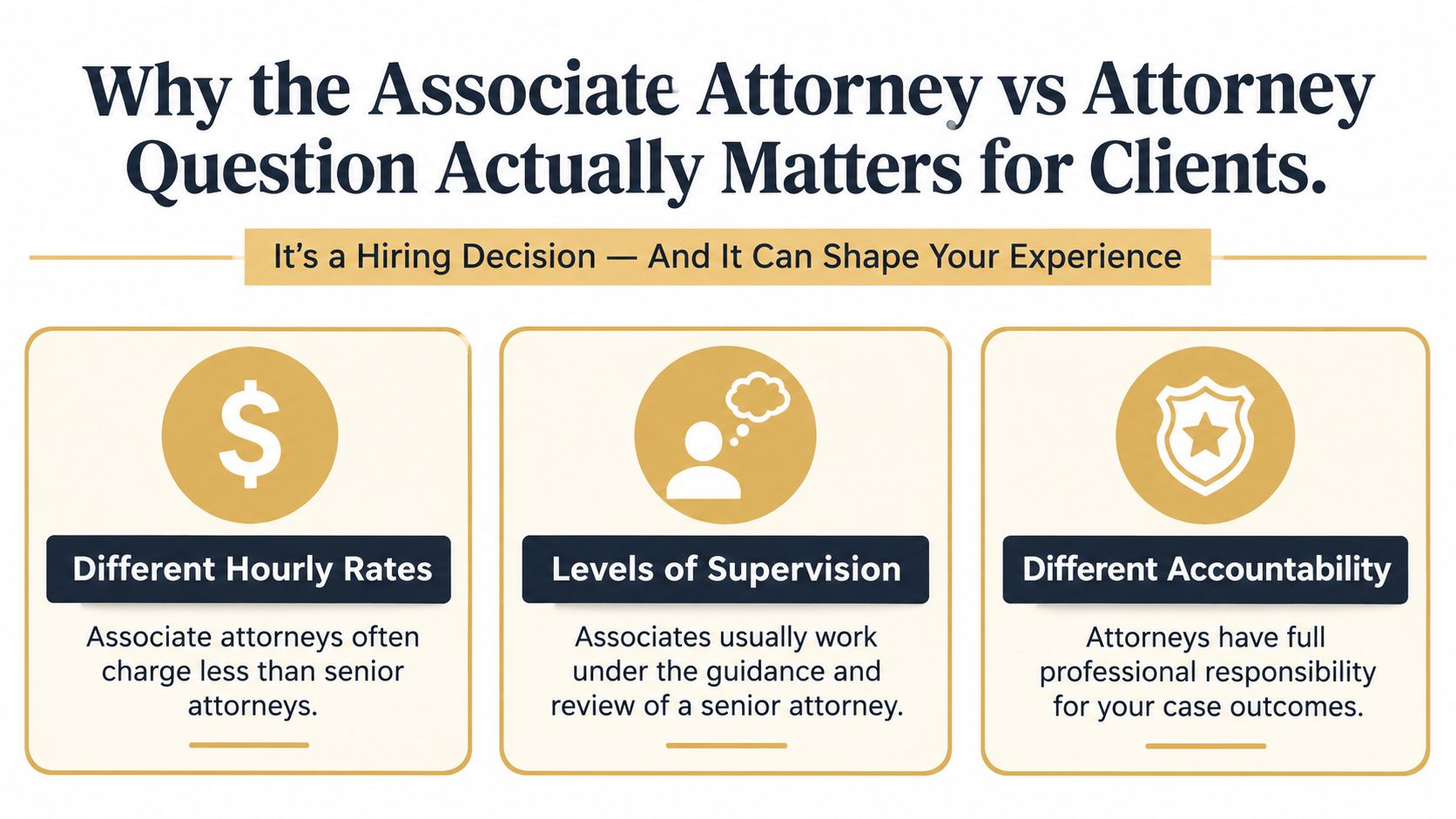
Four questions expose the real staffing model
Ask the firm these questions before you sign:
- Who drafts the key work product? Find out who will write the complaint, motion, contract, demand letter, or appellate brief.
- Who appears in court? The lawyer doing the drafting may not be the lawyer arguing the motion, taking the deposition, or trying the case.
- Who owns the strategy? Determine whether a partner will make the major decisions or merely receive occasional updates.
- Who is accountable to you? You should know the lawyer responsible for communication, deadlines, quality control, and escalation.
The answers reveal more than the label. A matter staffed by an associate with active partner supervision can be efficient and sound. A matter assigned to an inexperienced associate with little review can create avoidable risk. Conversely, paying partner rates for routine document work may be unnecessary.
Client rule: Hire the level of judgment your matter requires, then confirm who will perform each task.
Cost, supervision, and accountability are the three practical lenses. Resources such as Outh's guide to online legal help can help you prepare questions and identify the kind of assistance your situation may require. The final decision, however, should come from the staffing plan in your engagement letter, not from a polished biography.
What Each Term Actually Means in U.S. Law Firms
Attorney is the umbrella term. In ordinary U.S. usage, it describes a licensed legal professional authorized to practice under the rules of the relevant jurisdiction. That attorney may be an associate, partner, counsel, solo practitioner, or another lawyer with a different firm title.
Associate attorney describes a position inside a law firm. An associate is generally a licensed lawyer employed by the firm who doesn't hold an ownership interest. Associates perform core legal work, usually under some level of supervision, and may be working toward partnership or another senior role. The title doesn't create a separate license and doesn't reduce the lawyer's underlying authority to practice law.
The distinction becomes clearer inside the firm hierarchy. Earlier large-firm career structures often treated partnership as a relatively short progression. By the late 1980s, the path had lengthened, and firms added more attorney tiers between associate and equity partner. By the early 2000s, firms commonly separated equity partners, who share profits, liability, and voting rights, from nonequity or income partners, as described in this overview of lawyer compensation and firm progression.
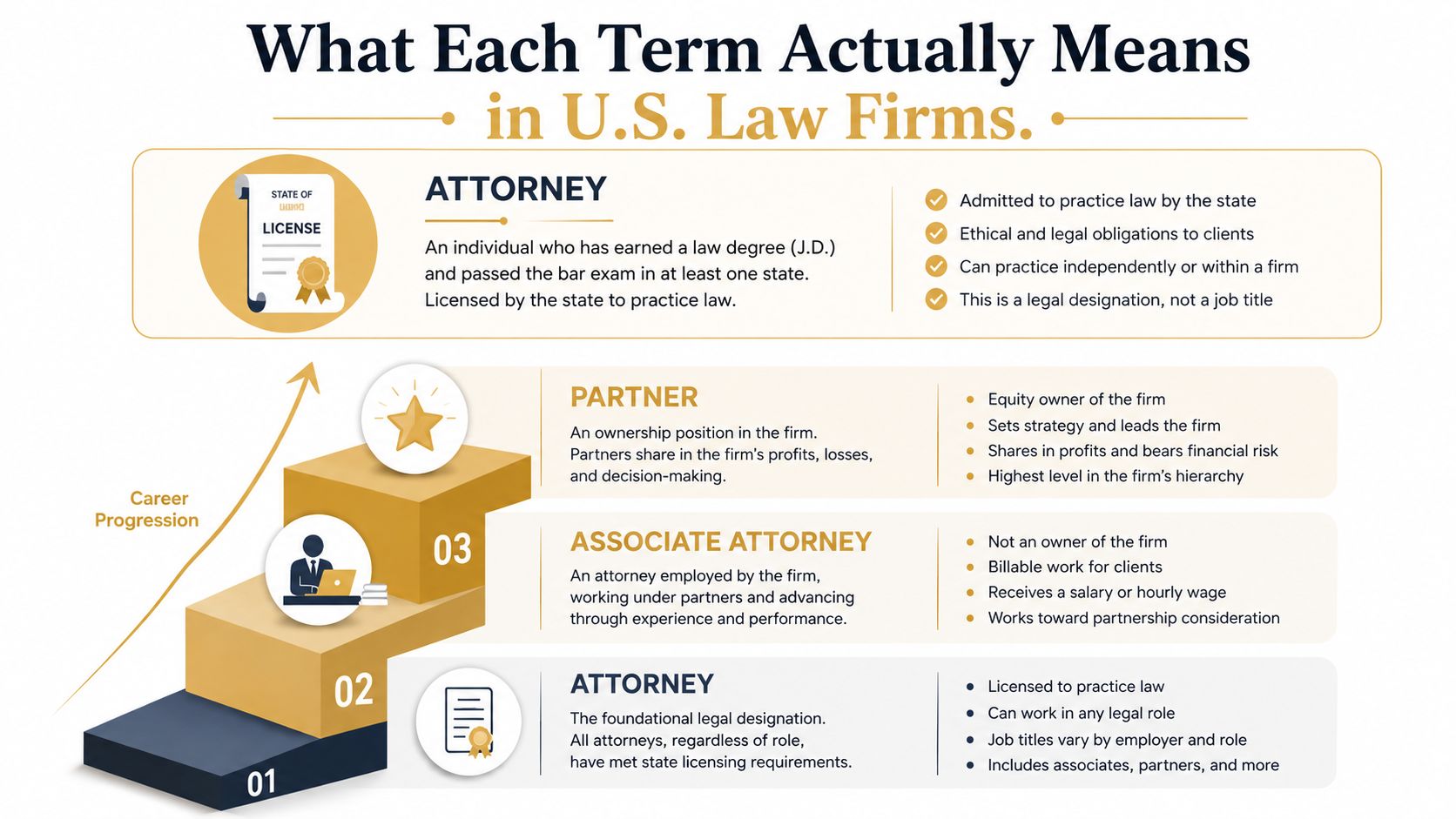
Pay reflects the career stage, not a different license
The compensation gap reinforces the point. BigLaw compensation data places junior associates with 0 to 3 years of experience around $225,000 to $260,000, mid-level associates with 4 to 6 years around $310,000 to $390,000, and senior associates with 7 or more years around $420,000 to $435,000. Equity partners in large firms can reach $1.5 million to $3 million or more, according to BCG Attorney Search's compensation analysis.
Major U.S. labor data reports a $159,670 median annual wage for lawyers in May 2025, with a $78,360 10th-percentile wage, a $351,600 90th-percentile wage, and about 754,500 employed lawyers nationwide, as summarized in this associate attorney salary guide. Those figures describe lawyers broadly, not one uniform associate role.
The practical conclusion is simple: every associate attorney is an attorney, but not every attorney is an associate.
Side-by-Side Comparison of Roles and Responsibilities
The most useful comparison isn't “who is a real lawyer?” Both roles involve licensed legal professionals. The useful comparison asks who has autonomy, who receives supervision, who owns the matter, and who answers to the client when a decision matters.
| Dimension | Associate Attorney | Senior Attorney / Partner |
|---|---|---|
| Autonomy | Handles assigned work within a broader plan, with autonomy increasing through experience | Sets or approves strategy and exercises broad control over the matter |
| Supervision | Usually works under partner, counsel, or senior attorney review | Supervises others and carries ultimate responsibility for strategic decisions |
| Billable work | Often performs research, drafting, discovery, preparation, and other time-intensive tasks | May focus on strategy, negotiations, court appearances, client counseling, and review |
| Ownership of the matter | Usually isn't an owner and may be one member of the staffing team | May own the client relationship, originate the work, or hold an equity interest |
| Accountability to the client | Reports through the assigned team and escalates major issues | Usually serves as the primary accountable lawyer for strategy, communication, and escalation |
The associate often creates the work product
Associates commonly prepare the first version of a motion, organize discovery, research legal authority, draft interrogatories, and build the factual chronology. Those tasks can require significant legal skill, particularly when the associate understands the record and practice area.
A partner's review isn't automatically a sign that the associate's work is weak. It can be the firm's quality-control system. The problem arises when nobody tells you whether the review is substantive, occasional, or limited to formatting and filing mechanics.
The senior lawyer owns the hard calls
Partners and senior attorneys typically control the decisions that can change the outcome: whether to file, what claims to pursue, how aggressively to negotiate, which expert to retain, and whether a settlement reflects the client's objectives. They may also sign filings, appear in court, and deal directly with opposing counsel.
That division creates a real trade-off. You may receive efficient written work from an associate while paying for senior judgment when the matter reaches a strategic milestone. You should know where those milestones occur and whether both lawyers bill time.
The hiring decision is about accountability, not prestige. Ask who owns the judgment call, not merely whose name appears on the firm website.
Experience Levels and the Associate Seniority Gradient
“Associate” describes a career stage, not a fixed level of capability. A new associate and a senior associate may share the same title while differing sharply in independence, client contact, judgment, and accountability. Hire for the work product and supervision the matter requires, not for the label alone.
Large-firm compensation data also shows a clear seniority gradient. Published bands classify 0 to 3 years as junior, 4 to 6 years as mid-level, and 7 or more years as senior. Those bands reflect meaningful differences in experience and expected responsibility.
| Seniority Tier | Approx. Base Salary | Typical Responsibilities |
|---|---|---|
| Junior associate, 0 to 3 years | $225K to $260K | Research, drafting, discovery, document review, and case preparation under supervision |
| Mid-level associate, 4 to 6 years | $310K to $390K | More independent motion practice, depositions, case management, and client-facing work |
| Senior associate, 7 or more years | $420K to $435K | Substantial matter ownership, advanced strategy support, complex negotiations, and lighter oversight |
Junior associates build the record
Junior associates usually perform best when the assignment has a defined structure and a senior lawyer gives clear direction. Appropriate work includes legal research, document analysis, discovery preparation, factual chronologies, and first drafts.
Lower autonomy does not mean low value. A junior lawyer can produce excellent work when the firm allows adequate time and provides meaningful review. The fit becomes weaker when the matter turns on novel legal questions, urgent judgment calls, or courtroom performance.
For a client, the practical question is who will review the work and how closely. Confirm whether review includes legal analysis, factual accuracy, and final strategy, rather than assuming a senior name on the matter guarantees active supervision.
Mid-level and senior associates carry more responsibility
Mid-level associates often manage substantial portions of a matter and communicate directly with clients and opposing counsel. Senior associates may coordinate daily case activity, prepare witnesses, handle depositions, and recommend a course of action for partner approval.
The title still leaves gaps. Ask the firm to identify the assigned lawyer's actual duties, decision-making authority, and review structure. A senior associate may be the strongest operational choice for a substantial matter, while a partner remains necessary for strategy, settlement authority, or a high-stakes judgment call.
When to Hire an Associate Attorney Versus a Senior Attorney
Start with the work, not the hierarchy. A routine document package doesn't need the same staffing model as a trial, and a complex regulatory investigation shouldn't be delegated just because an associate's rate is lower.
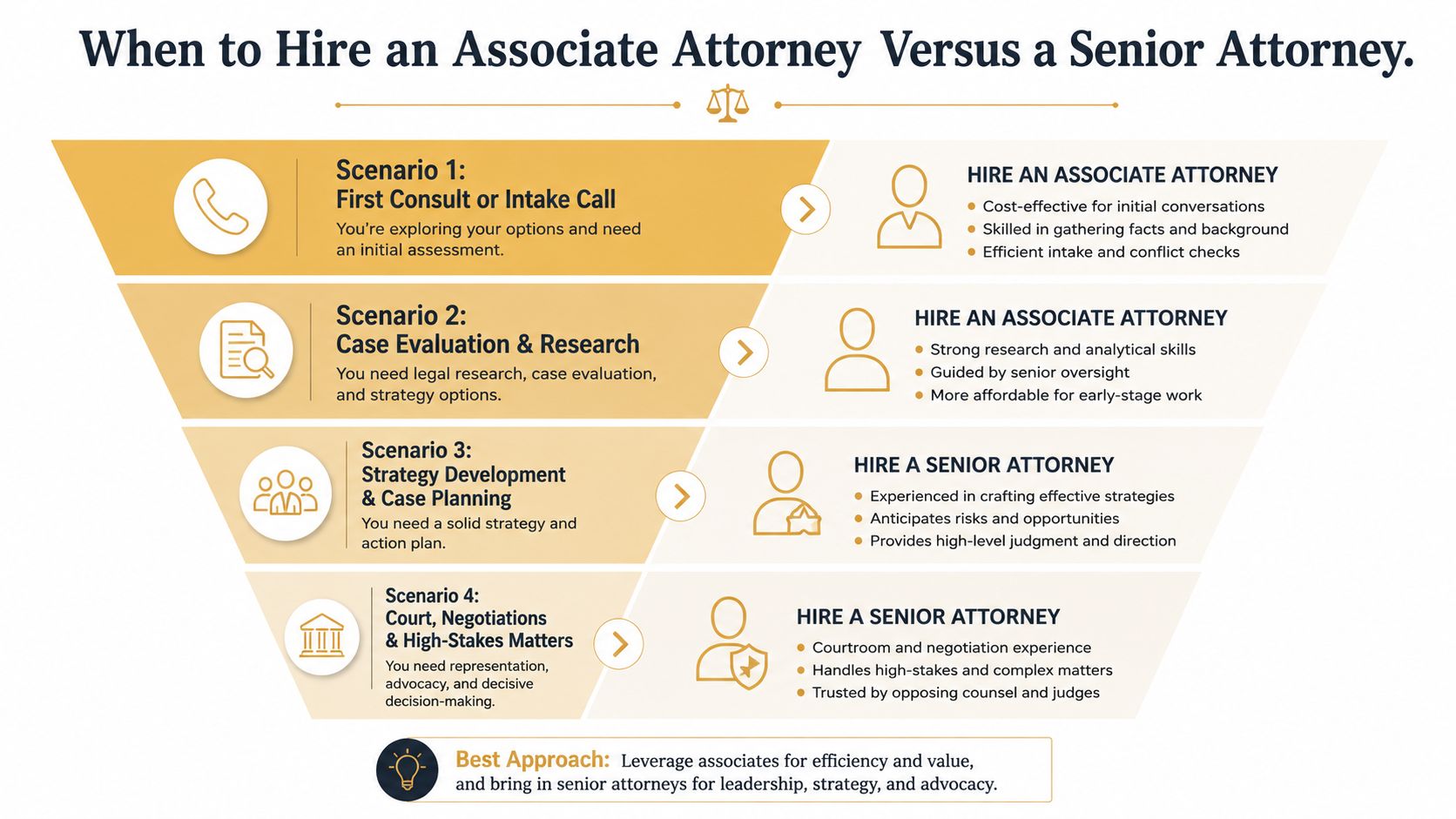
A routine first conversation
For a first consultation about a defined, routine issue, a junior associate or another supervised lawyer may be entirely appropriate. Examples include gathering facts for a simple estate-planning matter or discussing the procedural requirements of an uncontested divorce.
The lawyer's value at this stage is organization, issue spotting, and accurate communication. Ask whether a more senior attorney will review the advice before documents are finalized. If the firm can't explain that process, the lower rate isn't enough.
Defined filings and submissions
LLC formation, routine regulatory submissions, and basic trademark filings often fit a mid-level associate's skill set. The work is structured, but details matter, and a lawyer with practical experience can identify problems that a newer associate may miss.
You don't necessarily need the firm's most senior partner drafting every form. You do need someone who understands the filing requirements, checks the facts, and knows when an unusual issue requires escalation.
Trial preparation and appellate work
Trial preparation, expert depositions, and appellate briefs require more than document production. They demand strategic authorship, judgment under pressure, and credibility with the court or opposing counsel.
For these matters, retain a senior associate or partner who will personally carry the critical work. A junior associate can support the record and research, but shouldn't be the only lawyer shaping the argument or preparing the witness strategy.
High-stakes disputes and investigations
Complex litigation, business-threatening disputes, and regulatory investigations warrant a senior attorney with relevant subject-matter experience. The lawyer should be able to explain the exposure, identify the decision points, coordinate the team, and communicate difficult advice without hiding behind layers of staffing.
A name partner isn't automatically the right choice. The right senior lawyer is the one with relevant experience who will remain involved. Require that commitment in writing.
Billing, Fees, and Cost Transparency for Each Role
Legal fees reflect both the pricing model and the staffing model. An hourly invoice can include extensive associate work, partner review, conferences among lawyers, and administrative time unless the engagement terms limit what the firm bills.
| Fee Model | Associate Rate Range | Partner Rate Range | Best Use Case |
|---|---|---|---|
| Hourly billing | $250 to $600 | $600 to $1,200 or more | Matters with uncertain scope, including litigation and investigations |
| Flat fee | Usually included in one project price | Usually included in one project price | Defined work such as incorporations or uncontested divorces |
| Contingency arrangement | Usually part of the firm's overall fee structure | Usually part of the firm's overall fee structure | Plaintiff-side personal injury and some commercial litigation |
The hourly ranges and other fee figures above come from the supplied briefing data. They aren't universal rates. Geography, practice area, firm size, urgency, and the lawyer's experience can change the quote substantially.
Hourly arrangements
Associates often bill the majority of the working hours because they conduct research, draft documents, review records, and prepare discovery. Partners may bill fewer hours at higher rates for strategy, negotiations, supervision, and appearances. Unless the firm uses task-based pricing or a cap, you may pay for both layers.
Ask whether the firm offers a blended rate, a matter budget, or a cap on certain tasks. A blended rate can simplify forecasting, but it can also hide who is doing the work. Require staffing transparency and request notice before the firm changes the assigned lawyer.
Flat fees and contingency arrangements
A flat fee works best when the scope is narrow and the likely tasks are clear. The agreement should state what the fee includes, what triggers additional charges, and whether court appearances, revisions, filing fees, or unusual complications fall outside the package.
Contingency matters require a different conversation. The percentage is only one issue. You also need to understand case expenses, when they are deducted, what happens if the case doesn't resolve, and which lawyer will handle discovery, negotiations, and trial. This explanation of lawyer contingency fees can help you prepare for that discussion.
Before signing, ask for the staffing plan and the fee plan together. A low associate rate doesn't protect your budget if the file accumulates unplanned partner review.
How to Decide Which Attorney You Actually Need
Use three rules. They're more reliable than choosing the lawyer with the most impressive title.
Rule one, match routine work with efficient staffing
If the matter is routine and document-driven, a junior or mid-level associate is often the sensible choice. The engagement should include meaningful review at important milestones, but you don't need a senior lawyer spending every hour on standardized preparation.
This approach works for matters with established procedures, predictable documents, and limited strategic uncertainty. The risk is not the associate's title. The risk is inadequate supervision or unclear escalation.
Rule two, pay for judgment when strategy controls the outcome
If the matter involves settlement negotiations, courtroom advocacy, novel legal theories, expert selection, or serious reputational exposure, retain the senior attorney who will carry the file. You need that lawyer's judgment available when facts change and the opposing side applies pressure.
A senior lawyer who delegates routine preparation can still be the right choice. Insist that the senior lawyer personally handles strategy calls, major negotiations, and critical appearances rather than merely lending a name to the engagement.
Rule three, compare firm structures before assuming senior means expensive
A large firm may place an associate on most tasks and a partner on review. A solo practitioner or boutique may have the senior lawyer doing the work directly. The second structure can offer stronger accountability and a clearer budget, even if the lawyer's hourly rate appears higher.
The best arrangement is often hybrid: an associate serves as the day-to-day point of contact, while a senior attorney controls strategy and reviews key deliverables. Ask the firm to identify the exact handoff points. Outh's lawyer-finding guide is one place to organize the experience, practice-area, and staffing questions you should raise with candidates.
Questions to Ask Before You Sign the Engagement Letter
Treat the engagement letter as a staffing document, not just a payment document. If it doesn't identify who will do the work and who will supervise the matter, ask for an amendment or written clarification before you sign.
Identify the lawyers
Ask for the name of the lawyer primarily responsible for the file, the lawyer's bar admission year, and the senior attorney who will review strategy. Confirm who will attend hearings, take depositions, sign filings, and negotiate with the opposing side.
Pin down the billing mechanics
Request the staffing attorney's hourly rate, the supervising partner's rate, and any blended rate. Confirm whether the firm bills in tenths or quarters of an hour, how often invoices arrive, and whether the firm will notify you before exceeding a budget.
Set review and escalation points
Ask whether the firm caps associate hours before partner review begins. Find out who decides when a new legal issue, settlement offer, expert dispute, or court deadline requires senior involvement.
Protect communication quality
Agree on the expected response time, the primary contact, and the backup contact. Ask whether you'll receive status updates, how the firm handles urgent developments, and whether you can speak directly with the supervising attorney when a decision affects the case.
Explore alternatives
For defined work, ask about a flat or capped fee. For litigation, ask whether a hybrid arrangement is available and how expenses are handled. Confirm whether the firm carries malpractice insurance applicable to the representation.
Get every answer in writing. A verbal promise that “the partner will stay involved” is weaker than a named responsibility in the engagement letter.
Outh helps people compare attorney matches, experience indicators, and fee information before choosing representation. Visit Outh to prepare your matter, review potential lawyer matches, and ask sharper questions about who will handle the work.