 Outh
OuthTitle IX Complaint Process: Steps, Timelines & Tips
Learn the steps, timelines, and evidence tips for a Title IX complaint process. Get the guidance you need to file effectively in 2026.
The most popular advice about the Title IX complaint process is also the most dangerous: “Report it to your school and wait for the investigation.” A report doesn't necessarily open a formal case. Schools may offer supportive measures, conduct an initial assessment, or steer the matter toward an informal resolution without producing a finding on whether a violation occurred.
The federal docket shows why this distinction matters. In FY 2023, the U.S. Department of Education's Office for Civil Rights resolved 7,757 Title IX complaints and handled 8,151 complaints raising Title IX issues. In FY 2022, OCR received 9,498 Title IX-related complaints, representing 48% of all OCR complaints that year, according to OCR's annual report. At the school level, however, many matters end before a formal investigation begins. Your first priority is to identify the rule set governing your case, put your request in writing, preserve evidence, and make the school explain every procedural decision.
Table of Contents
- Why Most Title IX Complaints Never Reach Formal Investigation
- Navigating the 2025 Title IX Rule Changes
- Filing Your Formal Complaint and Triggering the Investigation
- Building Your Evidence Portfolio for the Investigation Phase
- Understanding Realistic Timelines and School Discretion
- Preparing for Hearings and Appeals Before You Need Them
Why Most Title IX Complaints Never Reach Formal Investigation
A report can alert a school to misconduct without opening a formal case. A formal complaint does something different. It asks the institution to apply its grievance procedure, investigate the allegations, and reach a determination under the rules governing the case. After the 2025 regulatory disruption, that distinction matters even more because schools may use different procedures for matters with different filing dates and procedural histories.
A peer-reviewed study of incidents reported to Title IX coordinators found that more than 90% were resolved through informal resolutions, including support and resources rather than formal investigations and conduct findings. The finding appears in the PubMed record for the study. Informal support can serve a student who wants schedule changes, counseling referrals, academic adjustments, or safety planning without an adjudicated outcome. It fails the student when administrators treat a request for accountability as a request for support only.
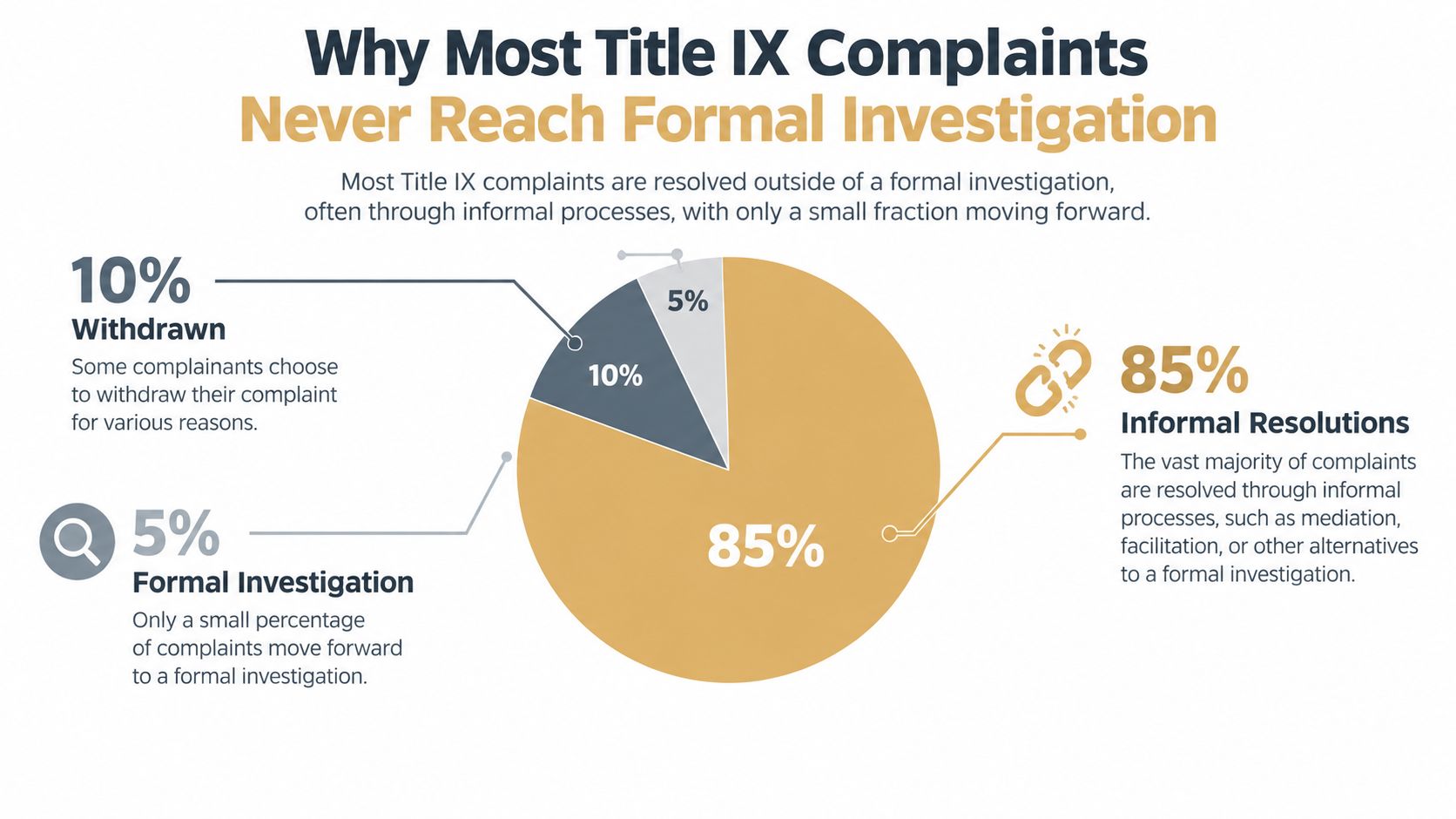
Report, complaint, and informal resolution
Use unmistakable language in your first written communication. State that you are making a formal complaint, identify the respondent if known, describe the conduct, and ask the school to initiate its formal grievance process. Messages such as “I need help” or “I want this documented” may be treated as a report or support request.
A written, signed complaint gives you the clearest procedural record under the framework many schools used after the 2025 changes. Sign and date the statement, including when you submit it electronically. Preserve the original file, sent email, delivery confirmation, and every attachment. Keep a separate chronology showing when you reported the conduct and how the school responded.
Practical rule: Never assume that a meeting with a coordinator means a formal case has opened. Request written confirmation of the case status and the procedure being applied.
Ask for supportive measures immediately if you need them, while stating that you want the formal process to continue. Supportive measures address access, safety, or participation during the process. A formal complaint seeks an institutional resolution and findings. Requesting both prevents the school from using interim assistance as a substitute for adjudication.
Preventing an intake dismissal
Schools screen complaints for jurisdictional and procedural fit. OCR's reported figures show that a single complaint can contain multiple alleged Title IX violations, rather than one theory only. In FY 2019, OCR received 1,802 complaints containing 2,418 alleged Title IX violations and resolved 2,713 Title IX allegations in 2,005 complaints. That distinction matters because a broad narrative can conceal separate allegations that should be identified individually. The same OCR annual reporting cited earlier provides the underlying context.
Give the school the facts it needs to assess each allegation: the program or activity involved, the people involved, approximate dates, the effect on your education or employment, and the remedy you seek. Name separate incidents instead of combining them into a general account. Attach records that establish timing, notice, retaliation, unequal treatment, or the school's response.
If the school proposes informal resolution, ask which allegations it will address, whether the outcome will include findings, what records will be created, and whether you may decline. State in writing that you want a formal investigation. If the school refuses, asks for clarification, or closes intake, request the decision and its reasons in writing. Keep that correspondence for any later discrimination lawsuit process.
A report starts communication. A precise, signed complaint creates the strongest foundation for formal review.
Navigating the 2025 Title IX Rule Changes
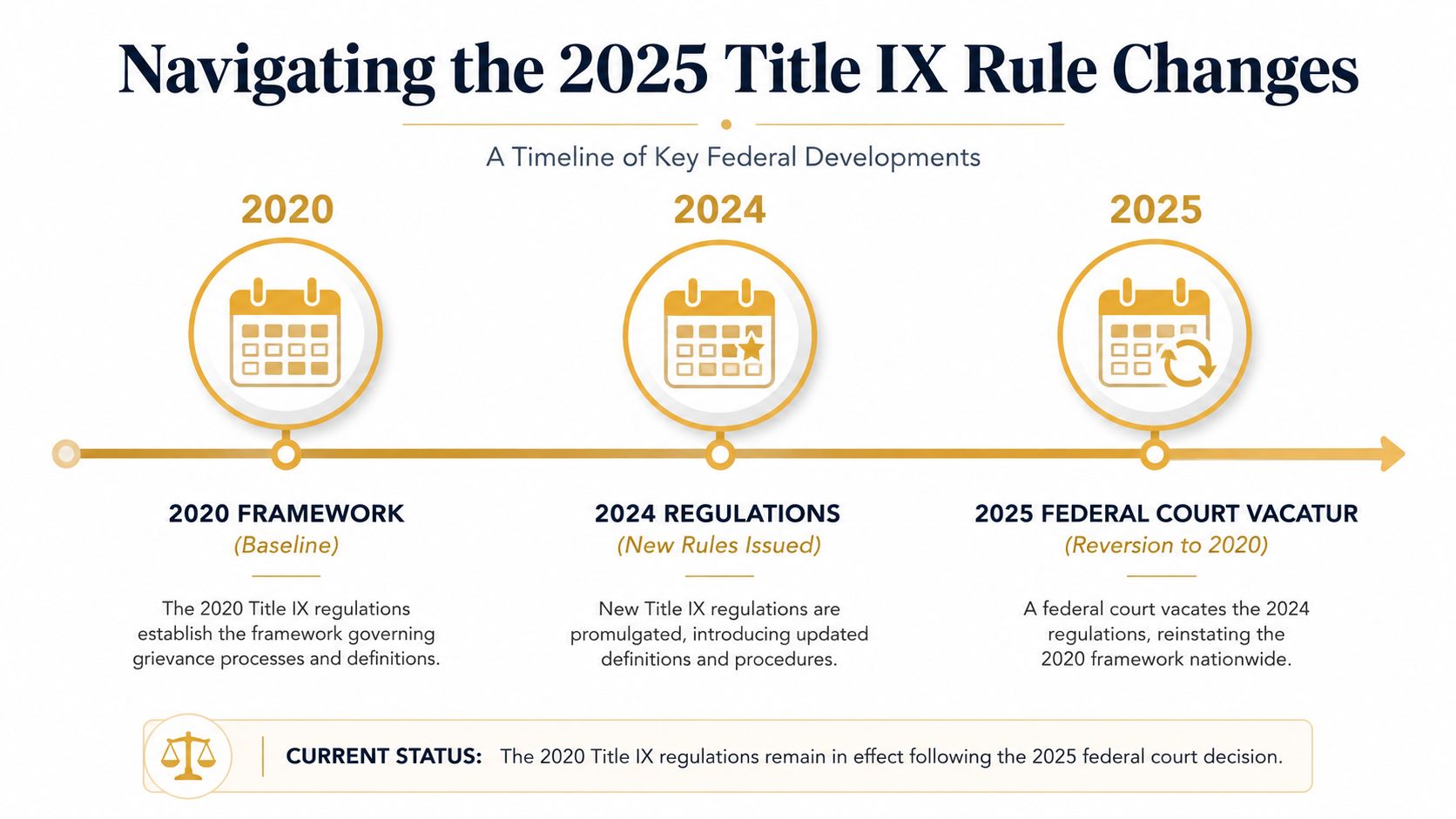
The school's website may not tell you which Title IX rules govern your case. A nationwide court vacated the 2024 regulations, and multiple training materials state that schools reverted to the 2020 framework for new complaints filed on or after January 9, 2025, as summarized in this 2025 Title IX regulatory overview. That means the filing date, the school's policy, and the procedural history can all matter.
Identify the governing framework
Ask the coordinator four questions in writing:
- Which regulations and institutional policy apply?
- What date does the school use to determine the applicable framework?
- Has the school classified my submission as a report or formal complaint?
- What are the published deadlines for investigation, evidence review, determination, and appeal?
The 2020 framework emphasizes a signed formal complaint, written notice, evidence sharing, and defined grievance procedures. Rules concerning live hearings, questioning, and evidence review can differ depending on the institution and the claims involved. Don't rely on an old handbook or a web page that still describes the vacated 2024 rules. Save a copy of the policy the school gives you and ask the coordinator to identify any superseding notice.
Federal guidance requires schools to use a “reasonably prompt” grievance process, while allowing institutional flexibility rather than imposing one nationwide deadline. The institution must publish measurable time frames for the formal complaint process, appeals, and informal resolution options, as reflected in OCR's procedural guidance. This creates a practical right to clarity, not a guaranteed result by a particular day.
Protect the procedural record
Regulatory confusion creates an opening for avoidable mistakes. Keep every version of the school's policy, every notice, and every message explaining why a procedure changed. If the institution switches frameworks mid-case, request the legal and procedural basis in writing and ask how the change affects notice, evidence access, questioning, and appeal rights.
The ED/DOJ Title IX Special Investigations Team announced in April 2025 adds another layer to the enforcement environment. It may lead to more centralized federal attention, but it doesn't replace your responsibility to build a clean record. A federal development doesn't cure an incomplete complaint, missing evidence, or an unexplained delay.
Filing Your Formal Complaint and Triggering the Investigation
A strong complaint gives the coordinator enough information to assess jurisdiction without forcing you to prove the entire case at intake. It should be factual, organized, signed, and specific about the action you want.
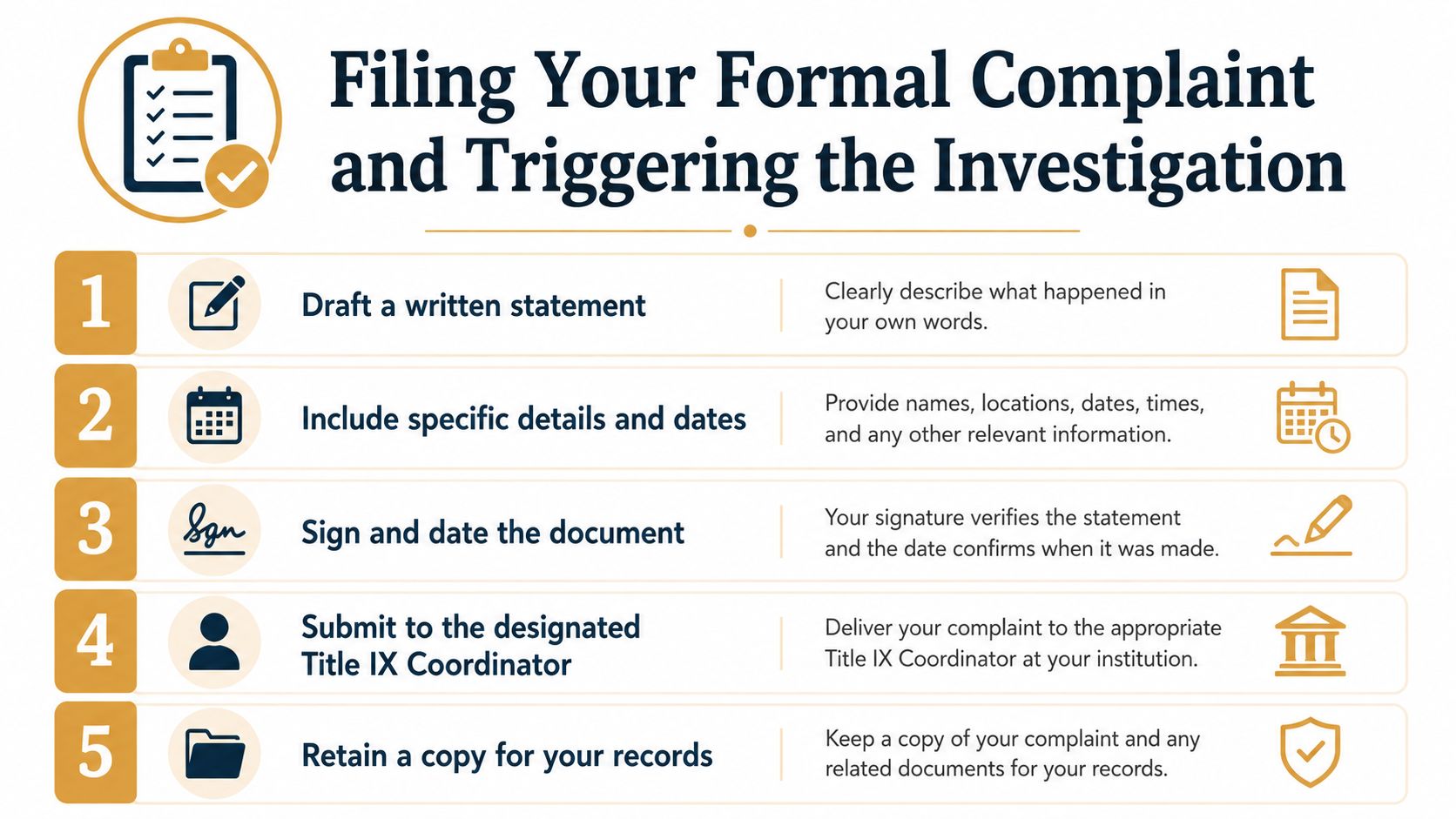
Draft the document for screening
Use a clear subject line such as “Formal Title IX Complaint and Request for Formal Grievance Process.” Address it to the designated Title IX coordinator, and copy yourself at a personal email address if school access could later be restricted. Your complaint should contain:
- Your identity and role: State whether you're a student, employee, applicant, or another participant in the school's program.
- The respondent: Name the person or institution involved when known.
- The conduct: Describe what happened in chronological order, using concrete language rather than conclusions alone.
- Dates and locations: Give exact dates where you know them and careful approximations where you don't.
- Program connection: Explain how the conduct affected, occurred within, or related to the school's education program or activity.
- Impact and requested relief: Describe academic, employment, safety, or access consequences and request appropriate supportive measures or remedies.
- Evidence and witnesses: Identify messages, records, photographs, witnesses, or other materials that can be located.
- Formal request: State that you are requesting a formal grievance process and a written determination.
Sign and date the complaint. Don't bury the request in a long narrative. Put it in the opening paragraph and repeat it in the closing paragraph.
Responding to intake decisions
The initial assessment can address jurisdiction, the alleged conduct, the respondent's relationship to the school, and whether the submission satisfies the applicable formal-complaint requirements. A dismissal or refusal to proceed should identify the reason and explain available review or appeal rights.
If the school says the matter falls outside Title IX, ask whether it will address the conduct under another school policy, civil-rights procedure, employee process, or student conduct code. A Title IX dismissal doesn't necessarily mean the underlying conduct is acceptable or that every remedy disappears. Request supportive measures regardless of whether the formal complaint proceeds, because access and safety concerns can exist independently of adjudication.
GAO's review illustrates how consequential screening can be. The agency reported that Education dismissed 97% of 9,453 college-athletics Title IX complaints during the analyzed period, as detailed in its report on Title IX athletics complaints. Don't read that figure as a prediction of your case. Read it as a warning that jurisdictional fit, complaint framing, and evidentiary specificity matter before the merits are ever tested.
Keep a decision log. Record the submission date, the coordinator's response, each request for information, every missed deadline, and the exact reason given for any dismissal. That record can support an internal appeal or later external review.
Building Your Evidence Portfolio for the Investigation Phase
Evidence isn't a scrapbook. It's a structured explanation of what happened, when it happened, who can confirm it, and how the conduct affected your education or employment. Begin preserving material before you submit the complaint, because messages can disappear and institutional records can become harder to obtain.
Create one master chronology. Use a neutral date format, identify the source for each entry, and separate what you personally observed from what another person told you. Don't edit screenshots. Preserve the full conversation when possible, including the sender, recipient, date, and surrounding messages.
| Evidence Category | Examples | Preservation Priority | Investigator Weight |
|---|---|---|---|
| Contemporaneous documentation | Personal notes, diary entries, incident reports, written disclosures | High, preserve originals and creation context | Strong when entries are consistent and close in time |
| Digital communications | Emails, text messages, direct messages, learning-platform records | High, export complete threads and retain metadata where available | Strong when authorship, timing, and context are clear |
| Witness information | Names, contact details, firsthand observations, prior statements | High, identify witnesses before memories fade | Varies with firsthand knowledge and consistency |
| Medical or support records | Counseling, medical, accessibility, or safety documentation | High, request only relevant records and protect privacy | Useful for impact, timing, disclosures, and requested measures |
| Institutional records | Schedules, attendance, grades, complaints, policy notices, coordinator emails | High, request in writing and keep responses | Important for notice, jurisdiction, retaliation, and procedural issues |
Preserve first, organize second
Send preservation requests to the coordinator or relevant records office when material may be held by the school. Identify the likely record, date range, people involved, and reason it matters. Ask the institution to retain relevant emails, messages, video, access logs, schedules, reports, and policy versions.
Evidence review is a procedural opportunity, not a formality. Under the 2020 framework, the parties receive access to relevant evidence and an opportunity to inspect and respond. Some procedures provide a 10-day review period, as described in this overview of Title IX investigations. Use the actual deadline in your school's notice, not a general guide.
Make your response useful
When reviewing the school's evidence, identify missing context, inaccurate dates, misidentified speakers, omitted witnesses, and statements that conflict with the full record. Respond in a numbered document that points to each item and attaches the supporting material. Avoid personal attacks, speculation, and repeated arguments that don't connect to evidence.
Give investigators a map. Label files consistently, include a short description for each item, and explain the significance of disputed evidence without overstating it. The strongest portfolio makes it easy to verify the chronology and difficult to dismiss a key fact as an unsupported assertion.
Understanding Realistic Timelines and School Discretion
Anyone who promises a fixed Title IX completion date is oversimplifying the process. Federal rules require a reasonably prompt grievance process, but they don't establish one universal number of days for every school, claim, witness list, or appeal. Schools must publish measurable time frames, yet actual duration can expand when parties request extensions, witnesses are unavailable, evidence is disputed, or the institution mishandles its own scheduling.
Track the process against the policy
Build a timeline with these milestones:
- Report or complaint received
- Coordinator's jurisdictional and procedural assessment
- Written notice to the parties
- Investigation interviews and evidence collection
- Evidence review and responses
- Investigation report or investigative materials
- Determination
- Appeal submission and decision
Compare each milestone with the school's published policy. If the coordinator misses a stated deadline, request a written explanation and a revised date. Don't accept “we're still looking into it” as a complete update. Ask what step is pending, who controls it, and whether the delay changes any right to submit evidence or appeal.
A long investigation isn't automatically unlawful. An unexplained investigation is a serious procedural problem.
The Title IX process timeline guidance from Equal Rights Advocates emphasizes that schools may take months to a year or more, and that no single legal deadline governs every school process. That range isn't a promise or a prediction. It tells you why documentation matters when a case stalls.
Prepare the appeal while the case is active
Appeals usually don't provide a second unrestricted investigation. They focus on defined grounds in the school's policy, such as procedural error, new evidence, conflict of interest, or a decision unsupported by the record. If you wait until the outcome arrives to locate the relevant policy, you may lose the chance to present a focused argument within the school's appeal window.
Keep a separate procedural file. Save notices, investigator communications, evidence disclosures, extension requests, and your responses. If the process becomes unreasonably delayed, the record can support an internal complaint, an OCR filing, or advice from counsel. For a separate federal administrative timeline, see this explanation of the EEOC complaint timeline, but don't assume EEOC deadlines govern a Title IX matter.
Preparing for Hearings and Appeals Before You Need Them
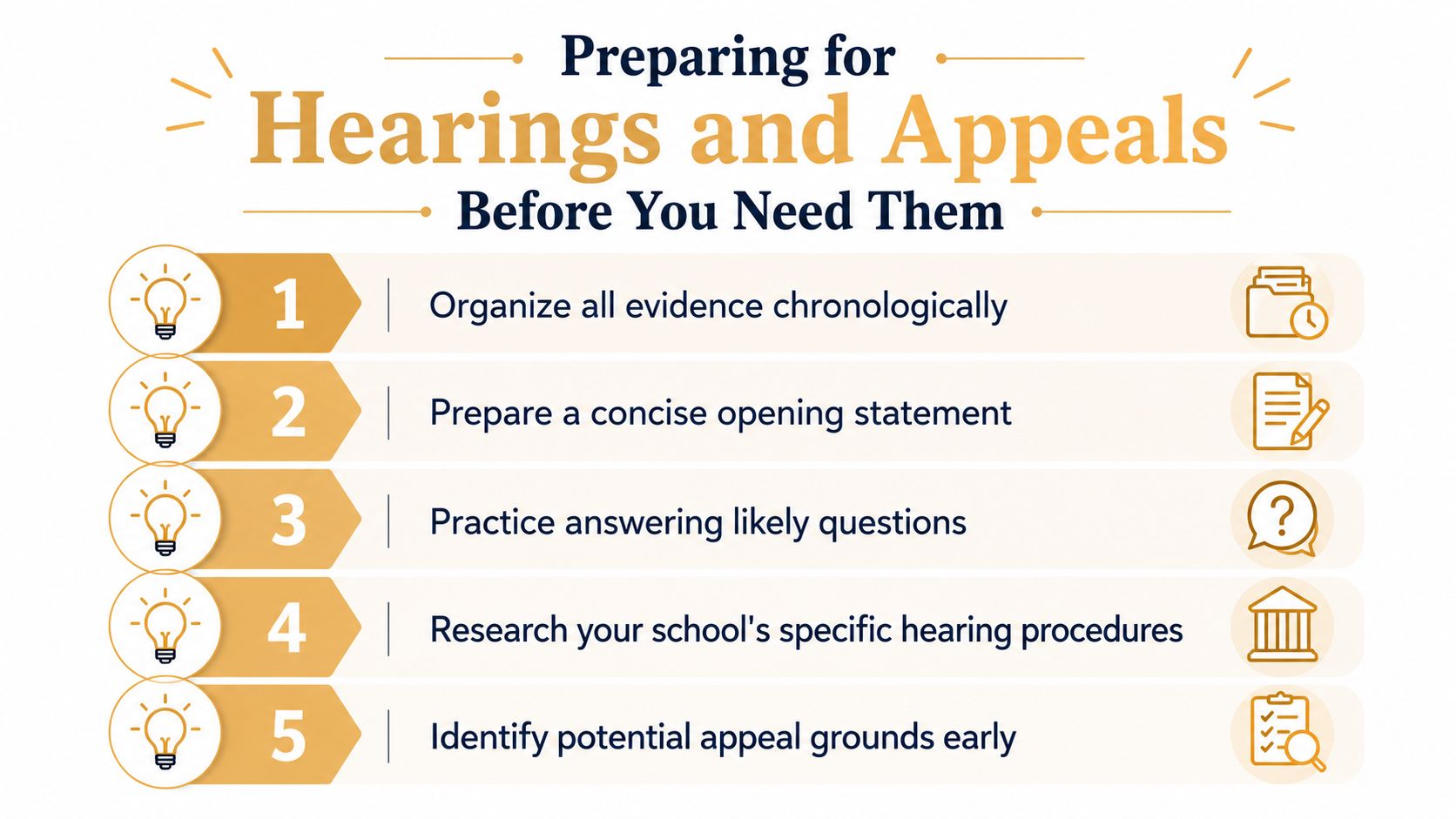
A hearing isn't the time to discover your theory of the case. Build it during the investigation. Organize your evidence chronologically, identify the facts that must be established, and prepare concise answers that distinguish firsthand knowledge from inference.
Higher-education procedures under the applicable framework may include a live hearing and questioning through an advisor. The exact requirements depend on the rules governing the complaint, the institution's policy, and the nature of the allegations. Read the notice and hearing procedures carefully. Find out whether questioning must be submitted in advance, what relevance standard applies, how remote participation works, and what happens if a witness doesn't appear.
Build a hearing file
Your hearing file should contain the complaint, the school's notices, the evidence list, the investigative report, your response, the governing policy, and a one-page chronology. Prepare an opening statement that identifies the requested finding and points the decision-maker to the most important evidence. Don't use the opening to argue every dispute.
Practice likely questions with an advisor. Answer directly, pause before responding, and correct an inaccurate premise without becoming argumentative. If you don't remember, say that you don't remember. Credibility suffers when a witness guesses to fill a gap.
Draft an appeal that matches the policy
The appeal should identify the precise ground, cite the relevant policy language, identify the record evidence, and explain the effect of the error. “The result was unfair” isn't enough. A stronger argument says that the school failed to provide required evidence access, excluded relevant material without applying its stated standard, used a conflicted decision-maker, or relied on a material factual error.
Don't wait for the written determination to begin this work. Maintain a list of potential procedural defects as the case develops, and preserve new evidence as soon as you find it. If the school process produces a harmful result, an attorney may assess administrative complaints, civil claims, employment remedies, or other legal options. Use a focused search for counsel with experience in education law and civil rights, such as this guide on how to find a lawyer.
A short video can also help you understand the practical sequence before you meet with an advisor:
If you're facing a live deadline, don't send a rushed appeal without checking the governing policy. A lawyer or qualified advocate can help you preserve objections, organize evidence, and avoid turning a procedural mistake into a permanent record.
Outh helps students and families assess potential civil claims, organize evidence and communications, understand legal correspondence, and identify attorneys with relevant experience. Visit Outh to create a structured record of your Title IX matter and make your next legal decision with clearer information.