 Outh
Outh10 Online Legal Help Options for Every Need
Compare 10 online legal help options for advice, documents, claims, legal aid, and representation, with use cases, costs, and limitations.

You're staring at a confusing letter, a denied claim, a deadline, or a legal problem that feels too important to ignore but too early to hand to a lawyer. That's where online legal help can do real work, because the category now ranges from AI-supported claim analysis and DIY document tools to attorney marketplaces and income-qualified pro bono services. The practical question is not “Which site is best?” It's “What do you need right now, quick answers, document help, subscription coverage, project counsel, pro bono support, or step-by-step procedural help, and does the service include legal advice or representation?”
The right choice depends on urgency, jurisdiction, complexity, affordability, privacy, and scope. A fast Q&A site can help you triage a problem, but it may not tell you whether your matter is even worth pursuing. A subscription plan can make repeated questions cheaper, but it still may stop short of courtroom representation. An evidence-aware platform can help you understand a civil claim and prepare better, while a legal aid directory can point you toward low-cost human help when money is the deciding factor.
Table of Contents
- 1. Outh
- 2. Rocket Lawyer
- 3. LegalZoom Personal Attorney Plan
- 4. LegalShield Personal Legal Plans
- 5. Avvo
- 6. JustAnswer Ask a Lawyer Online
- 7. UpCounsel
- 8. ABA Free Legal Answers
- 9. LawHelp.org
- 10. JusticeDirect
- Top 10 Online Legal Help Comparison
- Match the Resource to the Risk and Urgency
1. Outh
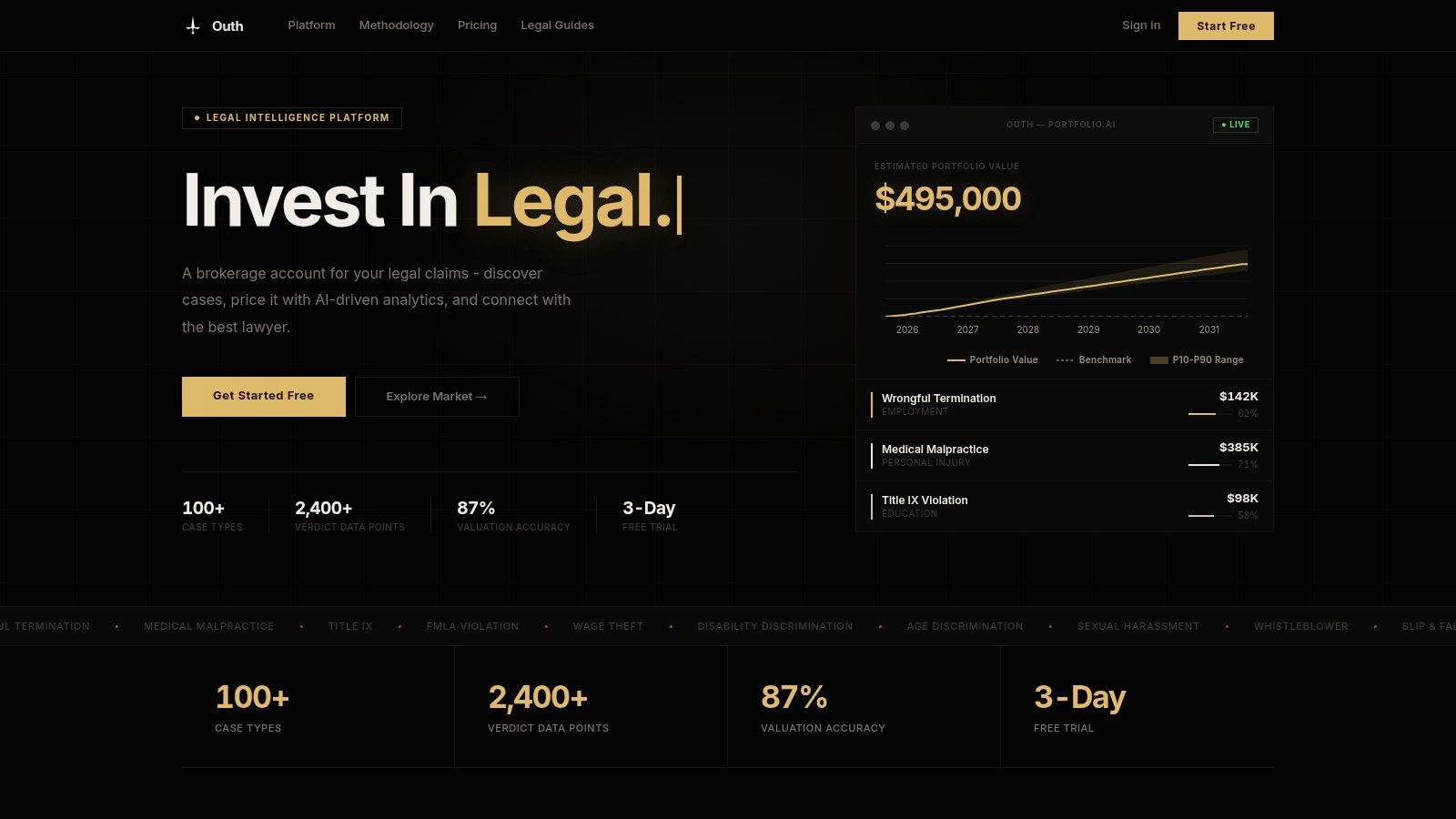
When the first problem is uncertainty, Outh is built for that exact moment. It treats a civil claim less like a random search query and more like a decision problem, using AI, evidence tracking, and case valuation to help you understand whether a matter looks plausible before you spend time or money on the next step. The platform says it covers 100+ case types, uses 2,400+ verdict and settlement datapoints, and reports an 87% valuation accuracy rate on its site, which is why it stands out as the most analytically detailed option in this roundup.
Best fit when you need claim clarity, not just a lawyer search
Outh is strongest when you're asking, “Do I have something here, and what would it take to prove it?” Its valuation model uses P10, P50, and P90 ranges, so you can see a lower, midpoint, and higher scenario instead of a single vague estimate. It also layers in market benchmarks refreshed quarterly from public sources such as the EEOC, BLS, DOJ, and IRC, which makes the tool more useful for expectation-setting than a plain document builder or Q&A forum.
The practical value is in the workflow. Outh's case-element checklist tells you what facts still need to be shown, its email integration can pull in documents, and the AI Email Decoder translates legal correspondence into plain English while showing how an update may affect settlement estimates or case pace. That makes it especially useful when you have a claim but don't yet know whether your evidence is strong enough to move forward.
Practical rule: Use Outh when the hard part is deciding whether to pursue a civil claim, not when you already need an attorney to file or appear in court.
Where it draws the line
Outh is not a law firm, and its valuations are statistical estimates, not legal advice. That boundary matters because a data-rich dashboard can improve your judgment, but it can't replace counsel for strategy, ethics, or representation in litigation. The platform's attorney-matching layer does help bridge that gap by surfacing lawyers by specialty, reported success indicators, proximity, and fee transparency, including contingency estimates, retainers, and a $0 retainer filter.
For people comparing options, the biggest advantage is clarity before commitment. Outh's subscription model, with monthly, quarterly, and annual plans plus a 3-day free trial, fits users who want ongoing monitoring across multiple matters rather than a one-off answer. If your legal problem feels financially urgent, procedurally messy, or spread across emails and documents, Outh gives you a structured way to decide whether you need more information, a lawyer, or both.
2. Rocket Lawyer
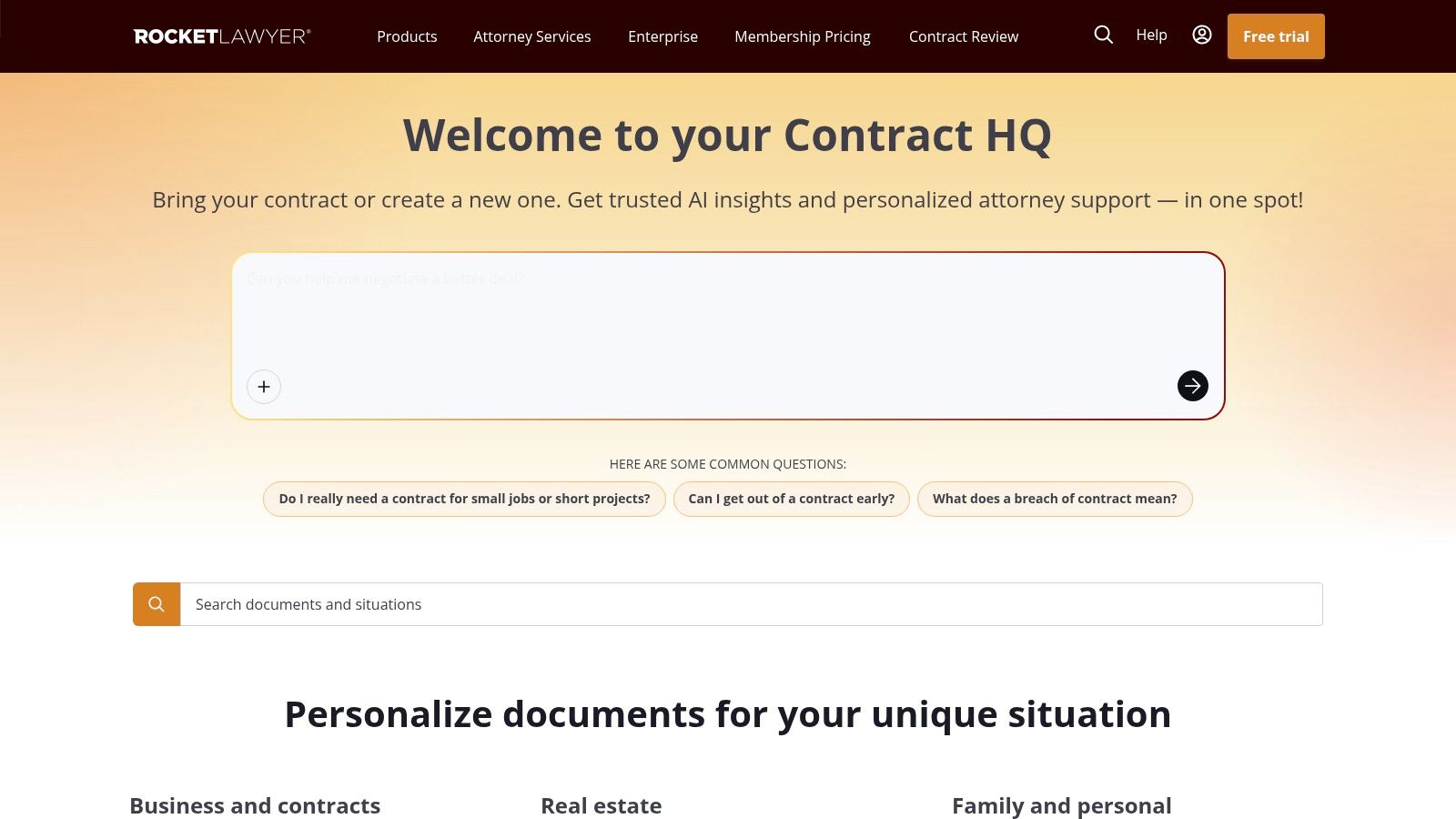
Rocket Lawyer is a better fit when your need is routine legal work plus a human backstop. The platform combines guided document builders, e-signatures, attorney Q&A, and higher-tier consultations, so it works well for users who want to draft something now and still have a lawyer available if the issue gets harder.
Outh's legal technology tools overview is useful context if you're comparing AI-supported legal workflows with more traditional subscription platforms.
Good for recurring documents and predictable access
Rocket Lawyer's value is its bundle. A subscription can cover document creation, e-signature, reminders, and access to attorney help, which makes it more practical than buying one-off forms every time a new issue comes up. That matters if you're handling leases, business setup, or repeat personal legal documents and don't want to start from zero every time.
The platform also includes Rocket Copilot, its AI assistant, which can speed up routine drafting and point you toward the next step. For a user trying to move quickly, that combination of guided paperwork and optional attorney input is often enough to get from confusion to a usable draft.
Where it fits, and where it doesn't
Rocket Lawyer is strongest for users who know they need legal documents but aren't sure how much lawyer time they need yet. Its structure makes spending more predictable than an hourly call with a private attorney, but consultation limits vary by plan, and the most extensive attorney access is reserved for higher tiers. Some features, such as trademarks or registered agent services, also cost extra.
The boundary is simple. Use Rocket Lawyer for DIY document creation with lawyer backup, not for full representation in a contested dispute. If your matter is about preparing a form, signing it, and getting a quick legal check, it makes sense. If your situation is already headed toward litigation, you'll want a platform or attorney relationship that goes beyond document support.
3. LegalZoom Personal Attorney Plan
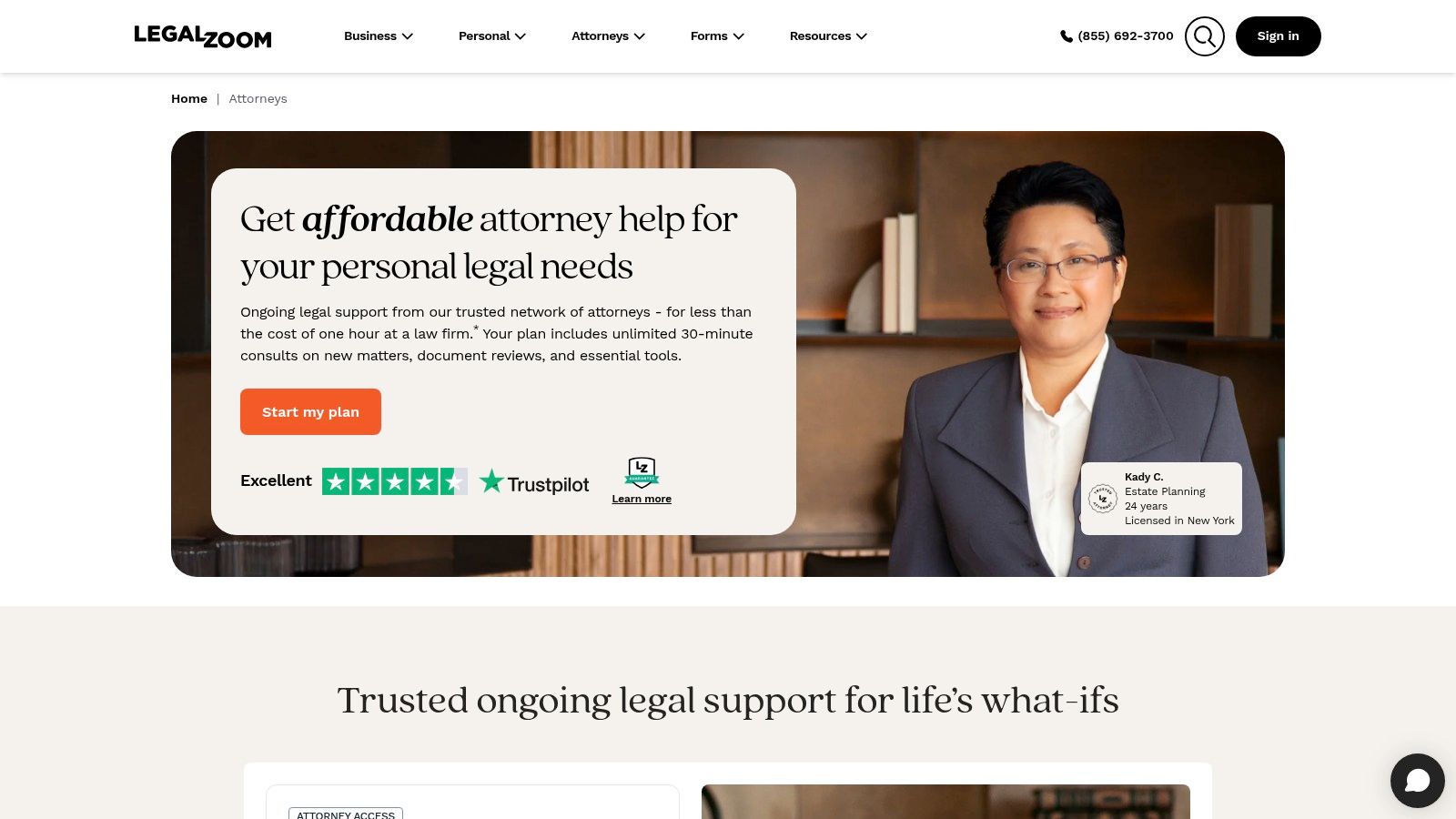
LegalZoom's Personal Attorney Plan is designed for people who want ongoing access to a lawyer without building a full firm relationship. It leans into predictable subscription coverage, especially for families and individuals who expect more than one legal issue over time.
Best for users who want scheduled legal access
The plan's main attraction is unlimited 30-minute consultations on new matters. That makes it easier to ask a lawyer about a new issue without treating every question like a separate billing event. The package also includes document review with page limits, e-signature, access to 150+ legal templates, member discounts on additional attorney services, and an annual estate plan check-up after six months.
That structure works best when your needs are personal and recurring rather than one-off and emergency-driven. If you expect to ask about family documents, estate-related updates, or a series of common legal issues, the subscription model is easier to budget around than a traditional hourly arrangement.
The important boundary is representation
LegalZoom's plan is not a litigation substitute. Representation for contested matters is not included, so this is more of an access and planning product than a courtroom solution. That's a useful distinction because many consumers want legal reassurance but don't yet need formal counsel to appear on their behalf.
The plan is also constrained by document-review page limits, so it isn't unlimited in every direction even if the consultation model feels broad. For people comparing it with Rocket Lawyer or LegalShield, the key question is whether they value more structured consultation access, template support, and national coverage over very specific attorney-availability features. If the answer is yes, LegalZoom fits neatly into the “subscription guidance” category.
4. LegalShield Personal Legal Plans
LegalShield is a strong choice when the main goal is broad personal coverage under a subscription model. It's aimed at users who want the comfort of ongoing access, especially when family issues, ticket questions, or estate-related updates can appear without warning.
Broad coverage with tiered limits
LegalShield's personal plans typically include unlimited consultations on personal legal issues, but the amount of document review and the exact services depend on the tier. Higher tiers can add traffic ticket assistance, annual will updates, and some estate or probate support, while certain covered situations include 24/7 emergency access.
That makes it useful for users who don't want to predict the exact legal problem in advance. Instead of buying help after each issue appears, they're paying for a standing relationship that can absorb a range of common matters.
Best fit for families, not just individuals
The family angle matters. LegalShield's tiered structure can cover more than one person, which makes the plan appealing for households that expect to share legal needs across time. That's different from one-off Q&A services, where every issue starts over from scratch.
Still, the limits are real. Some services have waiting periods, page caps, or added fees, and more complex representation may require discounted hourly billing beyond the plan. That means LegalShield is best viewed as an access layer, not a full replacement for a lawyer retained on a difficult dispute.
If your legal life is full of small but persistent questions, subscription coverage can be more valuable than trying to guess which issue will become expensive next.
5. Avvo
Avvo is the fastest option in this list when you just need a first-pass answer from a lawyer. It's a legal marketplace built for quick triage, and its free question format makes it especially useful when you're trying to understand whether a problem is urgent, state-specific, or worth taking to counsel.
Good for fast screening, not final decisions
The biggest advantage is speed. Users can post a legal question anonymously and often get responses from licensed attorneys within hours. That makes Avvo useful for time-sensitive issues where you need to know what category of problem you're even dealing with before you spend money.
Location-aware answers matter too, because legal issues are often state-specific. A landlord dispute, traffic matter, or family issue can change materially depending on jurisdiction, and Avvo's local emphasis helps filter out generic advice.
Use it as a triage tool
Avvo also gives you lawyer profiles, reviews, and practice-area information, so it can function as a search layer if you decide to move from a question to a retained attorney. That's helpful because a good first answer often leads to a better hiring decision, especially when you're comparing lawyers by focus rather than just marketing.
The limitation is simple. Q&A is informational, not representation, and answer quality can vary. If you need someone to file, negotiate, or appear, Avvo is a starting point, not the endpoint. For users who want to move quickly from confusion to a shortlist, though, it does the job well.
6. JustAnswer Ask a Lawyer Online
JustAnswer makes sense when your legal question arrives at an inconvenient hour. It's built around on-demand attorney access, so the main value is immediacy rather than long-form planning.
A fit for urgent, practical questions
The platform lets users submit questions 24/7, then alerts them when a lawyer responds. That makes it useful for issues that can't wait for a daytime appointment, especially if you're trying to make sense of a deadline, a notice, or a confusing legal message after business hours.
Its membership structure also supports follow-up, which matters because many legal questions are not one-and-done. A single answer can be enough to clarify your next move, but sometimes you need one more round of context before deciding whether to hire someone.
Where the membership model helps, and where it doesn't
JustAnswer is often cheaper than a standard hourly consult for initial guidance, but the pricing details aren't fully visible until sign-up, and premium services can add meaningful cost. That means it's best used for targeted questions, not as a substitute for a fully scoped representation relationship.
The most practical way to use it is for issue-level clarification. If you need someone to explain a notice, a legal process, or a deadline right away, it's a strong option. If your matter has moved into evidence disputes, negotiations, or court strategy, you'll probably outgrow the format quickly.
7. UpCounsel
UpCounsel is the strongest match when the problem is paid legal work with a defined scope. It's geared toward businesses and individuals who want proposals from vetted attorneys rather than a generic advice feed.
How to find a lawyer with a better fit can help you compare project counsel options before you commit to a specific attorney.
Best for scoped projects and competitive bids
The key feature is that you post a legal matter and receive proposals from attorneys who are already vetted by the platform. That creates a clearer buying process than emailing firms one by one, especially for discrete tasks like contracts, employment matters, or intellectual property work.
It also helps that the platform centers on transparent scopes and pricing before hiring. For a user who needs to compare options quickly, that can cut down on uncertainty and make attorney selection feel more concrete.
Stronger for business matters than free advice
UpCounsel is not designed for casual browsing or quick free guidance. It is a paid, project-based marketplace, so it works best when you already know you want professional help and need to compare who can do the work. For startups and SMBs, that is often exactly the right model.
The limitation is just as clear. Platform and billing policies apply, and this is not a pro bono or low-cost legal aid channel. Use it when you want experienced counsel on a specific task, not when you're still trying to figure out whether your issue deserves legal action at all.
8. ABA Free Legal Answers
ABA Free Legal Answers is one of the most valuable options when cost is the primary barrier. It connects income-eligible people with volunteer attorneys who provide written guidance on civil legal questions, usually through state-specific portals.
Best fit for free civil legal guidance
The structure is simple and powerful. You post a civil legal question, and a volunteer lawyer licensed in your state responds in writing. That makes the service useful for people who need legal context but can't afford a consultation.
It also includes a federal portal for certain matters, such as immigration and veterans' issues, which broadens its usefulness beyond ordinary state civil problems. Because the guidance is asynchronous, it works well for people who can't coordinate a live meeting.
Know the boundaries before you rely on it
This is not a criminal defense tool, and eligibility limits apply. Some state portals may also pause intake or have limited capacity, so it's not the right choice if your issue is so urgent that you need immediate live advice.
Still, for low-income users with civil problems, it's one of the best starting points available. It gives you a real attorney response without the first hurdle of cost, which can be the difference between moving forward and doing nothing.
9. LawHelp.org
LawHelp.org is the right move when you need a trustworthy directory, not a single answer. It points people toward local civil legal aid organizations, self-help resources, and low-cost or free help.
How to file a civil lawsuit can be a useful next step if you use LawHelp.org to locate support for a court-bound civil matter.
Best for finding the right local door
The biggest strength of LawHelp.org is that it helps you narrow the field. Instead of searching broadly and hoping the result is trustworthy, you can filter by topic and state, then get directed to reputable civil legal aid providers. That matters because the quality of “free legal help” on the open internet varies widely.
It's also a good starting point for people who need more than information. Some users don't want a document platform or a Q&A site, they want a local organization that can screen their case and maybe represent them or refer them onward.
A directory, not a direct provider
LawHelp.org doesn't solve the case itself. You still have to apply separately to the provider it lists, and availability depends on funding, location, and waitlists. That makes it less immediate than Avvo or JustAnswer, but often more reliable if your main concern is finding an organization you can trust.
For civil matters where budget is tight, that's enough. If you need a free or sliding-scale path into human legal help, this is one of the first places to check.
10. JusticeDirect
JusticeDirect is built for a very specific job, helping self-represented people move through small claims with procedural support. Its current focus on California makes it more specialized than the broader subscription platforms, but that specialization is also its advantage.
Best for step-by-step small claims support
The service offers attorney-written and signed demand letters, filing and service support, and judge-friendly evidence packet preparation. That is exactly the kind of support many self-represented litigants need, because small claims success often turns on process discipline more than legal theory.
Its a la carte model is another plus. If you only need subpoenas, a virtual hearing request, or print-and-mail help, you can buy the step you need instead of a larger package you won't use.
Narrow scope, clear boundaries
JusticeDirect is not an in-court representation service, and its geographic scope is limited. That means it is best for people who are comfortable handling the hearing themselves but want attorney-reviewed support to avoid procedural mistakes.
For small claims, clarity beats complexity. A clean demand letter, proper service, and a coherent evidence packet can matter more than a broad legal subscription you barely use.
The value here is precision. If you're in California and your case belongs in small claims, JusticeDirect can give you structured help without pretending to be full representation. If your dispute is bigger, more complex, or outside the state, you should look elsewhere.
Top 10 Online Legal Help Comparison
| Platform | Core features | UX (★) | Price/Value (💰) | Target (👥) | Unique selling point (✨) |
|---|---|---|---|---|---|
| Outh 🏆 | AI case discovery (100+ types); P10/P50/P90 valuations; portfolio dashboard; email/evidence ingest; attorney matching | ★★★★☆ (87% valuation acc.) | 💰 Subscription (monthly/quarterly/annual); 3‑day free trial; pricing tiered | 👥 Data-driven plaintiffs & self-represented users | ✨ Investor-style portfolio analytics + AI Email Decoder + confidence-interval valuations |
| Rocket Lawyer | Guided document builders, e-sign, AI assistant, attorney Q&A/consults | ★★★★☆ | 💰 Tiered memberships with predictable fees | 👥 Consumers & small businesses needing DIY docs + lawyer backup | ✨ Combines DIY documents with attorney access in one subscription |
| LegalZoom (Personal Attorney Plan) | Unlimited 30‑min consults on new matters; doc review; templates; e-sign | ★★★★☆ | 💰 Flat-rate personal plan; member discounts | 👥 Individuals & families seeking predictable attorney access | ✨ Prepaid plan with vetted national attorney network |
| LegalShield (Personal Plans) | Unlimited consultations (tiered); doc review; traffic help; 24/7 emergency access | ★★★☆ | 💰 Subscription tiers; some limits/waiting periods | 👥 Consumers & families wanting broad, always-on coverage | ✨ 24/7 emergency access and tiered family coverage |
| Avvo | Free Q&A with attorneys; lawyer profiles, reviews, concierge matching | ★★★★ | 💰 Free initial Q&A; paid hiring negotiated with attorneys | 👥 Users seeking fast triage or initial guidance | ✨ Very fast, location-aware attorney answers + marketplace |
| JustAnswer (Ask a Lawyer) | 24/7 Q&A marketplace; verified lawyers; membership-based ongoing access | ★★★☆ | 💰 Membership + possible premium fees; pricing revealed at signup | 👥 Time-sensitive legal questions outside business hours | ✨ On-demand, round-the-clock access to verified attorneys |
| UpCounsel | Post matters; receive scoped proposals; hiring & invoicing via platform | ★★★★ | 💰 Project-based bids; platform/service fees apply | 👥 Startups, SMBs, and one-off legal projects | ✨ Competitive scoped proposals from vetted attorneys |
| ABA Free Legal Answers | State-specific pro bono Q&A; volunteer attorney written responses | ★★★★ | 💰 Free for qualifying low-income users | 👥 Income-eligible individuals needing civil legal help | ✨ Free, state-licensed volunteer attorney guidance (ABA-backed) |
| LawHelp.org | State referrals to legal aid, self-help guides, filters for low-cost help | ★★★★ | 💰 Free directory/referrals; local program application required | 👥 Low-income users seeking legal aid & resources | ✨ High-trust nonprofit referral hub endorsed by USA.gov |
| JusticeDirect | Attorney-reviewed demand letters; small-claims filing support; evidence packets | ★★★★ | 💰 Clear flat-fee pricing per service | 👥 Self-represented litigants (small claims; CA-focused) | ✨ Stepwise, court-friendly packets and flat-fee small‑claims support |
Match the Resource to the Risk and Urgency
Start with LawHelp.org or ABA Free Legal Answers when cost and eligibility decide the next move. Both are useful when you need trustworthy civil guidance and you'd rather not pay for a first answer before you know whether your case is viable. If your problem is time-sensitive but still early, Avvo or JustAnswer can help you triage the issue quickly and get a state-aware response before you commit to a larger fee.
If you expect recurring personal legal needs, compare Rocket Lawyer, LegalZoom, and LegalShield side by side. The decision usually comes down to how much document support you want, how often you expect to ask questions, and whether you value a subscription that leans more toward templates, consultations, or broader family coverage. If you need a defined paid project instead, UpCounsel is the cleaner fit because you can compare scoped proposals from vetted attorneys before hiring.
For procedure-heavy small claims work in California, JusticeDirect is the most targeted choice because it supports each step without claiming to replace you in court. And if your immediate need is to understand a possible U.S. civil claim, organize evidence, estimate a settlement range, or find matching counsel, Outh is the most decision-oriented option in the group. The main discipline is the same across every tool, verify jurisdiction, scope, waiting periods, page or consultation limits, fees, privacy terms, and whether representation is included before you share sensitive information or rely on the answer.
If you're trying to decide whether a civil claim is real, what evidence still matters, or whether a lawyer is worth contacting now, Outh gives you a structured way to do that without guessing. It combines claim discovery, valuation context, evidence tracking, and attorney matching in one place, which makes it especially useful when online legal help needs to move from vague questions to a concrete next step.