 Outh
OuthCivil Rights Attorney Fees: Structures, Ranges, and Real
Understand civil rights attorney fees, including contingency percentages, hourly rates, and statutory fee shifting under 42 U.S.C. § 1988, plus what

You've been fired after reporting discrimination, or you've been injured during an encounter with police, and the first lawyer you call asks how you'll pay for the case. You're not just choosing a lawyer. You're choosing who carries litigation costs, who takes the risk of losing, and whether a future fee award belongs partly to you or entirely to the firm.
Civil rights attorney fees rarely reduce to one clean number. A case may involve a contingency percentage, hourly work, litigation expenses, and a separate court-awarded fee under 42 U.S.C. § 1988. The percentage in your retainer and the amount a judge may order a defendant to pay are different calculations.
Table of Contents
- What Civil Rights Attorney Fees Look Like in Practice
- How Statutory Fee Shifting Under Section 1988 Works
- Comparing Contingency, Hourly, and Flat Fee Structures
- The Lodestar Formula and Court Awarded Fees
- Questions to Ask About Fees Before Signing a Retainer
- Common Misconceptions About Recovering Attorney Fees
- Budgeting Your Out of Pocket Exposure and Next Steps
What Civil Rights Attorney Fees Look Like in Practice
A public employee fired after reporting discrimination may have a strong claim, supporting documents, and no money available for a large upfront payment. A lawyer might accept the case on contingency, while the engagement letter separately assigns filing costs, depositions, expert work, travel, and the consequences if the firm withdraws.
Civil rights litigation can be expensive and uncertain, so private-market lawyers commonly use contingency fees of 33% to 40% of a settlement or award. The higher percentage may apply if the case proceeds through discovery or trial. Under this overview of contingency arrangements for civil rights lawyers, the client generally does not pay the lawyer upfront, while the firm accepts the risk of receiving nothing if the case produces no recovery.
“Contingency” does not mean the entire case is cost-free. Filing fees, records, deposition services, expert work, travel, and other litigation charges may be advanced by the firm, paid by the client, or deducted from the recovery. Your retainer should state who pays each expense and when.
The two numbers clients confuse
The first number is the private fee, meaning the percentage or hourly rate in your agreement with the lawyer. The second is the statutory fee, which a court may award against the defendant if you become a prevailing party and the court finds the requested amount reasonable.
Those figures can differ sharply. Your lawyer may receive a percentage from your recovery and separately petition the court for a fee based on documented hours and a reasonable local rate. The court does not have to use your private percentage to calculate that award.
That distinction matters when you estimate your net recovery. A statutory award may reduce the amount your recovery must support, but your retainer controls how the firm handles any defendant-paid fee. Read the agreement's language on offsets, costs, expenses, and settlement authority.
If you are evaluating an employment claim, compare these provisions with the broader cost issues discussed in employment attorney fees. Request the net-recovery calculation before signing, not after settlement negotiations begin.
Practical rule: Ask, “What will I owe from my recovery, and what happens to any fee the defendant pays under a statute?” Treat those as separate questions.
How Statutory Fee Shifting Under Section 1988 Works
Congress enacted the Civil Rights Attorney's Fees Awards Act in 1976 after the Supreme Court's Alyeska Pipeline decision. The Act created 42 U.S.C. § 1988, allowing prevailing plaintiffs in qualifying civil rights cases to recover a reasonable attorney's fee as part of costs. The statute applies to major civil rights provisions, including 42 U.S.C. §§ 1981, 1982, 1983, 1985, and 1986, and later expanded to claims such as Title IX and Title VI, according to this U.S. Department of Justice solicitor general filing.
The policy is straightforward. Civil rights cases often matter even when the damages are modest, and private plaintiffs may face defendants with far greater resources. Fee shifting makes enforcement financially possible by treating reasonable attorney fees as a potential statutory remedy rather than merely a private bargaining term.
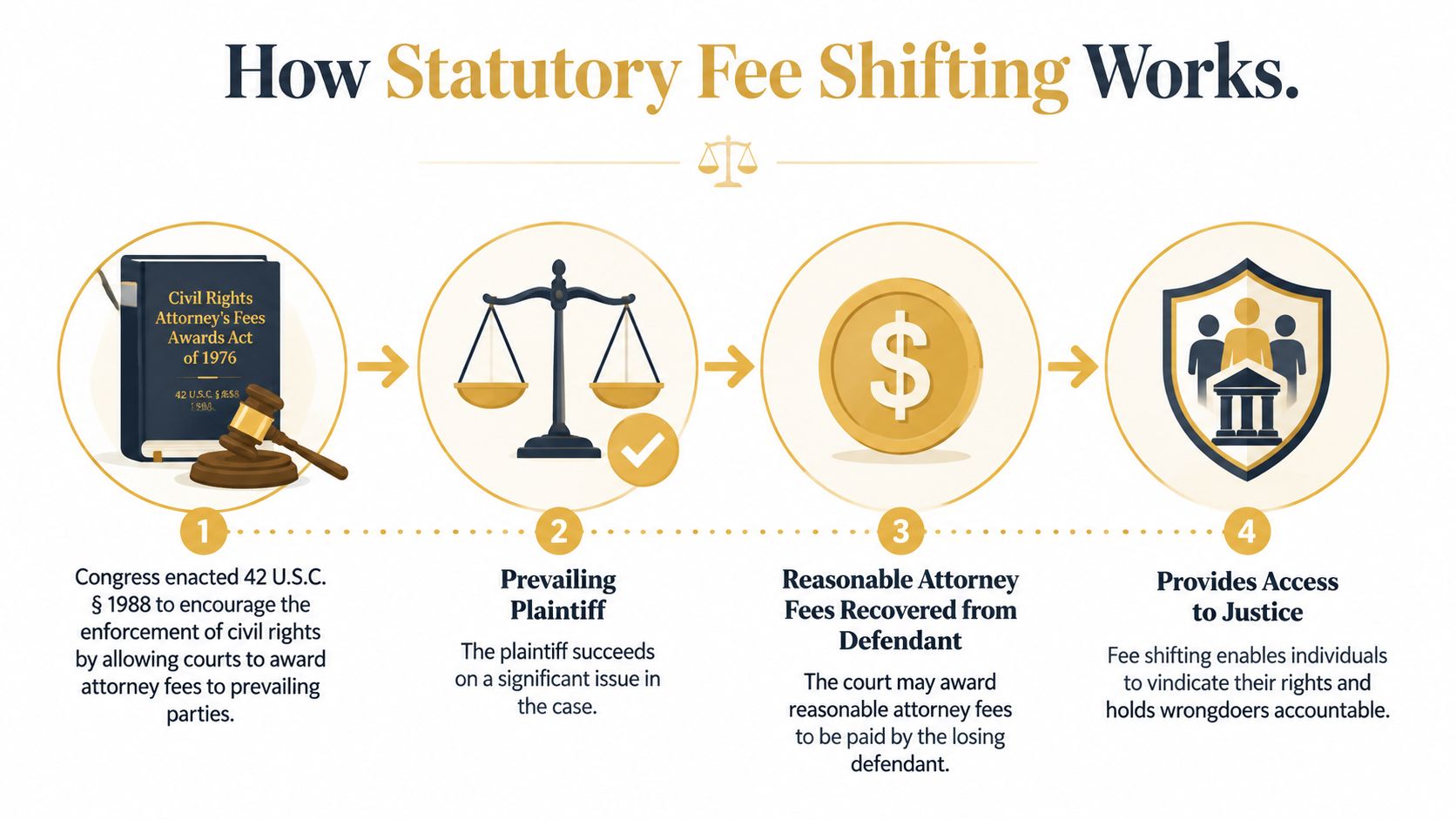
The process in practical terms
The plaintiff brings a qualifying claim. The case must arise under a statute covered by the fee-shifting framework or another applicable law.
The plaintiff obtains meaningful relief. A favorable result usually requires more than filing a claim or obtaining a temporary procedural advantage. The result must materially change the parties' legal relationship.
The plaintiff files a fee petition. The lawyer submits time records, billing rates, descriptions of the work, and evidence supporting the requested amount.
The defendant objects. Common objections attack unnecessary hours, vague entries, excessive rates, work on unsuccessful claims, duplication, or time spent on claims unrelated to the successful result.
The court decides the reasonable amount. The award is discretionary, limited to prevailing-party situations, and can be reduced even after the plaintiff wins on liability.
The defendant usually pays the court-awarded fee if the court grants it, but that payment comes later. Your lawyer may have to carry work and case expenses throughout the litigation. The statute doesn't guarantee cash flow during the case, and it doesn't erase the financial risk of an unsuccessful claim.
The rule also isn't a symmetrical loser-pays system. A prevailing plaintiff may seek fees under § 1988, while a defendant generally needs a much stronger basis to recover fees from a plaintiff. That asymmetry is part of the statute's access-to-justice purpose, but it doesn't eliminate the need to budget carefully.
Comparing Contingency, Hourly, and Flat Fee Structures
Civil rights cases are commonly priced through contingency, hourly, or flat-fee arrangements. Choose based on the evidence, expected workload, available cash, and the likelihood that statutory fee shifting will matter.
| Structure | Typical Range | Who Advances Costs | When Common |
|---|---|---|---|
| Contingency | 33% to 40% of the settlement or award, with terms often changing as litigation becomes more complex. | The firm may advance some costs, or the client may remain responsible under the retainer. | Damages are identifiable and the firm sees a reasonable recovery path. |
| Hourly | Varies by legal market, experience, and case type. The American Bar Association discussion of fees and expenses explains why rates differ by geography and lawyer experience. | Usually the client pays invoices and case expenses as they arise. | Liability is uncertain, damages are difficult to value, or the client wants control over scope. |
| Flat fee | Usually limited to a defined task rather than full litigation. | The client normally pays the agreed amount and separate expenses. | Demand letters, consultations, document review, or another discrete assignment. |
Contingency arrangements
A contingency fee ties the lawyer's compensation to the client's recovery. If the case produces no recovery, the lawyer may receive no professional fee, depending on the agreement. Case costs can still remain the client's responsibility. The contract may also calculate the percentage from the gross recovery or from the amount left after expenses.
Review the sliding scale before signing. A lower percentage may apply to an early settlement, while a higher percentage applies after discovery, motion practice, or trial preparation. Ask who pays filing, expert, investigation, and transcript costs, and when those costs are deducted.
The percentage in your retainer is not automatically the fee a court will award under § 1988. Your agreement controls what you owe your lawyer. A court generally evaluates a separate, lodestar-based request using reasonable hours and rates. The firm could therefore receive a court-awarded fee that differs from the contingency percentage, and the contract should explain how the two amounts interact. This guide to lawyer contingency fees provides further background on the arrangement.
Hourly billing
Hourly billing gives you direct control over the work authorized, but it places ongoing financial risk on you. Ask about billing increments, paralegal charges, different lawyer rates, retainers, replenishment requirements, and any proposed budget cap. Require written approval before the firm exceeds the budget.
A hybrid arrangement may suit a client who can pay part of the expense but cannot fund the entire case. Reduced hourly billing combined with a smaller contingency can distribute the risk. The agreement must state whether hourly payments are credited against a recovery, how costs are deducted, and how any statutory fee award affects the parties' obligations.
Flat fees work best for defined assignments. They are a poor fit for litigation whose scope can expand through discovery, motions, or trial preparation. Compare firms by the full package, including the percentage or rate, cost responsibility, billing triggers, withdrawal rights, and treatment of court-awarded fees.
The Lodestar Formula and Court Awarded Fees
The lodestar is the central benchmark for court-awarded civil rights fees. Courts generally calculate it by multiplying reasonably expended hours by a reasonable hourly rate. That figure is presumed to represent the reasonable attorney's fee under § 1988, as explained in this Department of Justice filing on civil rights fee awards.
The formula makes documentation decisive. A contingency contract may say the lawyer receives a percentage of the recovery, but a fee petition usually asks the judge to evaluate time, rates, results, and the relationship between the work performed and the successful claims.
What judges examine
Courts may consider factors associated with the quality and difficulty of the work, including:
- Novelty and difficulty: Was the legal or factual problem unusually demanding?
- Skill required: Did the matter require specialized civil rights experience?
- Experience and ability: Does the lawyer's background support the requested market rate?
- Time limitations: Did urgent circumstances require accelerated work?
- Results obtained: Did the plaintiff win meaningful relief, or only a narrow portion of the case?
- Relationship with the client: Did the representation involve unusual demands?
- Awards in similar matters: Does the request fit comparable work in the relevant legal community?
The court may reduce time spent on unsuccessful, unrelated, duplicative, or excessive work. It generally uses the market rate for the relevant legal community, not a nationwide average. The strongest petitions separate time by claim and connect the requested hours to the relief obtained.
A contingency percentage tells you how your lawyer gets paid under the contract. The lodestar tells the judge what the defendant may be ordered to pay.
Enhancements above the lodestar are exceptional. The Supreme Court has limited upward adjustments to rare situations where the lodestar fails to account for a relevant factor, and later authority says contingency risk alone generally doesn't justify an enhancement, as summarized in this analysis of limits on fee enhancements.
| Component | How It's Calculated | Typical Range | Who Controls the Number |
|---|---|---|---|
| Reasonable hours | Contemporaneous records tied to necessary work | Case-specific | Lawyer documents, defendant challenges, judge decides |
| Reasonable rate | Relevant local market rate supported by comparator evidence | Market-specific | Lawyer proves, defendant contests, judge decides |
| Lodestar | Hours multiplied by rate | Case-specific | Court applies the benchmark |
| Enhancement | Exceptional adjustment above lodestar | Rare and discretionary | Court decides |
| Retainer fee | Percentage or rate agreed with client | Contract-specific | Client and firm negotiate |
The petition process can become litigation within the litigation. Defendants file objections, lawyers respond with revised records or explanations, and the judge may cut hours or rates. Don't treat an anticipated fee award as guaranteed revenue or as a complete reimbursement of what your lawyer spends.
Questions to Ask About Fees Before Signing a Retainer
A consultation should end with clear answers, not a vague promise that “the defendant will pay.” Bring the proposed engagement letter and ask the lawyer to explain every provision affecting your recovery, costs, and ability to end the relationship.
Structure clarity
Ask these questions before discussing percentages:
- What is the exact fee base? Is the percentage calculated from the gross recovery, the recovery after expenses, or damages excluding a court-awarded statutory fee?
- Does the percentage change? Look for a sliding scale tied to settlement stage, discovery, dispositive motions, trial, or appeal.
- What happens to statutory fees? The retainer should state whether a defendant-paid fee offsets your obligation, belongs to the firm, or is credited against the contingency.
- Who performs the work? Confirm whether partners, associates, contract lawyers, and paralegals bill at different rates.
A promise to “handle the case” isn't a pricing structure. The written agreement should explain billing increments, approval requirements, and the treatment of work on unsuccessful claims.
Cost transparency
Request a written schedule for filing charges, service, records, deposition services, experts, travel, mediation, copying, and electronic discovery. Ask how often you'll receive invoices and whether the firm requires replenishment of an advance-cost account.
Then ask for a sample monthly statement. You're checking whether entries identify the task, person, time spent, and expense. Vague entries make it harder to challenge a bill and harder for the lawyer to support a fee petition.
Case-cost responsibility
The most important question may be who pays when the case becomes expensive. Ask directly:
- Does the firm advance filing fees and deposition costs?
- Are expert retainers your responsibility even under contingency?
- Who pays travel and appearance costs?
- Are unsuccessful claims billed separately?
- Can the firm stop advancing costs if the case lasts longer than expected?
A contingency fee shifts professional-risk exposure, not necessarily every financial obligation.
Exit terms
Review the withdrawal clause. Find out whether the firm can withdraw over a fee dispute, whether you owe hourly compensation if you terminate the relationship, and how a replacement lawyer's fee will be handled.
Before signing: Request a written estimate of total case costs, a sample billing statement, and the exact clause governing any statutory fee award.
Common Misconceptions About Recovering Attorney Fees
The most expensive mistake is assuming a win automatically produces a complete refund of legal spending. Fee shifting helps, but it has conditions, limits, and procedural fights.
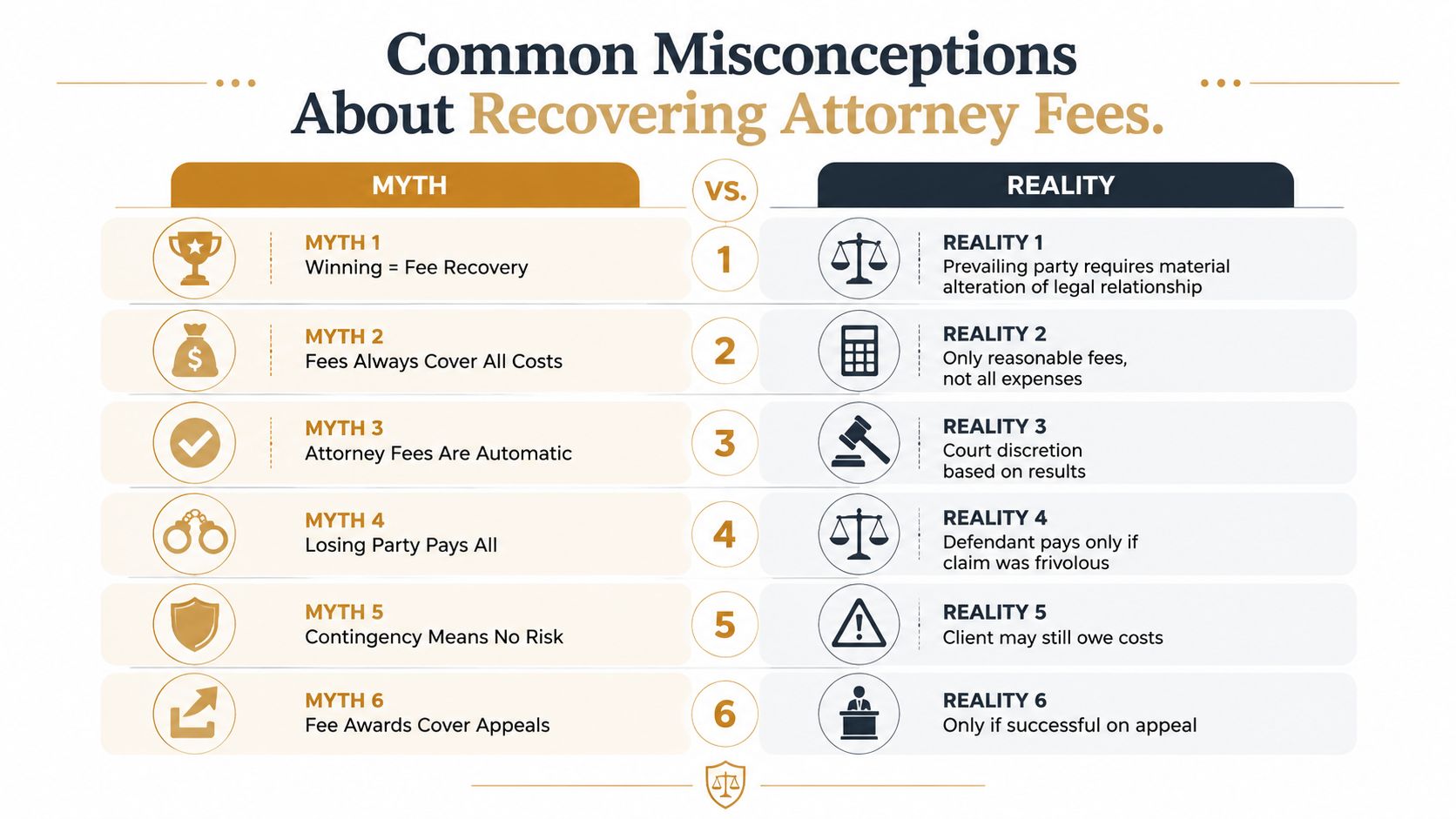
Myth, winning guarantees fees. A favorable event doesn't necessarily make you a prevailing party. The result generally must materially alter the legal relationship and provide meaningful relief. The Supreme Court's recent treatment of temporary victories that later become moot shows why injunction-heavy cases require special caution. See this SCOTUSblog analysis of the 2025 fee ruling.
Myth, contingency means free. A contingency arrangement may eliminate upfront professional fees, but you can still owe litigation costs under the contract. The lawyer may also receive compensation from your recovery even if the defendant later pays a statutory fee.
Myth, the court pays every hour worked. Courts award reasonable fees, not every time entry a firm submits. Judges can reduce work that's excessive, duplicative, vague, unrelated, or tied to unsuccessful claims.
Myth, fee shifting covers every related claim. A successful federal civil rights claim doesn't automatically shift fees for every state-law theory or every issue included in the complaint. The work must connect meaningfully to the successful result.
Myth, the defendant pays every expense in full. Fee-shifting rules and cost statutes don't automatically make the defendant responsible for every expert charge, transcript, travel item, or administrative expense. Recoverability depends on the governing law and the court's analysis.
Myth, a fee award equals your net recovery. The award may go to the lawyer, may be reduced, and may not match the private retainer. Tax treatment also matters to the attorney's net compensation, but it doesn't turn the award into a guaranteed reimbursement for the client.
Treat statutory recovery as a possible offset, not a promise that you'll emerge financially whole. Your settlement analysis should show damages, costs, contracted fees, and expected fee-shifting recovery separately.
Budgeting Your Out of Pocket Exposure and Next Steps
Use the next 90 days to build a realistic litigation budget. Start by gathering employment records, police reports, medical records, internal complaints, agency correspondence, witness names, and communications with the defendant. Preserve originals and record when each document was created or received.
Then separate three categories: money you may pay during the case, money the firm may advance, and expenses a court might later shift. Filing charges, mediation, medical records, postage, parking, and similar items may remain your responsibility. Deposition or expert costs may be recoverable in some circumstances, but never assume recovery before your lawyer explains the governing rule.
The Outh lawsuit valuation guide can help you frame the broader damages discussion, but no valuation tool replaces legal analysis of liability, defenses, exhaustion requirements, or prevailing-party status.
| Cost Item | Typical Range | Recoverable Under Fee Shifting |
|---|---|---|
| Filing and service expenses | Varies by court and service method | Sometimes, subject to applicable law and court approval |
| Deposition transcripts | Depends on provider, length, and format | Sometimes, when reasonably necessary and legally taxable |
| Expert services | Depends on subject and scope | Limited and statute-dependent |
| Records retrieval | Depends on custodian and record type | Sometimes, but not automatically |
| Travel and hearings | Depends on distance and appearances | Case-specific |
| Mediation and administration | Depends on provider and arrangement | Often contract-dependent or case-specific |
Choose counsel by risk profile
If your case has clear liability and documented damages, a contingency structure with a statutory fee claim as a possible secondary source of compensation may preserve cash while aligning the lawyer with the outcome. If liability is disputed, evidence is incomplete, or the case may require substantial work before its value becomes clear, ask about hourly billing with a written budget cap and approval checkpoints.
Before retaining anyone, complete three tasks:
Organize your evidence. Create a dated chronology and preserve at least the records relevant to the alleged violation, damages, complaints, and response.
Get competing written proposals. Ask each firm for the fee percentage or rate, cost schedule, billing practices, withdrawal terms, and a plain-language estimate of your potential net recovery.
Confirm fee-award treatment. Make sure the retainer says whether court-awarded fees offset your obligation, are payable in addition to the contingency, or are handled under another arrangement.
Outh provides case discovery, evidence organization, valuation estimates, attorney matching, and fee-information comparisons for U.S. civil claims, including estimated contingency percentages and retainer structures. Visit Outh to organize your claim, compare cost questions, and prepare for a more informed attorney consultation.
